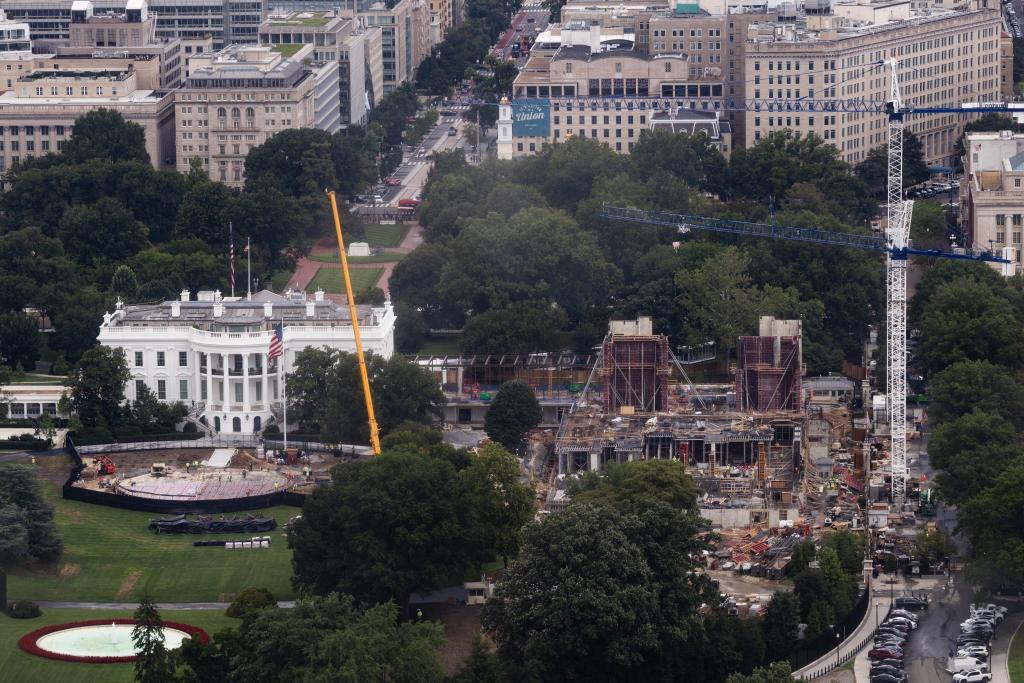
Among all the decisions, measures, and initiatives that have defined Donald Trump's second term, from trade policies to immigration, including the layoffs of thousands of officials, conflicts with universities, or accusations against the media, there is one that has always held a special place in his speeches and his heart: the grand ballroom of the White House.
Since he presented the project, a monumental work costing hundreds of millions of dollars with a strong visual symbolism, Trump has spoken about the event hall with an unusual enthusiasm even for him. It was not just an improvement, an expansion of the presidential complex, with space for receptions and the latest security measures, but an obsession. In impromptu appearances, interviews, campaign events, and even meetings with foreign leaders, he always found a way to come back to the same topic: the size, the height of the ceilings, the marbles, the capacity for thousands of guests, or how it would look once completed.
It is undoubtedly his flagship project, part of the physical legacy with which he wants to be remembered, alongside his name in airports, buildings, or bills, or an arch of triumph. And that is why the position of the courts, which once again reminded him that he is a president, not a king, and that he must consult and obtain permission from the legislative branch for his actions (such as tariffs or wars), carries significant weight.
This Friday, in a two-to-one decision, the three-judge panel of the DC Circuit Court of Appeals upheld the ruling issued in April by another federal judge, which stated that most of the construction of the ballroom should be halted until Congress expressly authorized the project. At least everything on the surface. "The president is a temporary tenant, not the owner, of the White House and his executive residence," wrote judges Patricia A. Millett and Bradley N. Garcia, appointed by Obama and Biden, in their majority opinion. Judge Neomi Rao, appointed by Trump, issued a dissenting vote.
The decision, however, includes a 14-day suspension to allow the White House to appeal to the Supreme Court, the final instance. And it clarifies that the Administration still has permission to continue with underground works, as well as with elements affecting national security, such as the complete renovation of the presidential bunker.
Trump's project goes far beyond what will be more visible and controversial, the 8,000 square meter ballroom with an estimated cost of $400 million, supposedly funded by private donations from friends and companies. The demolition of the East Wing of the White House is part of a comprehensive reconstruction that includes new offices for the first lady, support spaces, medical facilities, security enhancements, and above all, the replacement of the historic presidential bunker (the Presidential Emergency Operations Center) with a much larger and modern underground military complex. While the White House maintains that the ballroom would be funded by private donations, security works and the new underground complex would require public funding, with proposals in Congress reaching up to $1 billion for security facilities associated with the project.
And the Court states that Congress should have had and should have a voice. This is important because currently the Republicans control both chambers, but it is likely that in November they will lose at least one of them. "The decision to build or not a grand ballroom belongs to Congress, and it is not a matter of executive self-help," the court stated today. "This decision has nothing to do with whether the proposed ballroom is convenient or not from a political point of view. This ruling does not even necessarily imply that the defendants cannot build it (...) What it does mean is that the defendants cannot do so without obtaining authorization from Congress, as required by the Constitution and laws."
The case began with a complaint from the National Trust for Historic Preservation, which challenged the project in December, a week after the White House unexpectedly finished demolishing the East Wing to build a ballroom with a capacity for 999 people, as President Trump stated. Government lawyers argued that the most significant structural modification of the White House in 70 years included crucial security measures to protect against various threats, such as drones, ballistic missiles, and biological risks. And when there was an attempted attack on Trump at a Washington hotel during the White House Correspondents' Dinner, they insisted on the need for these facilities. "These improvements, modifications, and reforms are essential to protect the president, his family, and his staff, as well as the White House itself, and the entire project stems from them," they argued before the panel.
However, the response from the preservation group's lawyers was that the absence of a ballroom in the White House does not constitute a national security emergency. And the panel seems to agree. In the spring, Trump had already lashed out at the first judge, appointed by George W. Bush, calling him a "Trump-hating judge" who "has worked to undermine national security and ensure that this great gift to the United States is delayed or not built."
White House lawyers argued before the panel in June that federal courts should not have the power to halt the construction of the ballroom and that Trump had the authority to make modifications to the White House grounds. But now everything is, once again, in the hands of the Supreme Court. A predominantly Republican court but one that Trump has in his sights, after some painful defeats, such as those on tariffs and the citizenship rights of those born in the country to foreign parents, with or without papers.