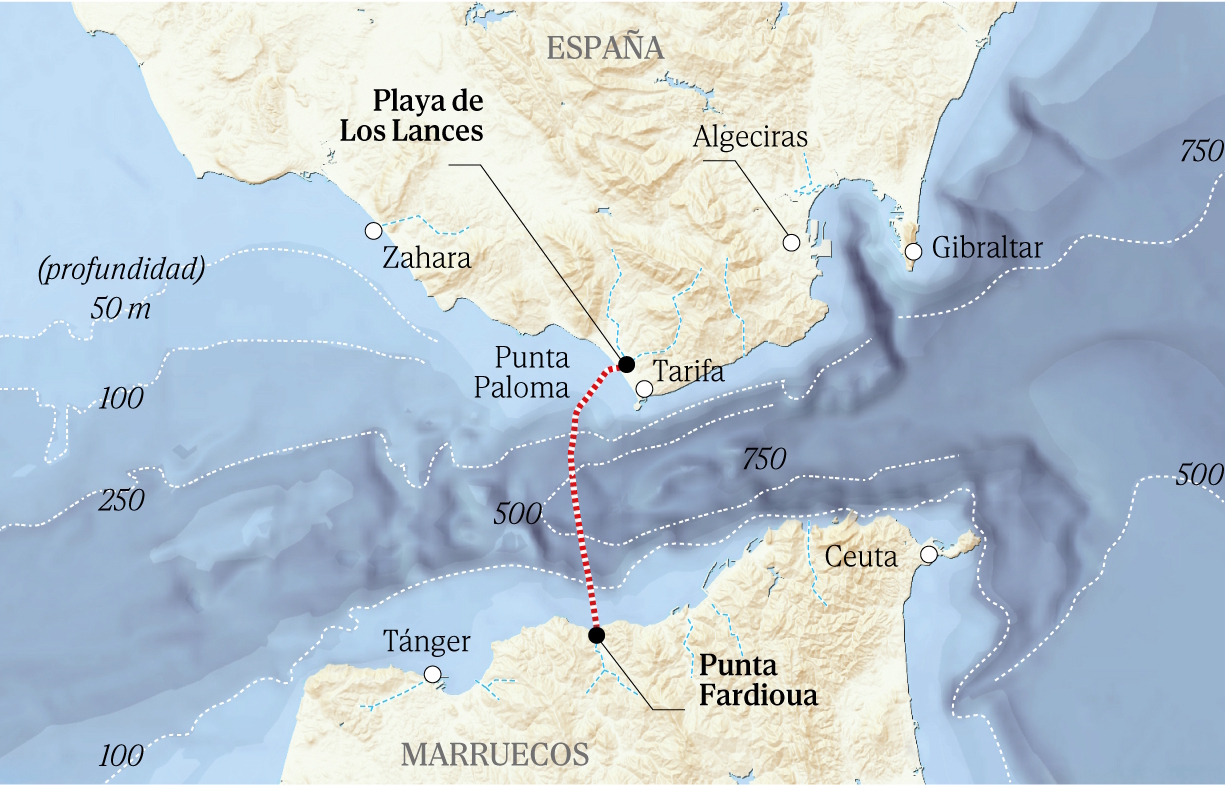
Hundreds of meters deep, on the seabed of the Strait of Gibraltar, 29 kilometers of electrical cables lay the invisible bridge that anchors Morocco to Europe, an underwater highway with two-way traffic. Every year it transports a huge volume of electricity, the vast majority of which flows from Tarifa to the Moroccan territory. It rarely goes in the opposite direction. The infrastructure is dispensable for Spain and absolutely critical for Rabat. The Maghreb country has come to cover 20% of its national electricity demand thanks to this connection. It is also a cushion that prevents its electrical system from collapsing.
The cable provides the Mediterranean neighbor with much more than electrons: it synchronizes its grid with the European electrical system. "Before the interconnection, Morocco suffered many power outages. It's not just about how much electricity Spain sends, but when it is transferred. The link maintains the frequency of the Moroccan grid and serves as a backup in critical moments. For example, if a generator fails or if there are sudden changes in demand, it allows to compensate for any disruption in milliseconds," explains Ignacio Urbasos, a researcher at the University of Navarra's Global Affairs.
In short, the interconnection is a blackout shield for Morocco and a constant (and cheap) source of supply. Furthermore, since its diplomatic rupture with Algeria in 2021, it is the only powerful interconnection left to the country. Without it, its electrical isolation would be total.
Amid an unprecedented migration crisis due to the irregular entry of 70,000 immigrants into Ceuta, this highway also becomes strategically relevant for Spain. Urbasos points out that, unlike with gas, there are no fixed-term contracts that oblige our country to maintain the electricity flow. "Electrically, Morocco is like any other market unit. In theory, Spain could unilaterally cut off," he asserts. And while admitting that such an action would mean a "total loss of trust," he also argues that Spain should leverage the energy lever in its "deterrence strategy against the irredentism of its neighbor."
"Ceuta was a victim of an operation in the gray area organized by Morocco, a country that does not recognize Spanish sovereignty over this city. That gray area is not part of the foreign policy manual of EU democracies, but it is a topic that, at the very least, should be discussed more," he argues.
The underwater highway began to take shape in 1986. The first phase was marked by the fervent opposition of neighbors and fishermen in the Algeciras area, motivated by the rumors -now we would call it fake news- of the supposed damage that electromagnetic fields would cause to fish, birds, and ultimately, any living being several kilometers around. A decade later, in 1997, it started operating.
The original cable had a technical capacity for an exchange of 700 MW. In other words, it could move enough energy to simultaneously supply about 600,000 households. It soon proved insufficient.
Red Eléctrica, the semi-public company that manages the Spanish electrical system, and its Moroccan counterpart, the ONEE (National Office of Electricity), began contacts in 2000 to reinforce the link. The initiative, named the REMO Project, was understood from Spain - and from Brussels - with a geostrategic vision: to contribute to the stability and industrial development of the southern Mediterranean. It cost 115 million euros, shared equally by both states.
Two unique ships in the world, the Giulio Verne and the Skagerrak, were needed to transport and lay the 7,000 tons of submarine cable, which are still buried at a maximum depth of 620 meters between the coasts of Tarifa and Fardioua.
The reinforcement was almost ready in 2006. "The second phase was managed much better and was smooth sailing." This is how former minister Luis Atienza, who experienced the construction and commissioning of the REMO project as president of Red Eléctrica, recalls it.
The result? A twice as powerful highway that has been crucial in securing the electrical supply to the most remote areas of Morocco. It has also been instrumental in developing the country's major industrial hubs such as Tanger Med, a hub for its automotive and electronics sectors. Ultimately, it has bolstered an economic policy that has become one of the great successes of Mohamed VI.
According to the World Bank, today Morocco's electrical system is one of the most reliable in Africa, with fewer power outages. This advantage, not enjoyed by other countries in the region, helps Rabat attract industrial investments. "Much modern machinery requires a much higher quality of supply than an isolated system can offer," says Atienza, who acknowledges that the interconnection thus consolidates an "asymmetric interdependence."
Although it was crucial, for example, in restoring the Spanish electrical system after the major blackout of 2025, the cable is "much more important, in terms of security and supply stability, for Morocco than for Spain." The international scope of the recent migration crisis has revived the debate on the effectiveness of Spanish foreign policy with the Maghreb country. "It is important to understand this energy interdependence, but it is not desirable to use it as a pressure lever," says the former minister.
"Morocco has its umbilical cord in Spain with the European electrical system. This geostrategic dependence is very beneficial for us, but it is not advisable to flaunt it too much, as if it distrusts it, Morocco could become obsessed with reinforcing its energy independence," he argues. Similar to what happened to Russia with the EU, which responded to Kremlin's energy blackmail by drastically cutting its imports.
"I don't understand the policy of weakness with Morocco. I am convinced that we are better off when the other party is doing well, and we must work with that spirit because through conflict, we can harm each other a lot. But through conflict, Spain is stronger... and it doesn't seem like it," points out Jorge Dezcallar, former director of the CNI. When the second cable was launched, he was the Spanish ambassador to Morocco. "At that time, energy united us...". And now? "I wouldn't rule out the use of the energy weapon and its interconnections, although I would prefer not to use it because it can lead to an unwanted spiral... unless we are forced to."