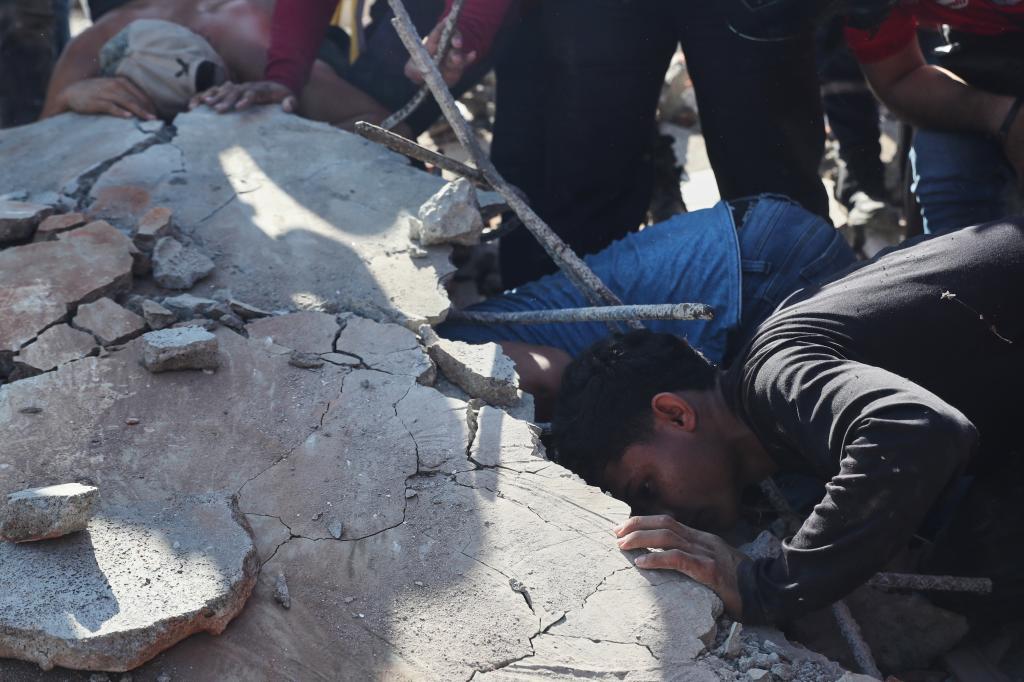
The provisional death toll stands at 132 dead and 483 injured, with dozens of buildings collapsed across the country. The main cities in western Colombia, including Pereira and Cali, experienced moments of panic, with thousands of people in the streets and buildings collapsing or suffering severe damage.
In Pereira, the most affected city so far, most of the urban area is without electricity. Dozens of volunteers, equipped with flashlights, comb through the rubble in search of signs of life. "Too distressing, I have no words for everything that is happening right now. We are trying to clear the rubble," said 25-year-old marketer Juana Marín, who is participating in the search efforts in the main square. According to the latest count, the coffee-growing city already has 60 fatalities. The magnitude of the tragedy has left many with a profound sense of desolation: "I feel defeated. It is too sad to see the whole city like this, knowing that there are still people alive there," added Marín.
Meanwhile, in Cali, Colombia's third-largest city, rescue teams work tirelessly in the most affected neighborhoods. Rescuer Nelson Moreno described the scene as "the end of the world" upon arriving at the site of two collapsed five-story towers. Hundreds of volunteers, some with dogs, form human chains to remove rubble with picks and basic tools. Constantly, the cry of "silence" is heard to perceive possible signs of life among the trapped. President Abelardo de la Espriella, who took office just three days ago, has reported 61 collapsed buildings, 18 damaged health centers, and 52 affected educational institutions. In Cali alone, 188 people are reported missing.
The epicenter of the earthquake was located near San José del Palmar, in the impoverished region of Chocó, where 13 deaths have been confirmed so far. Desperation was palpable; Wilmer Cuesta, a law student who witnessed the disaster, recounted how "people were running out naked, people were jumping from their houses... desperate."
The earthquake, which has generated 47 aftershocks so far, has revived the painful memory of the devastating 1999 earthquake that left nearly 1,200 dead in the coffee-growing region. Faced with the magnitude of the catastrophe, President Abelardo de la Espriella has declared a state of emergency and committed to coordinating a massive rescue operation. International aid has not been delayed, with offers of support from the United States, the European Union, Israel, Mexico, Chile, Argentina, and El Salvador.