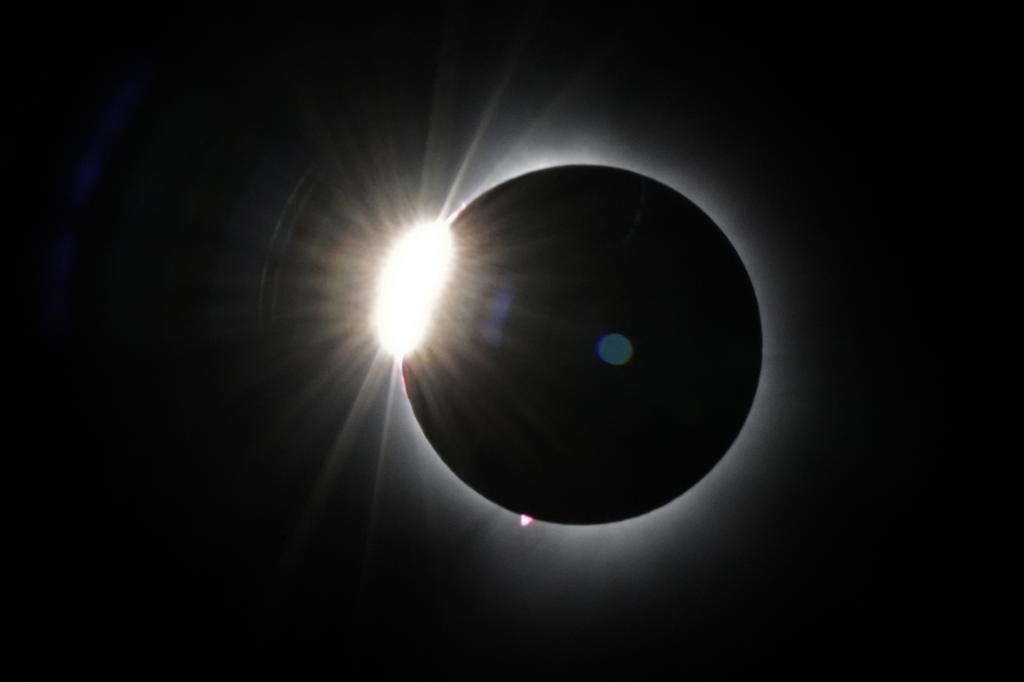
Eclipse chasers travel to remote places on the planet to experience what around 14 million Spaniards will be able to witness without leaving their places of residence this Wednesday at sunset. As the highly anticipated total Solar Eclipse of August 12 approaches, the eclipse mania is spreading throughout our country.
It is no wonder. For the first time since 1912, the most spectacular astronomical phenomenon that nature offers will be visible on the Peninsula: a total Solar Eclipse. In other words, the moment when the day suddenly darkens for a few seconds because the Moon comes between the Earth and the Sun, covering our star. It will be very intense but brief, as the maximum of the eclipse will last between half a minute and one minute and 48 seconds, depending on the totality zone where we are located.
Although this eclipse will also be visible from Greenland, Iceland, and a small part of northeastern Portugal, Spain will undoubtedly be the best country in the world to witness it. Galicia, Asturias, Cantabria, Castilla y León, La Rioja, Basque Country, Navarra, Aragón, the Community of Madrid, Castilla-La Mancha, Catalonia, the Valencian Community, and the Balearic Islands have part or all of their territory in the totality zone, meaning in the strip where the Moon will completely cover the Sun, leaving only the solar corona visible (the outer part).
In the rest of the country, a partial eclipse will be seen (like a bite out of the Sun), with percentages of obscuration of our star ranging from 99% in Pontevedra and Alicante to 93% in Ceuta and Melilla. "Contemplating the totality of a solar eclipse is a unique experience on our planet. I, who have seen three, can assure you that it is something unforgettable, people who have the opportunity to see it will always remember it," says Valentín Martínez Pillet, director of the Institute of Astrophysics of the Canary Islands (IAC).
The astronomer, who will follow the eclipse from Palencia, emphasizes that there is a huge difference between being in the totality zone and in an area where the solar disk is not completely obscured. "To see the corona, it has to be 100%. For example, in Madrid city, where it will be seen at 99.9%, the solar corona will not be visible," he asserts. And it will be worth it: "It is a magnificent, absolutely magical and overwhelming moment that makes you think, 'This cannot be happening'," summarizes this solar physicist.
The fever to be in the perfect place - and with favorable weather -, to get the essential special glasses - ophthalmologists never tire of repeating that looking at the eclipse without them can cause irreversible damage - and the concern for children to enjoy the day safely is increasing. Almost everyone is talking about the eclipse.
You may be among the people excited to witness a historic day but perhaps you are tired of the topic or find it indifferent and do not plan to do anything special or travel to see it. But the truth is that what we are going to experience in Spain on Wednesday goes far beyond the eclipse itself. It will be a critical day where the electrical infrastructures, Security Forces, civil protection and health services, communication systems, and the transportation and road network will be put to the test due to the large number of people expected to travel.
The Ministry of Economy estimates that our country will receive an additional 446,000 visitors throughout this week, resulting in a total tourist expenditure of 347 million euros -247 million from foreign tourists-. "The eclipse will mobilize almost as many people as a World Cup," says Antonio Marín-Franch, head of the Javalambre Astronomical Observatory (Teruel), from where the European Space Agency (ESA) will broadcast this event internationally. For Marín-Franch, this event will highlight the quality of the sky in the so-called depopulated Spain and could promote astrotourism, but it also poses a major security challenge due to the lack of infrastructure and tourist accommodations in some of the best places to view the eclipse.
In addition to the revenues, which will benefit many rural areas of Spain, these figures mean that millions of people will be on the road and in natural spaces throughout the day, so there is great concern about the extreme risk of forest fires we face this week. The same weather that will be conducive to viewing the eclipse without clouds and with atmospheric stability has turned many areas of Spain into a powder keg. Another week.
According to the latest special forecast for the eclipse from the State Meteorological Agency (Aemet), made on Monday afternoon, two days before the eclipse "it seems very likely that the skies will be mostly clear or partly cloudy in most of the country. However, in some areas, clouds could hinder the observation of the phenomenon, at least for some moments." Specifically, the Cantabrian area and some areas of the Galician coast and Alboran are the regions where clouds are expected to prevail. Additionally, in the afternoon, cloud intervals will form in the mountains of the north and in the eastern third of the peninsula that could locally interfere with the eclipse viewing.
"This cloudiness is more likely and could bring some storms or showers in areas of the eastern Pyrenees, Teruel's Iberian range, eastern Castilla-La Mancha, and eastern Betic Systems. Otherwise, no precipitation is expected," according to Aemet. On the other hand, the light haze that will be present in the Alboran Sea, the southern tip of Andalusia, Lanzarote, and Fuerteventura could reduce visibility in those areas.
It will be a very hot day, with much of the Peninsula and the Balearic Islands experiencing temperatures of over 35 degrees - with the exception of northern Galicia, the Cantabrian area, and the peninsular coasts and mountains. In the Guadalquivir and Ebro valleys, the thermometer could exceed 40 degrees.
On Monday, the Ministry of the Interior activated the Unified Command Post (PMU) that will direct and coordinate security and civil protection devices to try to anticipate before, during, and after the eclipse any type of emergency that may affect the thousands of people who will witness the solar eclipse on Wednesday in the territories of the Peninsula where it can be fully observed.
As a central element of the operation, the PMU will have a tracking technological tool specifically designed for this eclipse, integrating information from various observation points and participating organizations. According to the Interior Ministry, this platform will provide a comprehensive and updated view of the situation on the ground, facilitating continuous monitoring of the operation, information exchange, and greater analysis and response capacity to any incidents that may occur.
In this regard, authorities emphasize that observing the eclipse from a location near the place of residence is the safest and most responsible option, and if traveling, to take extreme precautions in natural environments and plan their trips in advance. On the other hand, the night of August 12 will coincide with the peak of the Perseids, so to avoid road congestion after the eclipse, a suggestion is to enjoy the meteor shower to stagger the return home.