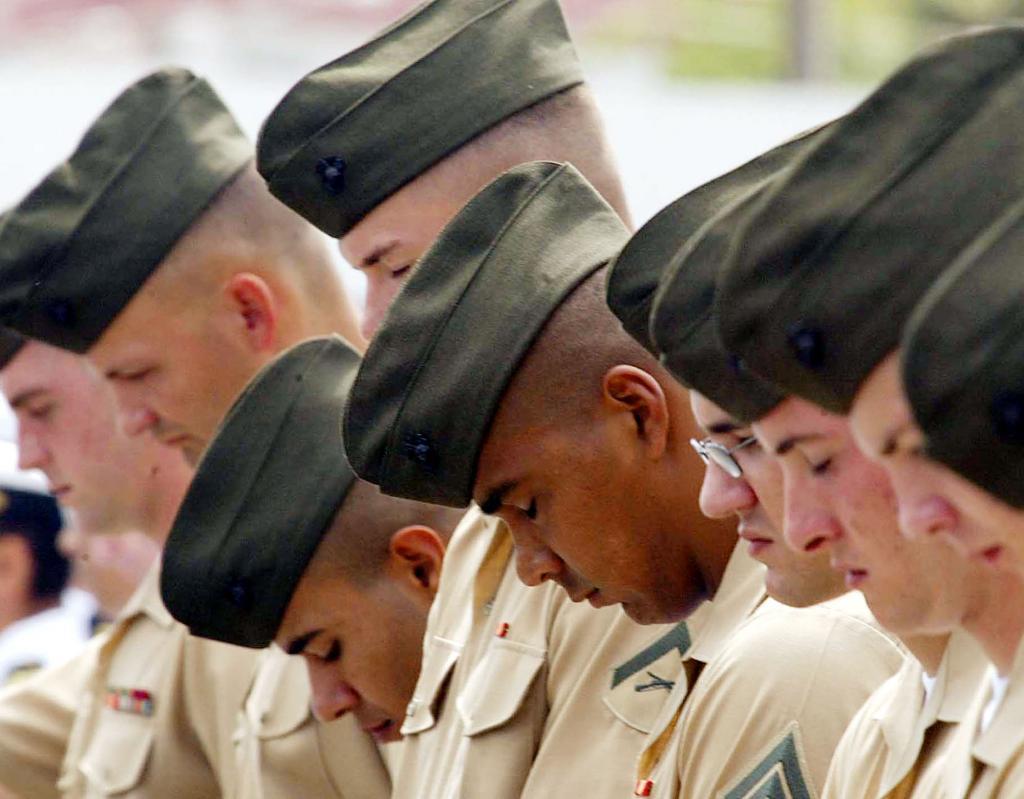
"Since the events on Perejil Island, Morocco uses its citizens as bargaining chips with the Spanish government at the borders of Ceuta and Melilla." The speaker is not an analyst from a Washington think tank or a diplomat. It is Marcus, a fictitious name used to maintain anonymity, a Fire Controlman in the United States Navy stationed at the Naval Station Rota, the largest concentration of U.S. military power in southern Europe.
In one of the pubs in the central area of Rota, where dozens of U.S. military personnel gather on weekends as a tradition since the base was permanently established in 1958, the topic of conversation is somewhat taboo due to the political sensitivity of the matter. In conversations where they want to keep their identity hidden, they all maintain the same discourse: the serious migration problem Spain is facing, reflected last week with the massive entry of 72,000 immigrants on the coast of Ceuta, where more than 140 deaths have been recorded to date.
The massive influx of immigrants to the coasts of Ceuta last week has marked a turning point in Spain's borders. This geopolitical movement has triggered a mass international reaction regarding the direction of the migration policy of Pedro Sánchez's government and the European Union. Donald Trump and his administration come into play...
The President of the United States wasted no time in reacting on his social media: "What is happening in Spain, with tens of thousands of illegal immigrants invading it, happened in the United States during the Administration of Sleepy Joe Biden, and will happen again if the Democrats ever return to power." In this regard, his second in command, JD Vance, echoed the same discourse by stating that "this is an unfortunate reminder of the consequences of mass migration and the globalist policies of the radical left that have allowed the invasion of the West."
Marcus's American perspective on Spain's stance regarding the events is clear: "Sánchez's policy of opening the doors to everyone and facilitating the mass regularization of hundreds of thousands of immigrants is undoubtedly a political, social, and security problem. This issue extends to Europe, which should strengthen its borders as it did in Poland when the war broke out in Ukraine, even though there had been no intrusion into Polish territory."
Two factors weigh heavily on paper. The first is the good relationship that Morocco maintains with the United States, largely built on contracts in the arms industry with Israel in between. The second is geography: Ceuta and Melilla are a stone's throw from the Straits of Gibraltar, one of the major chokepoints through which around 10% of international maritime traffic passes.
These circumstances, combined with the open conflict between Iran over control of the Strait of Hormuz, another of the most important chokepoints globally, make the two autonomous cities gain political significance in the United States.
In fact, last April, the U.S. House Appropriations Committee, in the report accompanying the State Department budget law, included a paragraph that caused a stir. "The cities of Ceuta and Melilla, administered by Spain, continue to be the subject of Morocco's historical claim." It goes further by supporting the Secretary of State to promote a diplomatic commitment between Morocco and Spain regarding "the future status of Ceuta and Melilla." Why is the U.S. already discussing the "future status" of Ceuta and Melilla?
"Mass regularization and immigration at current levels will generate even more conflict."
While the relations between the Kingdom of Morocco and the United States are clearly positive outwardly, according to Marcus, currently the ties between Washington and Madrid are at their lowest point, as is happening with most European countries. In this regard, the American military points to ideological differences. "They are taking their toll," he asserts.
Nevertheless, the White House currently maintains strategic points within the country, so in a relationship where tensions are high, Marcus states that "Spain is not a bad partner for the United States; the bad partner is Pedro Sánchez."
There is also talk of "Make Spain Great Again." That was the phrase displayed on the cap of Ferran Torres, the scorer who gave Spain its second star in the overtime against Argentina, during the bus parade through the streets of Madrid. Following these images, political associations began to spread like wildfire to the point that the Valencian had to clarify that it "had nothing to do with politics, it was just to see Spain once again at the top, winning the World Cup."
However, far from finding it amusing, Marcus believes it represents that a large part of Spaniards want a change in the country's political direction. Nevertheless, he asserts that it is not a support for Trump, as many right-wing individuals reject his policies and ideas.
During EL MUNDO's stay in the coastal town, conversations with waiters, taxi drivers, and hairdressers always pointed in the same direction... there are fewer Americans than before. Everyone agrees that the Iran war has led many of the US Navy personnel to be deployed in the ongoing conflict with the Arab country.
This factor has sparked another debate: Will Donald Trump move the Rota base to Morocco? Beyond assumptions and statements, Marcus downplays the issue: "I believe such a radical change won't have time in the remainder of his term. Besides, I think it was a bluff, to scare Spain and Europe, a simple tactic to apply pressure. Such a thing is not easy to change."
Amid the iconic sound of Sweet Caroline and the nostalgic Country Roads, the Americans do not dare to predict a future outside Rota. Young and not so young, Americans and Latinos, prefer to stay out of it all and enjoy a lager. Marcus is the only one willing to take a stand: "Spanish society is deeply polarized."