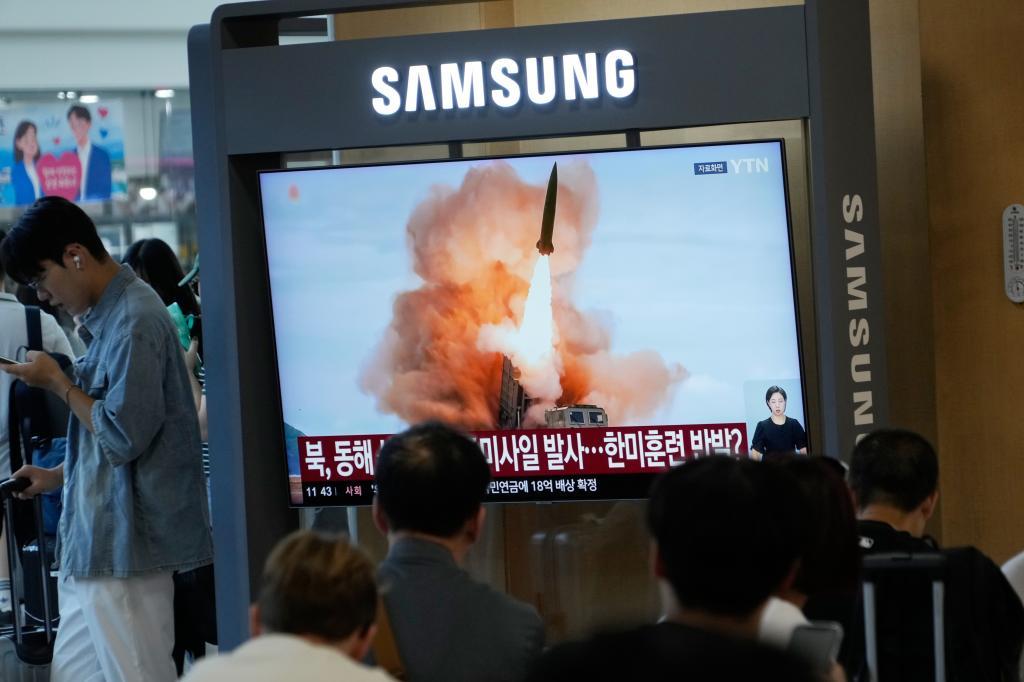
The North Korean ballistic missile was launched shortly after 6:00 a.m. this Wednesday from the vicinity of Wonsan, a port city on the eastern coast of North Korea that Kim Jong-un has turned into one of his showcases for weaponry.
The projectile ascended over the Korean peninsula, alerted the radars in Seoul and Tokyo, and traveled over 700 kilometers before disappearing into the waters of the Sea of Japan.
There was another North Korean missile a few hours earlier, over 7,000 kilometers away from Pyongyang. But this one did not fall into the sea.
It impacted Zaporiyia, one of the major industrial cities in southeastern Ukraine. According to President Volodymyr Zelensky, Russia used a ballistic missile supplied by North Korea during the wave of attacks on Tuesday. Seven workers died at a steel plant, and 21 others were injured.
Two missiles. Two ends of the planet. And the same regime behind the weapons.
For years, North Korean missiles served mainly to simulate threats. They would launch from hidden bases among mountains, cross the sky of the peninsula, and end up sinking into the waters separating Korea and Japan. Each launch triggered the same ritual: monitoring from Seoul, emergency meetings in Tokyo, condemnations from Washington, and new images of Kim, smiling, supervising some test alongside his loyal generals.
Now, a portion of those missiles is flying in the opposite direction. Towards Europe.
The relationship between North Korea and Russia ceased to be a mere diplomatic alliance between two leaders opposed to the West long ago. In June 2024, Putin traveled to Pyongyang and signed with Kim a Comprehensive Strategic Partnership Treaty that includes a commitment to mutual assistance if either of the two countries faces aggression. Shortly after, trains, ships, containers, ammunition, and soldiers began to circulate.
North Korea has supplied Russia with huge quantities of artillery shells and ballistic missiles. It has also sent thousands of soldiers to support Putin's war.
According to South Korean intelligence estimates, Pyongyang has dispatched around 33,000 containers of military supplies over these years. If all that volume translated solely into 152-millimeter artillery shells, it would amount to over 15 million units.
Putin thus found one of the arsenals he needed to fuel his war. Kim, on the other hand, found something equally or more valuable: money, fuel, and diplomatic support from a permanent member of the United Nations Security Council. And, above all, access to Russian military technology for his nuclear program.
In Ukraine, North Korean missiles are not flying against targets drawn on a test range. They are facing Western radars. Patriot systems. Electronic countermeasures. Each launch allows for checking the precision of the projectiles, detecting flaws, and improving future versions. And each North Korean contingent sent to the front can learn how to fight in a war dominated by swarms of drones, precision artillery, and electronic warfare.
And that is precisely what worries Seoul the most. That the knowledge acquired in the Ukrainian trenches may one day return to the Korean peninsula.
More North Korean Soldiers for Russia
Zelensky warned this week that Pyongyang may be preparing to send more troops to Russia. For Kiev, the flow of North Korean weaponry is also part of Moscow's strategy to intensify missile attacks by exploiting one of Ukraine's major problems: the shortage of Patriot interceptors. "Every step Russia takes shows that Moscow is not preparing for peace, but for escalation," said the Ukrainian president.
While Kim deepens his military alliance with Putin, in East Asia South Korea and Japan have accelerated their military alliance with the United States. Upon detecting the projectile launched from Wonsan, the South Korean Joint Chiefs of Staff emphasized that they were sharing real-time information with Washington and Tokyo.
The latest North Korean launch, the second in less than a week, also came shortly after Seoul and Washington announced the details of the Ulchi Freedom Shield, their major annual military exercises. The exercises will begin on Monday, August 17, last 11 days, and involve around 18,000 South Korean soldiers.
Pyongyang has been describing these military exercises for years as a rehearsal for an invasion. Americans and South Koreans insist that they are defensive exercises.
North Korean missiles now connect two scenarios that until just a few years ago seemed very distant. In Eastern Europe, Putin receives ammunition, artillery, soldiers, and missiles to prolong his war. In Asia, Kim receives resources and experience to strengthen the army with which he threatens South Korea and Japan.