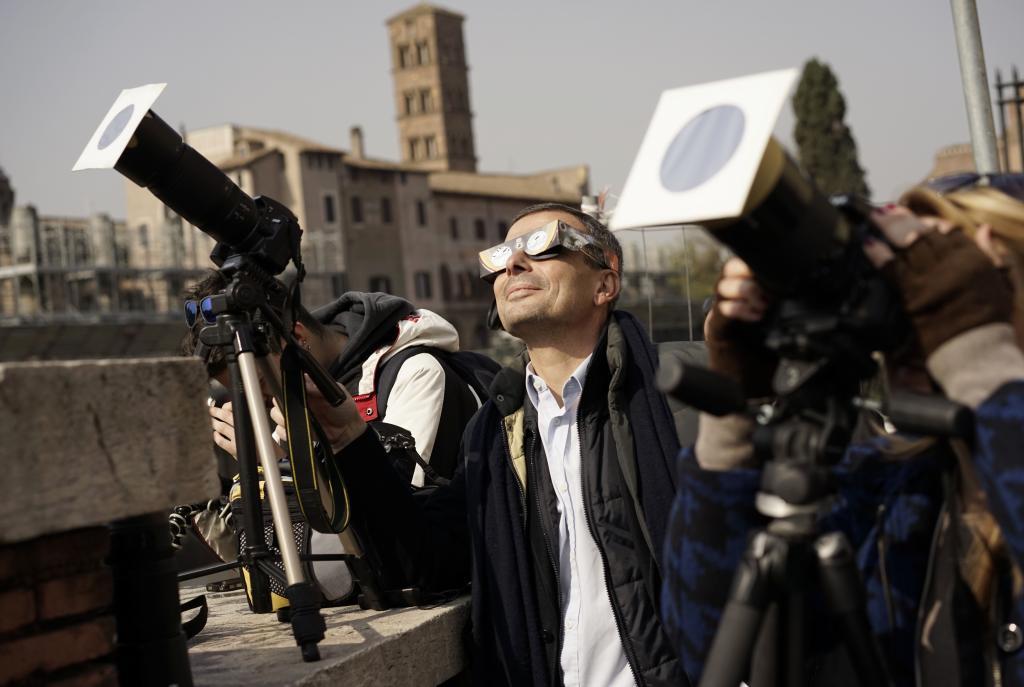
It has taken 114 years for us to see a total solar eclipse from the Iberian Peninsula. More than a century in which photography itself has evolved tremendously. It is not surprising that many want to capture it. But before preparing to click with our camera or our phone, we should reflect on whether it is worth missing a unique event just to get a memory of something we have not experienced.
If we proceed with the idea, we must consider a series of principles and tips that allow us to obtain the best possible images. The most important of all is safety. It is even the determining factor in this whole process: the light of the Sun, in its visible radiation and, above all, in the invisible, can permanently damage the sensors of our devices, whether they are cameras or mobile phones. And above all, it poses a risk to our eyes and to retinal injuries, where there are no replacements or technical service, so, be very careful!
To avoid damage and injuries, we must consider that, during the partial phase of the eclipse, the use of suitable protective filters for our lenses and eyes is absolutely essential, and not looking directly at the sun is not a recommendation, it is mandatory. Only during the totality phase can we do without this protection.
Furthermore, we must be especially careful both with the brightness of the Sun before this totality phase and afterwards (at the exact moment they appear) to be able to adjust both the filters and the glasses. Taking photographs of the eclipse with a mobile phone will be the most common option, and even with the limitations imposed by the lack of a good telephoto lens - in terms of its ability to zoom in on the image of the Sun - this does not prevent us from obtaining spectacular images of the historic moment.
What will be needed is a tripod or a way to stabilize the phone, so that our photographs come out sharp. When shooting, using the timer will prevent blurry images or, as is often said in photographic jargon, camera shake.
We should only use the optical zoom because the digital telephoto function is simply a crop that does not offer quality. There are specific filters for mobile phones with ND 100,000 certification that cost around 30 euros, but we can manage in a rudimentary way by overlaying a cutout of certified ISO 12312-2:2015 glasses over the phone's lens, which is being sold in optical stores and which, in some batches, includes a small accessory to place in front of the phone's lens.
Do not expect high image quality from this process, but it will be sufficient. Prohibited to use X-rays, welder's filters and neutral density filters that are not specifically designed for photographing an eclipse. The risk is real.
The camera settings on the phone must take into account some variables: the focus, which we should do in manual mode to avoid probable blurriness, and the exposure, where adjustment, also manual, is essential. If the phone has them, the PRO settings will allow the choice of sensitivity, aperture, and speed. In any case, using the simplest EV compensation, which all devices have, will allow the sun to take on the reddish tone of the moment, and not appear as an excessively bright, white, and textureless point.
Photographing the eclipse with a DSLR camera will allow for greater precision, flexibility, and naturally, final quality in the shot. Being able to use powerful telephoto lenses and appropriate professional filters (starting from 50 euros) allows for shots of the eclipse that, in general, will be superior to those taken with a phone. And a good tripod will allow for working with slow shutter speeds and the use of bracketing (taking shots with different exposures to merge them afterwards).
There are also special ball heads - the piece that connects the tripod to the camera - that allow for tracking the celestial body as it moves across the sky and creating striking timelapses (fast motion), but that's another level. The ISO (sensor sensitivity) should be set as low as possible for higher quality, while the aperture will be fixed between f8 and f16, varying the exposure speed until it reaches the appropriate one.
Only during the totality phase will it be possible to do without the protection filter, also during two optical phenomena that occur only during a total eclipse, the spectacular Bailey's Beads or the Diamond Ring. Both last only a few seconds and occur just before the moon completely covers the sun and just after the totality ends.
Indeed, beyond directly taking photographs or videos of the moon intersecting with the Sun, there will be many more light effects as a result of the eclipse. Shadows and reflections that will create atmospheres of unreal light. But the best images and memories that the eclipse will leave us with will be those that unfold around us: the silhouettes of buildings against the darkened Sun in the background, the thousands of amazed people looking up and shouting to the sky through their cardboard glasses enjoying an event...unrepeatable?