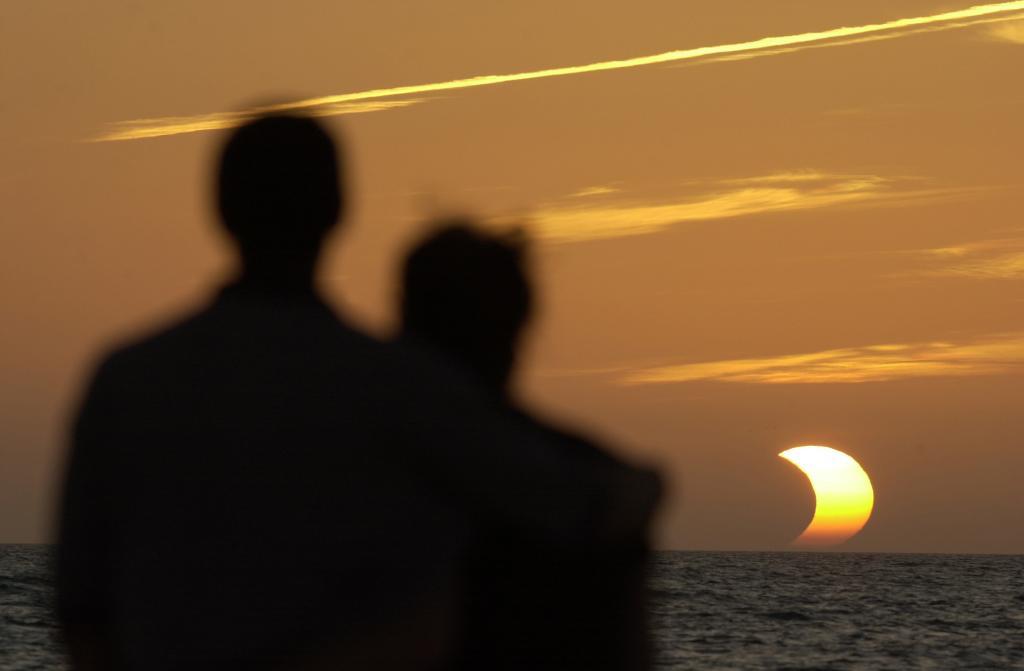
The agenda for the upcoming August 12th is marked in red in much of Spain due to the solar eclipse. It has been 100 years since this astronomical phenomenon was last visible in our country. Hence, the great anticipation that is being generated these days both in the media and on social networks.
However, this astronomical phenomenon also has health risks if observed directly or if protective equipment is not used on cameras or phones. How can you photograph and record this phenomenon safely with your phone?
The key is to place a solar filter on the lens. Otherwise, the camera sensor, whether on a mobile phone or a professional photography device, will be damaged.
José Luis Mur, expert and owner of Fotocasión, explains to EFE the essentials for a good snapshot on the designated day. For him, a moment that requires effort to capture, but is worth it for the "satisfaction of the desired photo."
For a phone: filter and maximum 'zoom'
In the case of a phone, the idea is the same. The lens, although to a lesser extent, is damaged if a filter is not used.
"From what I know about phones, I would go for the simplest system: put the filter in front of the lens so it doesn't affect the sensor," Mur suggests.
You can use approved glasses, but it is more effective to use a filter.
In fact, there are already some specific ones for these devices that can cost less than 10 euros. The most basic one is a kind of card that is manually placed over the sensor; the most professional one is a 20-step round filter, with a fixed support on the phone and a customized size, which costs around 70 euros.
As an additional recommendation, Mur suggests using the maximum 'zoom' possible with the phone.
"We can take it in general, but then it's like a landscape, the eclipse part will be very small within the whole frame," he says.
Additionally, he states that a telephoto lens for maximum 'zoom' and a tripod enhance the experience.
For a professional camera, a 16-step filter
For cameras, a solar filter of between 16 and 20 steps is necessary, a measure in the photographic world that considers the exposure of the lens glass. Two 8-step filters can be used, for example, as they would have the same effect as a 16-step one.
"The filter is very dark because, otherwise, the eclipse will affect the sensor, doing it without this is dangerous because it is the heart of the camera. If we don't want to damage the sensor, it is mandatory to use a solar filter," Mur warns.
These filters are explicitly designed for astronomical use in everyday life: "They are mainly used in telescopes."
Filter sales skyrocket: between 50 and 100 euros
Filters are not readily available to the public everywhere. "In specialized places," Mur points out. "It's not a filter that is available everywhere these days. Even some simpler brands have sold out because some suppliers did not anticipate such a high demand right now," he adds. The price, according to the specialist, ranges between 50 and 100 euros per filter.
"Of course, there are filters of many prices, but now the most expensive ones that are best made have remained," he comments.
In total, the photographer estimates that he has already sold between 500 and 600 filters in his store alone and believes that sales will continue until the day of the eclipse.
Do you need glasses to look through the camera?
To observe the eclipse directly, specific glasses are necessary (EN ISO 12312-2:2015). It is not safe to look through the phone or camera without a filter, as there is a risk of eye damage.
"In addition to damaging the sensor, it will also affect our vision if we do not look through glasses, because the image is transmitted through a prism and goes directly to the eye," he points out.
"In short, this filter is mandatory if we want to use any camera to take a correct photo of the eclipse," Mur insists. However, in case a solar filter of at least 16 steps is used, glasses will not be necessary.
"They are not necessary because we will look through the lens and the filter will be there, which already prevents strong light from passing through," Mur justifies.