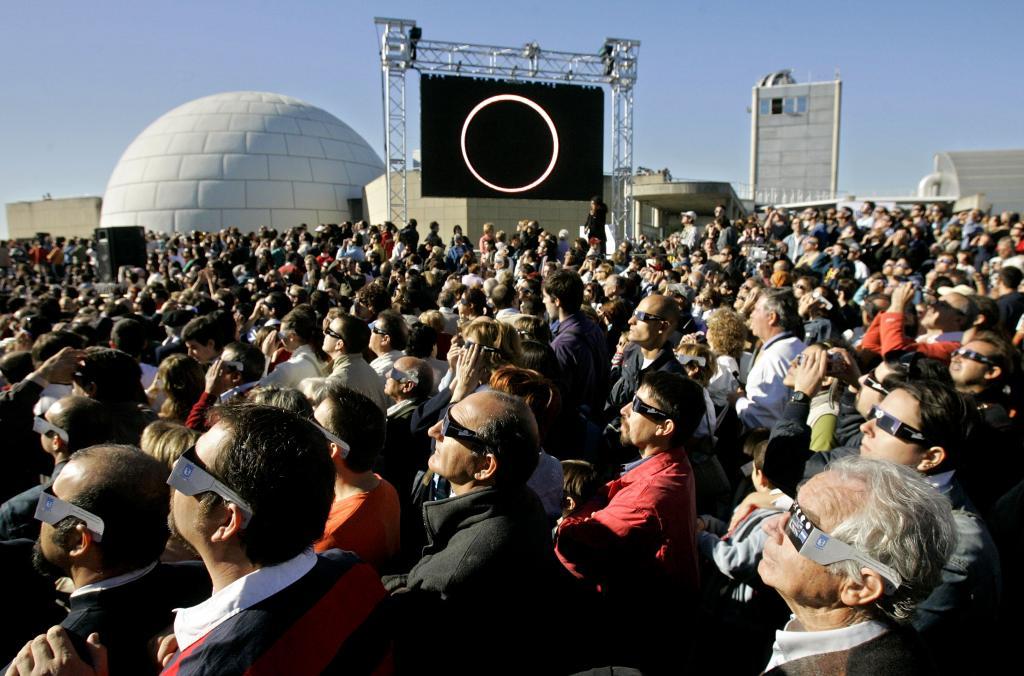
The upcoming solar eclipse this Wednesday will cross Spain from Galicia to the Balearic Islands and will also be visible in its entirety from parts of Greenland, Iceland, the Atlantic Ocean, the far north of Siberia (Russia), and a small corner of Portugal.
In other areas of the northern hemisphere, including parts of the United States, Canada, Europe, and northwest Africa, a partial solar eclipse can be witnessed.
The darkness will not be complete, but there will be a shadow intense enough to witness another exceptional moment: the Sun sharing the stage with other stars and planets. Among the latter, the most visible will be the brightest: Venus and Jupiter. It may also be possible to see Mercury, Mars, and Saturn.
Around 8:30 p.m., depending on the viewing location, this Wednesday's solar eclipse will reach its peak: the Moon completely covers the Sun.
Sunset in the town of San Vicente de la Barquera (Cantabria).
Duration of this Wednesday's solar eclipse
The total duration of the eclipse, Wednesday, August 12, 2026, will be 264 minutes (just under 4 and a half hours), as highlighted by the National Astronomical Observatory (OAN). In Spain, the duration of the totality phase depends on the location, but will not exceed two minutes.
The longest total solar eclipse since 2001 was on July 22, 2009, lasting six minutes and 38.86 seconds, crossing India, Nepal, Bangladesh, China, and the Pacific.
During this century, there were also two solar eclipses considered hybrids, transitioning from annular to total as the Moon's shadow moved across the planet, occurring on November 3, 2013, and April 20, 2023.
Do eclipses have an expiration date?
"We live in a privileged period in the history of the Solar System. In the very remote past, total eclipses were even longer than those of today; but in about 600 million years, our descendants will no longer be able to see any," explains the president of the Eclipse Trio Scientific Commission and director of the National Astronomical Observatory, Rafael Bachiller.
The Moon is currently moving away from the Earth at an average rate of about 3.8 centimeters per year, a "very slow movement - the width of two fingers each year - but constant on an astronomical scale," and as the distance increases, the lunar disk appears slightly smaller in our sky.
Thus, there will come a time when, even when the Moon is at its closest point in its orbit (perigee) and the Earth at the farthest from the Sun (aphelion), the apparent diameter of the lunar disk will not be enough to completely hide the solar disk. Then, total solar eclipses will disappear forever, and only annular ones will remain.
"I think it's an idea that invites reflection. We often think that eclipses are eternal phenomena," but the coincidence that the Sun and the Moon present almost identical apparent sizes in our sky does not correspond to any physical law; "it is a very extraordinary geometric coincidence."
Although on August 12, the eclipse takes center stage, it will be a long night for sky enthusiasts because when darkness falls, one of the most anticipated phenomena of each summer will begin, the Perseids meteor shower, reaching its peak of activity.
On a new moon night, dark enough for observation, the shooting stars will start crossing the sky, and this year, according to NASA's website, it will be "one of the best meteor showers in the northern hemisphere."