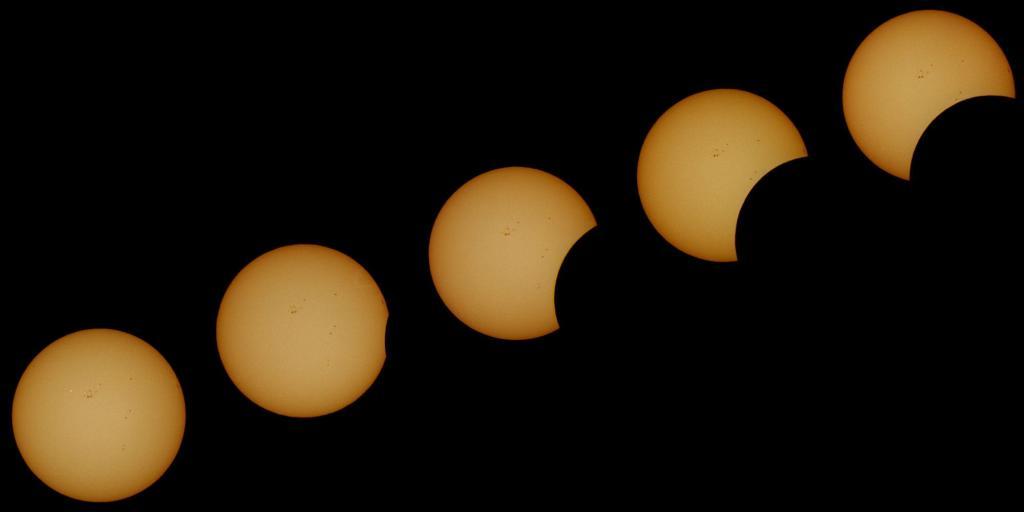
Today's solar eclipse on Wednesday will be an exceptional astronomical moment. The last time it happened and was visible from Spain was in 1959. However, looking at the eclipse without approved glasses or special filters on cameras and mobile phones can cause eye problems.
Among the main mistakes to avoid, staring at the Sun during the partial phases stands out. Even when the Moon covers 99% of the solar disk, the small remaining visible portion can cause a burn on the retina.
Another mistake is using sunglasses or homemade methods. Regular sunglasses, even if very dark or layered, "are not suitable". Also, smoked glass, photographic negatives, camera filters, polarizing filters, CDs or DVDs, and even welding glasses should not be used.
It is also important not to use damaged filters. Glasses should be checked before use and discarded if they have scratches, punctures, deformations, or any other damage, or if the filter has partially or completely separated from the frame.
Be careful with camera lenses during the eclipse
Looking through cameras, telescopes, or binoculars with eclipse glasses is another mistake identified by the Spanish Association for Standardization (UNE). Filters should not be used with optical devices unless they have been specifically designed for that purpose and are placed on the front of the instrument.
The association also warns against the mistake of "thinking that the absence of pain means there is no danger." The retina does not have pain receptors, so an injury can occur without the person feeling discomfort. Additionally, its effects may take several hours to manifest.
"During an eclipse, the darkness can create a false sense of security. Regulations allow turning these recommendations into verifiable technical requirements and help citizens identify and correctly use filters designed for observing the Sun," UNE points out.
Six models of eclipse glasses withdrawn from the market due to potential eye damage
FACUA-Consumers in Action has warned that consumer protection authorities have ordered the withdrawal of six models of eclipse glasses due to the risk of eye injuries.
These are products from the brands Lionstar, ECP Eye Care Professional, Pelispan, Homanaje, Orro, and Opticalia whose "irregularities" have been detected by consumer administrations in the Community of Madrid, Castilla y León, Galicia, La Rioja, and Aragón, as reported by FACUA.
"The six models of glasses share the irregularities detected by consumer agencies, which may also occur in many other products that have been commercialized or given away in recent months," the organization has warned.
Although this August 12th the eclipse takes center stage, it will be a long night for sky enthusiasts, as when darkness falls, one of the most anticipated summer phenomena will begin, the Perseids meteor shower, reaching its peak of activity.
On a moonless night, dark enough for optimal observation, the shooting stars will start crossing the sky, and this year, according to NASA's website, it will be "one of the best meteor showers in the northern hemisphere."