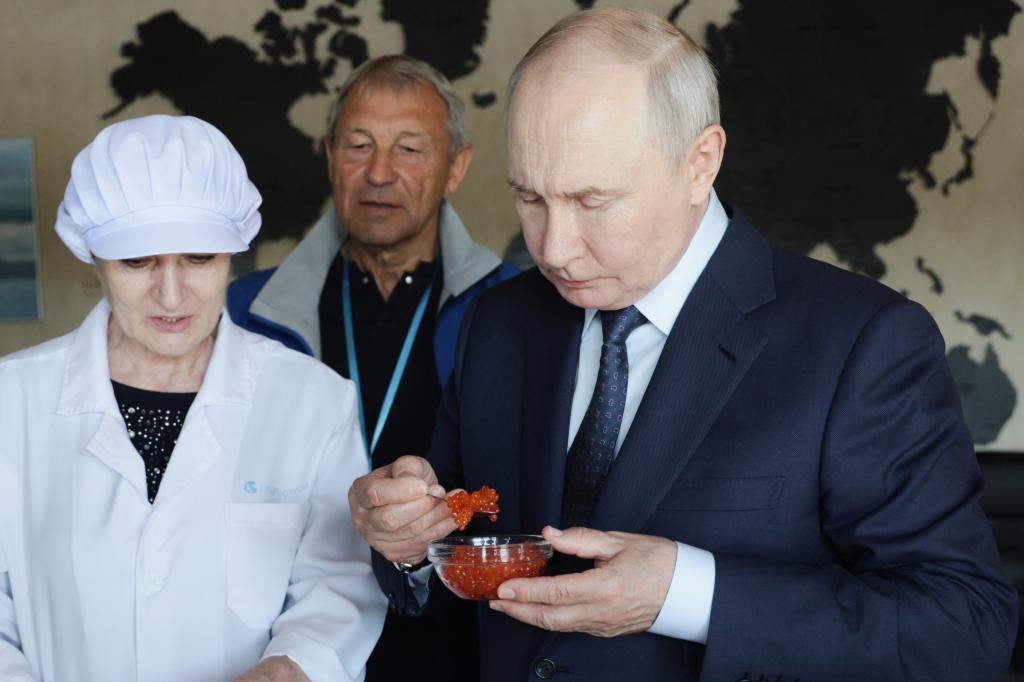
In a room of a fish factory lost in the far east of Russia, Vladimir Putin observed two huge tunas and a halibut placed on a table this Thursday. The plant's officials explained the catches and migratory routes of the fish while the cameras of Russian state television followed every move of the president. Putin even stopped to taste some local fish roe. An apparently trivial scene that, seen from Japan, had little to do with gastronomy and much to do with provocation.
Putin was not in any corner of the vast Russian Far East. He was in Iturup, the largest of the four islands in the Kuril archipelago, which Japan has claimed from Russia since the end of World War II. It was the Russian leader's first visit to this disputed territory, sparking Tokyo's anger.
"The Northern Territories, including Etorofu (as the Japanese call Iturup), are inherently Japanese both historically and according to international law," said Japanese Foreign Minister Toshimitsu Motegi. "Japan strongly protests this visit."
Putin's trip to Iturup also marked the end of a military-focused tour of the Pacific. The Russian leader had overseen significant Russian naval maneuvers in the Far East, and his landing on the island came just a day after North Korea, an increasingly close ally of Moscow, launched another ballistic missile towards the waters east of the Korean peninsula.
To understand why photos of Putin trying fish roe have provoked Tokyo's anger, one must look at the map and go back several decades.
The Kurils form a long chain of volcanic islands that extends from the Russian peninsula of Kamchatka to the vicinity of Hokkaido, the large northern Japanese island. At their southern end are the islands Iturup, Kunashir, Shikotan, and Habomai. Russia administers all of them.
But Japan claims them and refers to them as the Northern Territories. The term is not coincidental: the Japanese government argues that these islands never legally belonged to the Kurils, which Japan renounced after World War II. According to this view, they remain Japanese territory under occupation.
On August 9, 1945, when Japan was on the brink of surrender after the atomic bombing of Hiroshima, the Soviet Union declared war on Tokyo and launched a massive offensive against Japanese forces in Manchuria. Stalin was thus fulfilling the commitment made months earlier with the United States and the United Kingdom to enter the war against Japanese imperial forces. The Soviets also advanced on the Kurils and occupied the four southern islands.
Around 17,000 Japanese lived there at that time. In the following years, almost all were expelled. The islands became part of the USSR and, after its dissolution in 1991, came under the administration of the Russian Federation.
This is where Moscow's and Tokyo's narratives collide head-on. Japan argues that the four islands never belonged to the Kurils it renounced after the war and were therefore illegally occupied by the USSR. Moscow considers its sovereignty over the southern Kurils a legitimate consequence of the conflict's outcome.
In 1956, Tokyo and Moscow signed a joint declaration that ended the state of war and restored diplomatic relations. The USSR then agreed to hand over to Japan the two smaller pieces of the puzzle -Shikotan and Habomai- after the signing of a future peace treaty. But there was no agreement on Kunashir and Iturup, and that treaty was never signed.
Decades later, it was the late Japanese Prime Minister Shinzo Abe who invested the most political capital in trying to untie the knot. Abe and Putin met up to 27 times. The Japanese leader sought a personal relationship with the Russian leader and even agreed in 2018 to base the negotiations again on the 1956 declaration, a formula that opened the door to at least regaining Habomai and Shikotan.
But the Russian invasion of Ukraine ultimately shattered any possibility of understanding. Japan aligned itself with Western powers and imposed sanctions on Moscow. Russia responded in March 2022 by suspending peace treaty negotiations and cooperation programs related to the islands. This year, the Kremlin has acknowledged that dialogue is completely frozen.
In addition to the historical dispute, there is also an increasingly visible military dimension. Iturup is not just an island of fishermen and volcanoes. Russia maintains military installations there and considers the Kurils a strategic piece to protect its Pacific flank.
Military activity around the archipelago has also increased. Russian and Chinese ships have conducted joint patrols through Kuril passages. For Tokyo, these movements take on even greater significance at a time when Russia is strengthening its strategic partnership with China and its military cooperation with North Korea.
For all these reasons, Putin's stroll through Iturup goes far beyond a visit to a factory. More than 80 years after the war's end, Russia and Japan remain trapped in one of their last unresolved frontiers.