The failed US and Israel offensive against Iran has had serious consequences on the price of oil, the balance of power in the Middle East, and the ability to maintain deterrence to prevent future wars by Washington. The ripple effect of the erratic operation Epic Fury will be felt in the West for years, even decades.
The strategic defeat of the US in an asymmetric war in which the Tehran regime has suffered but has been far from breaking has emptied the arsenals of the world's most potent military power, with enormous global implications. In response to the US and Israeli attacks, Iran has consumed nearly four-fifths of its inventory of Thaad anti-aircraft missiles and 60% of the Patriot missiles, according to the Center for Strategic and International Studies (CSIS). Before the conflict, the US had about 2,200 Patriots and 452 Thaad missiles, while today estimates are at 827 Patriots and 278 Thaad projectiles.
How is it possible that all these anti-aircraft missiles were used in a few weeks of attacks? Iran responded to the bombings in an unprecedented way for the United States: with swarms of drones and massive launches of ballistic missiles of different capacities against their bases in the Middle East. The saturation of projectiles in the sky forced Washington to fire all available arsenal, which also did not prevent, during the 40 days of Epic Fury, 22 US military personnel from dying and 624 being injured, according to figures from the US Central Command. The documented attacks affected bases in Kuwait, Saudi Arabia, Bahrain, and Qatar, with significant damage to military installations and the loss of valuable assets, such as a E-3 Sentry AWACS aircraft and several US tanker aircraft, as well as several F-15 fighter jets of the US Air Force.
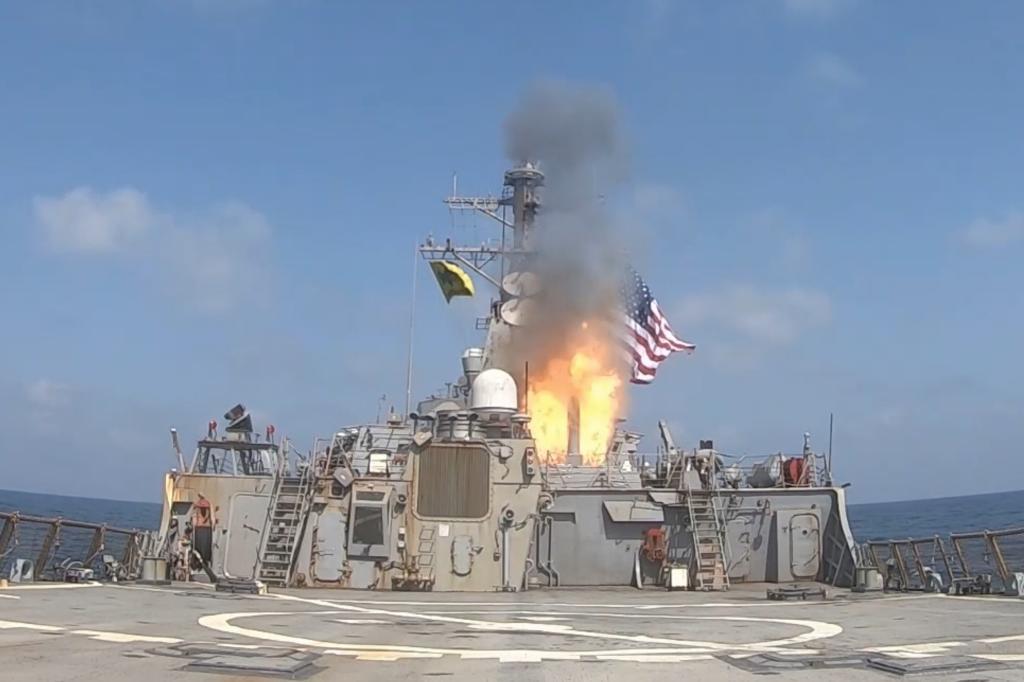
But anti-aircraft missiles are not the only ones whose reserves have been depleted after this military adventure by Trump and Netanyahu. The Tomahawk cruise missiles, which are the most used offensive weapon by the United States during its recent armed interventions, have also decreased in the arsenals by between 30% and 50%. During the Epic Fury operation, over 1,000 were fired, the highest use of this armament in its history. Analysts believe there are still about 2,000 units in the arsenals.
What are the consequences for the deterrence capabilities of the US against geopolitical rivals like China or Russia? The analysis arising from the consequences of this strategic error represents one of the most concerning security situations since the Cold War. The first reason is that the geopolitical enemies of the US (and by extension, NATO) are watching and counting ammunition. Under normal circumstances, China, Iran, Russia, or North Korea do not consider attacking the US or its allies or interests for fear of their vast arsenals, but those same powder kegs are at their lowest point in decades. That is why Donald Trump does not want to continue the war with Iran despite the threats he makes, even though Tehran has taken the Strait of Hormuz hostage and continues to work on its nuclear program.
In this context, the Indo-Pacific region is the most threatened by the decline of US arsenals. Taiwan has orders for US weaponry worth $20 billion, but right now Washington cannot supply the island with that material. Those anti-aircraft systems (Patriot and Thaad) are critical to counter China's air power, but they may take years to arrive, and Beijing knows it.
Russia is the other major beneficiary of Iran's victory in the war, in which it has participated by providing satellite intelligence to Tehran.
Ukraine needs about 300 Patriot anti-aircraft missiles for this winter to defend its cities from Russian ballistic missiles that will try to kill Ukrainians with cold, but it will be challenging for them to obtain them. Kiev has the money and willingness to buy them, but those arsenals no longer exist because they were depleted in the Persian Gulf. Donald Trump promised to grant Kiev a license to manufacture these missiles on its own, but then backed out. Its European allies are also running low on supplies, just like Israel (which also faced attacks with dozens of Iranian ballistic missiles that it had to intercept), or the Gulf countries, such as the United Arab Emirates, Qatar, Kuwait, Saudi Arabia, or Bahrain, all with the funds to make the necessary purchases, but unable to do so due to the lack of supplies.
Faced with this situation, Russian autocrat Vladimir Putin is escalating his bombings of Ukrainian cities, while US intelligence and several European allies already warn that he could attempt some military move against a NATO country even if he has not ended his invasion of Ukraine, as Moscow knows that the US arsenals are nearly depleted.
The annual production of Patriot Pac3 missiles is 650 units. Only Ukraine estimates that it would need that quantity every two to three months. This means that it will take years, perhaps a decade, to replenish all their powder kegs of this type of armament, a window of opportunity for Western geopolitical rivals, who only need to do the math to see the enormous setback caused by Trump's failure in Iran.