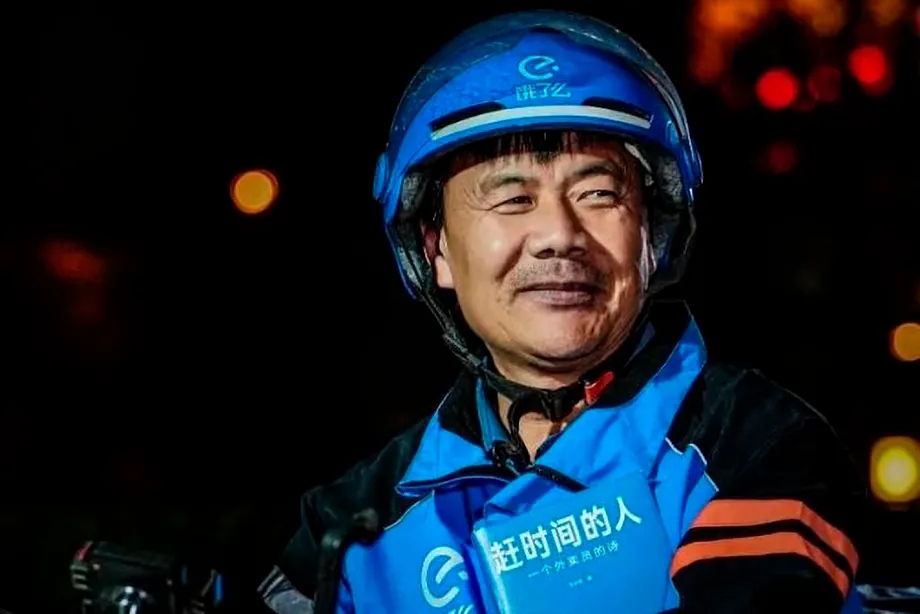
When the traffic light turns red, Wang Jibing stops his electric bike, takes off a glove, and pulls out his second phone from his pocket. The work phone is attached to the handlebars, displaying a map marking the route to the next customer and a timer reminding him that every minute of delay could cost him a penalty. Taking advantage of the stop, he opens a notes app and starts dictating some verses. When the light turns green, he continues on his way delivering food in Kunshan, an industrial city on the outskirts of Shanghai. In the evening, back home, he sits quietly in his study to refine those voice notes into poems.
For years, this has been Wang's routine. Thanks to it, this 56-year-old delivery driver who dropped out of school as a teenager and made a living as a construction worker, scrap collector, or garbage collector conquered the Lu Xun Prize in July, China's top poetry award. The recognition was bestowed upon Flying Low, a collection of poems where Wang speaks of invisible delivery drivers, endless workdays, and the dignity of those who sustain the daily life of big cities. One of the opening verses in the work asks: Who says spreading wings means flying high? Flying low is also flying. A statement of principles for a man who never stopped observing the world from the asphalt.
His life is far from that of the usual writers who frequent the elitist literary circles of big Chinese cities. Born into a peasant family in Jiangsu province, he dropped out of school due to his family's economic difficulties. Since then, he held various jobs. He worked as a construction worker, a sand dredger operator, a garbage collector, and a scrap collector alongside his wife. In 2019, he decided to become a delivery driver.
As a writer, he started sending short stories to local magazines in his twenties. Then came poetry. He explained in an interview that his life was too fast-paced to write novels. "Poems could be born in the few minutes of waiting between one order and another." Thus began an almost clandestine routine. He recorded verses as voice notes on his phone while waiting for an elevator, for the restaurant to hand him the bag with the order, or at a red traffic light. Later, he shaped those lines at home. He boasts of having written over 6,000 poems.
His first major success arose from a bad workday. A customer provided the wrong address. Wang had to climb 18 floors of the wrong building carrying the order. The platform he works for also penalized him for the delay, and the recipient complained because the food arrived cold. That mix of exhaustion and helplessness turned into the poem "The Hurried Man," whose verses began circulating on Chinese social media until reaching tens of millions of readers.
People in a hurry do not know the seasons; only the next stop, he writes. In another stanza, he summarizes the daily vertigo of delivery drivers with a devastating image: People in a hurry steal 61 minutes from each hour.
His poetry barely uses elaborate metaphors or refined quotes from traditional culture. His followers admire him for writing in the language of the streets and constructing poems from recognizable scenes: a cold food box, a fine, tired legs after climbing stairs, or a brief conversation with a stranger. It is precisely there where much of his strength lies. Wang turns small everyday episodes into a reflection on work, dignity, and resilience.
After receiving the Lu Xun Prize, named after the author considered the father of modern Chinese literature, Wang explained that his greatest wish is for readers to better understand delivery drivers and for there to be fewer conflicts between them and customers. Despite the achieved prestige, he states that he will continue working by driving his electric bike: "I need to keep living what I write about."
His story also reflects a broader transformation in Chinese literature. For decades, cultural prestige was associated with academics or intellectuals linked to universities and specialized magazines. In recent years, authors from the margins have emerged strongly: workers, peasants, delivery drivers, taxi drivers, or migrant workers who narrate China's economic growth from below.
Chinese critics already speak of a new "popular literature," a trend that has found a massive showcase on social media and that particularly resonates with a generation of young readers tired of grandiose narratives about the country's economic success.
Wang's case is not an exception. In 2023, another delivery driver, Hu Anyan, turned his diary about life delivering packages on the streets of Beijing into an editorial success. His memoir, written in a straightforward style, depicted the precarity, fierce competition, and constant pressure experienced by those who fuel China's massive platform economy.
It is estimated that around 15 million delivery drivers work in the Asian superpower. Among them are increasingly more university graduates unable to find qualified jobs in an economy struggling to absorb an entire generation of young graduates. For many, the electric bike has become the last refuge for employment.
This context explains why Wang's poetry resonates with millions of readers. His verses do not just speak of a delivery driver. They speak of a part of Chinese society that rarely occupies the center of the official narrative.