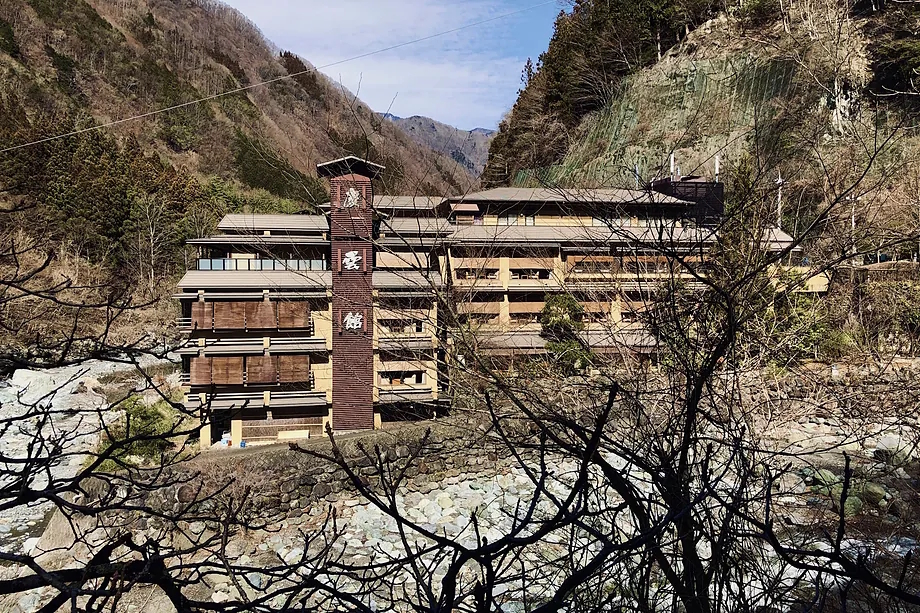
There are hotels that boast having hosted a Hollywood actor. Others proudly exhibit the suite where a king, a Nobel laureate, or a rock star slept. The Nishiyama Onsen Keiunkan is in a league of its own. Its greatest attraction cannot be displayed in a showcase or a photo album. It simply consists of having remained open since the year 705.
When this small Japanese inn began receiving travelers, much of Europe was still in the High Middle Ages, Islam had just emerged as a religion, and it would be decades before Charlemagne became emperor. While the world was building and toppling empires, changing alphabets, inventing nations, and waging endless wars, a Japanese family continued to do exactly the same: welcoming travelers seeking rest in hot springs hidden among the mountains.
Few stories are as hard to believe as this one. And yet, it is entirely true.
The Nishiyama Onsen Keiunkan, located in the Yamanashi prefecture, holds the Guinness World Record as the oldest hotel in the world. But perhaps the most astonishing fact is not its opening date, but that it still belongs to the same family that founded it over 13 centuries ago. Fifty-two generations have passed down the business from parents to children, as if time had decided to stop at the establishment's doors.
In an era where many restaurants barely survive a couple of seasons and hotel chains change ownership as quickly as room access cards are renewed, the Keiunkan's story seems like a work of science fiction.
Although in Japan, it actually reflects a different philosophy.
Here, there is a word, shinise, which refers to centuries-old businesses capable of keeping a family legacy alive for generations. Japan is home to thousands of companies with centuries of history, but even within that admirable culture of continuity, the Nishiyama Onsen Keiunkan stands in a category of its own. Because 1,300 years allow for much to happen.
When the hotel first opened its doors, the Vikings did not yet exist. The Crusades were four centuries away. America was an unknown continent to Europe. Printing presses, gunpowder, trains, automobiles, airplanes, and the Internet belonged to the realm of imagination.
However, the hot water has always flowed just the same as it does today. That has always been the hotel's greatest treasure.
The hot springs, fed by natural springs that originate in the nearby mountains, continue to fill the traditional Japanese baths where guests immerse themselves while admiring the landscape. The ritual has hardly changed for centuries. Entering slowly, letting the steam envelop the body, and allowing silence to do the rest. It doesn't seem like a bad recipe for surviving centuries.
History tells us that even ancient samurais found rest here after long military campaigns. It is easy to imagine them leaving their swords at the entrance before immersing themselves in the hot waters. Warriors accustomed to the sound of steel finding, for a few hours, a refuge of peace among the mountains.
Then came feudal lords, merchants, Buddhist monks, pilgrims, imperial officials, foreign travelers, businessmen, and tourists armed only with a mobile phone. All sharing the same destination.
Sleeping under a roof that has been welcoming visitors for over a millennium inevitably leads to reflection.
When one settles into a room at the Nishiyama Onsen Keiunkan, one cannot help but wonder how many people have slept in that same place before. 100,000? 200,000? Half a million? It is impossible to calculate.
The only certainty is that very few buildings on the planet have heard as many conversations before the lights go out. Perhaps therein lies the true legend of the hotel.
No ghosts are needed when the building itself seems to have become a living memory.
Its walls have survived devastating earthquakes, fires, epidemics, civil wars, the fall of the shogunate, the Meiji Restoration, two world wars, and a global pandemic. They have witnessed entire dynasties disappear, emperors change, and Japan transform from a feudal society into one of the great technological powers of the planet.
And while all of that was happening, someone was still placing slippers at the entrance and preparing the thermal bath for the next guest. There is something profoundly Japanese in that persistence for continuity.
Here, luxury does not lie in excess, but in the perfection achieved through repetition. Doing the same thing over and over again until a daily gesture becomes an art form. Serving tea with the same care as 500 years ago. Folding a futon with the same delicacy as the great-great-grandfather did.
Modernity is present, of course. The hotel offers all the comforts expected by a 21st-century traveler. But what is truly exclusive is feeling that one is participating, even if only for one night, in a tradition that began when Europe's history was just beginning its medieval chapters.
Perhaps that is why many travelers describe the experience almost like a journey through time. Not because the hotel seems like a museum. On the contrary. The extraordinary thing is to see that it is still alive.
It is not a set reconstructed for tourists. It is an establishment that never stopped operating. It never closed to become a monument. It never needed a complete reinvention. It has evolved over the centuries without giving up what made it special from the beginning: hospitality, hot springs, and a surprising serenity.
There is an old Japanese idea that suggests some places end up acquiring their own soul after centuries of coexisting with people. It is a belief hard to explain in words but very easy to understand when one walks through the halls of the Keiunkan.
There are no surprises. No chains dragging in the night. No spectral figures crossing the garden at dawn.
And yet, it is impossible to shake off the feeling that time lingers there in a different way. As if haste had decided to stay outside. As if each generation had left a small invisible mark that still accompanies the next.
Perhaps it is an illusion. Or perhaps a building that has remained open for over thirteen centuries ends up accumulating more than just guests.
While the rest of the world obsesses over inaugurating the tallest, most technological, or most extravagant hotel, the Nishiyama Onsen Keiunkan continues to remind us that there is another kind of luxury much harder to achieve: endurance.
Enduring as empires disappear. Enduring as maps change. Enduring as history accelerates. And continuing to welcome each new traveler with the same calmness as in the year 705.
After all, perhaps that is the greatest legend of this hotel. Not that it has survived thirteen centuries. But that it still retains the extraordinary ability to make anyone who crosses its threshold believe that time, for once, has decided to wait.