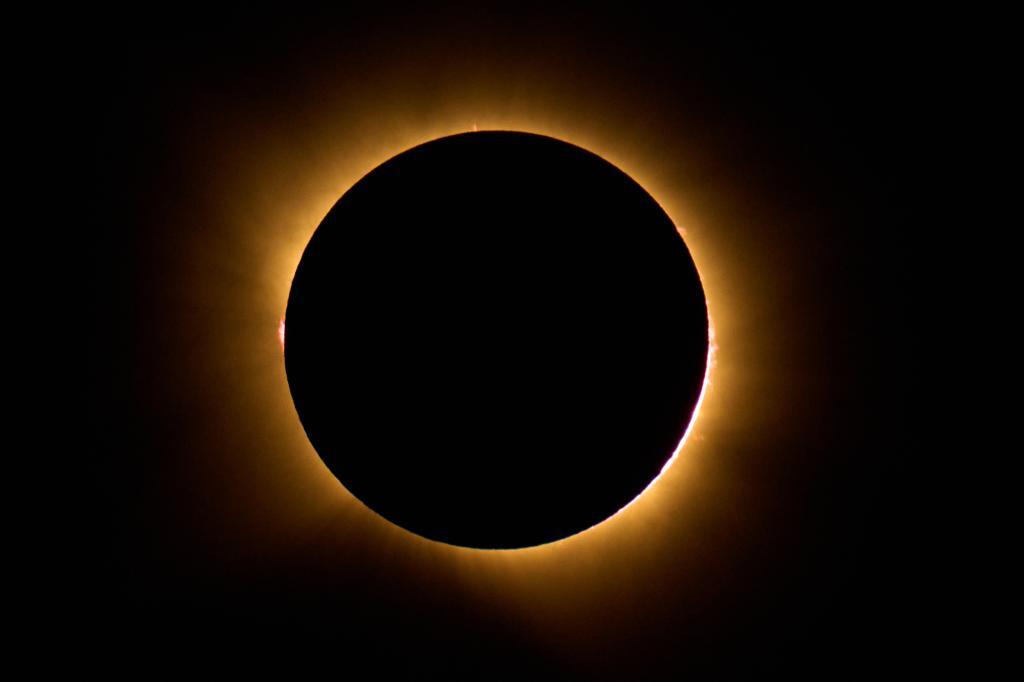
If the total solar eclipse we just enjoyed left you wanting more and you are eager to experience it again, the good news is that we have an extraordinary calendar ahead to witness these phenomena without leaving Spain.
For instance, at the end of August, there will be a new opportunity. It will not be a solar eclipse like the one on August 12, but on the night of August 28, 2026, it will be possible to observe a partial lunar eclipse throughout Spain that will be visible to the naked eye and does not pose any danger, so no special protection or instrumentation will be required.
But if you want to repeat the fabulous experience of witnessing a total solar eclipse, you will only have to wait a year to do so without traveling outside our country. However, it will be from a different geographical area, and fewer people in our country will be able to see it, as the path of totality will cross a part of southern Spain. You have probably heard of the famous Iberian eclipse trio that have converged between 2026 and 2028. The one on August 12 was the first, and the second will be the total solar eclipse on August 2, 2027, dubbed the eclipse of the century due to its duration and because it will be globally visible in strips of heavily populated countries like Egypt.
Thus, it can be enjoyed in North Africa, the Middle East, and southern Europe. In Spain specifically, the path of totality will cross the Strait of Gibraltar from west to east, covering the autonomous cities of Ceuta and Melilla, almost the entire province of Cadiz, a large part of Malaga, and the southernmost areas of Granada and Almeria. It will be longer than the one we just experienced, lasting almost five minutes in Spain, and will take place around 10:50 a.m., making its observation easier due to the Sun's elevation.
According to the National Geographic Institute (IGN), in Ceuta, the totality can be admired for four minutes and 48 seconds (starting at 10:45 and ending at 10:50 a.m.), while in Melilla, it will be four minutes and 34 seconds of darkness. In Cadiz, it will last two minutes and 45 seconds, and in Malaga, one minute and 48 seconds.
In the rest of the country, it will be a partial eclipse, with significant darkening, as in any location on the Peninsula and the Canary Islands, the sky will darken by at least 70%.
Due to the limited territory in Spain that the total eclipse of August 2027 will cross compared to 2026, it is expected to be very crowded, so if you plan to travel, plan well in advance.
If you decide to travel abroad, Egypt will be the best country to witness it, just as Spain was the most suitable place to enjoy the phenomenon on August 12. In Egypt, the city of Luxor - the ancient Thebes, home to the temples of Luxor, Karnak, or Hatshepsut - will experience it for the longest time: six minutes and 23 seconds.
Other options include Morocco (Tangier will experience totality for four minutes and 51 seconds) or Lampedusa, Italy (two minutes and 56 seconds). Eclipse chasers will head to Saudi Arabia, where totality will last for five minutes and 53 seconds in Jeddah and five minutes and 10 seconds in Mecca.
The last episode of the Iberian trio will be an annular eclipse scheduled for January 26, 2028. The Moon will align between the Earth and the Sun, but being at its farthest point from Earth, it will appear smaller than the Sun and will not completely cover it, leaving a ring of fire around the dark disk.
In the late afternoon, it will cross the peninsula from southwest to northeast, covering much of the country: Andalusia, the southern part of Extremadura, Castilla-La Mancha, part of Madrid, Aragon, Murcia, Valencia, part of Catalonia, and the westernmost islands of the Balearic Islands. From the rest of the country, it will be enjoyed as a partial solar eclipse.
As it happened this year, the Sun will be low. Additionally, being annular, there will never be a safe moment to look directly at our star without eye protection. The ring of light is still direct sunlight, so eclipse glasses should not be removed at any time.