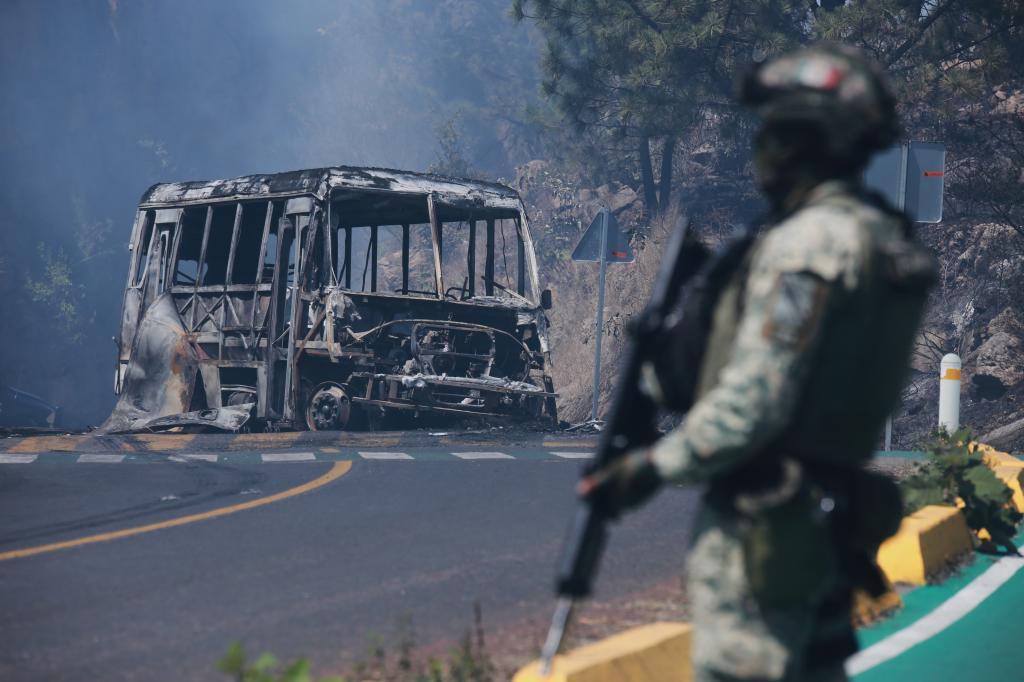
Tequila and mariachis brought worldwide fame to Jalisco. But, unfortunately, the western state of Mexico bathed by the Pacific Ocean has been more present in international media in recent years due to the extreme violence in the birthplace of one of the most bloodthirsty cartels in the country, the Jalisco New Generation Cartel (CJNG), the infamous and powerful criminal organization dedicated to drug trafficking.
The Mexican Army operation, in close collaboration with the US, which managed to end in February with its fearsome historical leader, Nemesio Oseguera Cervantes, alias El Mencho, has allowed Jalisco to improve its security rates so far this year. However, the cartel is rebuilding its tentacles after the blows to its leadership, with its new boss at the helm, Juan Carlos Valencia González, alias El 03 or Pelón, El Mencho's stepson, who shortly after his death took over the leadership of the criminal organization. "It's as if we were in a peace before the storm," says a local from Jalisco to EL MUNDO who prefers not to be identified.
The impressive operation that took down El Mencho on February 22, 2026, in Tapalpa unleashed panic in the region, with days of extraordinary violence, burning of vehicles, roadblocks, and Security forces on high alert. In a single day, 25 soldiers and 33 criminals lost their lives, according to Efe. Then, "the community was in a tense calm because there were no disputes, particularly because there was a deployment of federal forces. However, the criminal structure remained because the drug sales continued to flow," explains Darwin Franco, a member of the independent media ZonaDocs, to EL MUNDO.
On the other hand, the co-founder of the collective Luz de Esperanza Desaparecidos Jalisco, Héctor Flores González, warns us that "insecurity has not diminished because the organization remains intact, despite the arrests". He refers to the captures by federal authorities of other cartel leaders like Audias Flores Silva, alias El Jardinero, on April 26. "The US and Mexico show that they are capable of capturing the big bosses. But it's another thing to end the criminal structure," adds Franco.
One of the worst nightmares for the local population is the disappearances, that is, the forced recruitments by organized criminal groups in the region, especially the Jalisco Cartel, which needs slave labor to sustain its operations and clandestine fields. And for this, they resort to both recruiting people, many in desperate situations, and kidnappings, including many minors. Augusto Chacón Benavides, director of the organization Jalisco Cómo Vamos, emphasizes to this newspaper that disappearances are "both for enslaving work and for revenge and debt collection through killing people and making them disappear."
Ceci Flores Armenta, leader of the Madres Buscadoras de Sonora collective, highlights how organizations take advantage of the need of so many citizens in exclusion. "They recruit them with job offers (deceptive). They offer them a good salary, houses, and even cars over the internet." Once they fall into the trap, many "are trained to kill". Apart from turning them into hitmen, they perform other functions, from cooking and cleaning to forced sexual work and drug smuggling.
Today, anyone is a target. Teacher Nadia Cea tells EL MUNDO how they infiltrate daily life: "They pretend they are looking for employees. And the biggest fear among the population is that you can no longer look for a job because you don't know if it's real or not". Faced with this insecure panorama, society survives in an environment where violence is normalized. And the situation forces citizens to measure each of their movements. "If you are driving and someone in a truck overtakes you on a street, you can't honk or confront them because you don't know if they are armed," concludes Cea.
While fear prevails, "disappearances remain the same. The cartel continues to recruit forcibly because it is an operational necessity. And, despite cutting off the head of the cartel, all its cells remain active," indicates Flores González, who experienced firsthand in 2021 the disappearance of his son, Dani, when he was 19 years old, taken from his home by members of the State Prosecutor's Office. The case revealed the infiltration of criminality within state agencies, increasing citizen distrust.
Throughout Mexico, there are more than 130,000 missing persons recorded. Only in Jalisco, a total of 16,191, according to the State Registry. However, these figures could be just the tip of the iceberg due to the widespread fear that prevents people from going to the authorities. Chacón Benavides explains that "beyond the tragedy, there is a distrust. There are those who say: 'I don't report it because I'm afraid of reprisals'". This fear is confirmed by Flores Armenta: "Many are intimidated because they are taken in front of their families and told that if they look for them, they will also disappear."
"There is a lot of fear to report. People get used to it because they have to keep living, but not to be happy, but to avoid conflicts", laments Chacón Benvides. On the other hand, Flores Armenta, who receives daily reports of disappearances, recounts that "they cannot live peacefully. There is always the fear that someone from the cartel will show up." Such is the violence that Héctor Flores warns that "it's not about being in the wrong place at the wrong time, but even in your home they can arrive, break down the door and take you."