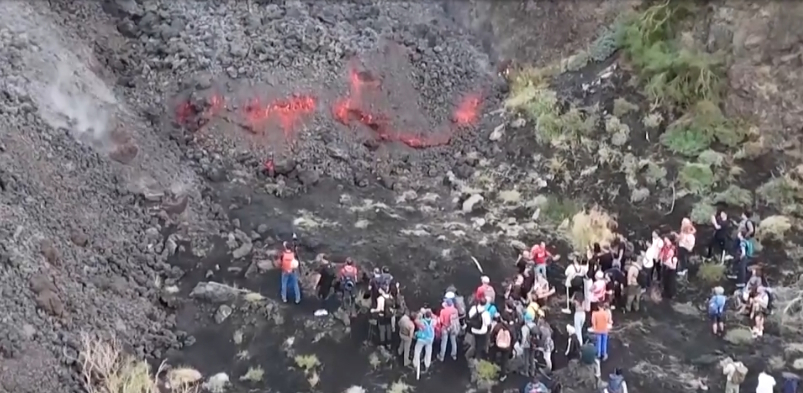
For days, Etna has been spewing ash and lava, intermittently forcing the closure of Catania airport, a crucial gateway for many visitors to Sicily. Italy's civil protection agency has issued a yellow alert for Etna, the second-highest on a four-level scale, indicating frequent eruptions and possible explosions.
Companies organizing nighttime excursions to closely observe the eruption report being overwhelmed by demand. Daniele Perricelli, a 41-year-old local guide, stated that "everyone wants to come see the lava flow, everyone is drawn to this unique beauty." His group, Guide Etna, which usually takes a few dozen visitors per night, is now receiving about 300 requests per day, tripling their usual demand. Ernesto Maria Magri, another guide, added that even Sicilian residents are climbing up to see the lava, sometimes "crowding disorderly."
However, this massive influx of curious onlookers is not without risks and is the main source of concern. Perricelli pointed out that many, reluctant or unable to hire a guide, venture up on their own, which poses potential dangers. "Every night, up to 2,000 people climb, the trails are crowded," he exclaimed, with the alarming observation that he saw "some in flip-flops." According to current regulations, visitors can ascend on their own up to about 2,400 meters in altitude, but they must be accompanied by a guide to go higher, towards the 3,324-meter summit.
The eruption has also had a significant impact on air connectivity, with ash emissions forcing Catania airport to repeatedly suspend flights in recent days. Italian media report hundreds of flights canceled since Saturday. Despite the challenges and warnings, the allure of an active volcano remains a powerful draw for those seeking an unforgettable natural experience, even if they do not always take the necessary precautions.