In the fifth year of war, with the front line stuck due to fatigue and the deadly drone swarms dominating the entire contact line, both Ukraine and Russia have embarked on a race to see who can undermine the opponent's economy from a distance, which is what truly causes a country to lose a conflict. In this war of attrition, where both nations feel the exhaustion of military and civilians, bombings of factories, power plants, or logistics companies have become the main current military target.
In this war between two capitals, Kiev and Moscow, both have sought to continue imposing high levels of destruction last night. The Z army has launched ballistic missiles against the capital and the south of Ukraine (Kremenchuk and Krivi Rig, President Zelenski's hometown). Among them are the Russian Iskander and also the KN23, missiles sent by North Korea, with great destructive power but less precision. Over the past years, the Iskander and KN23 have been the main culprits of civilian massacres by firing on urban areas throughout Ukraine.
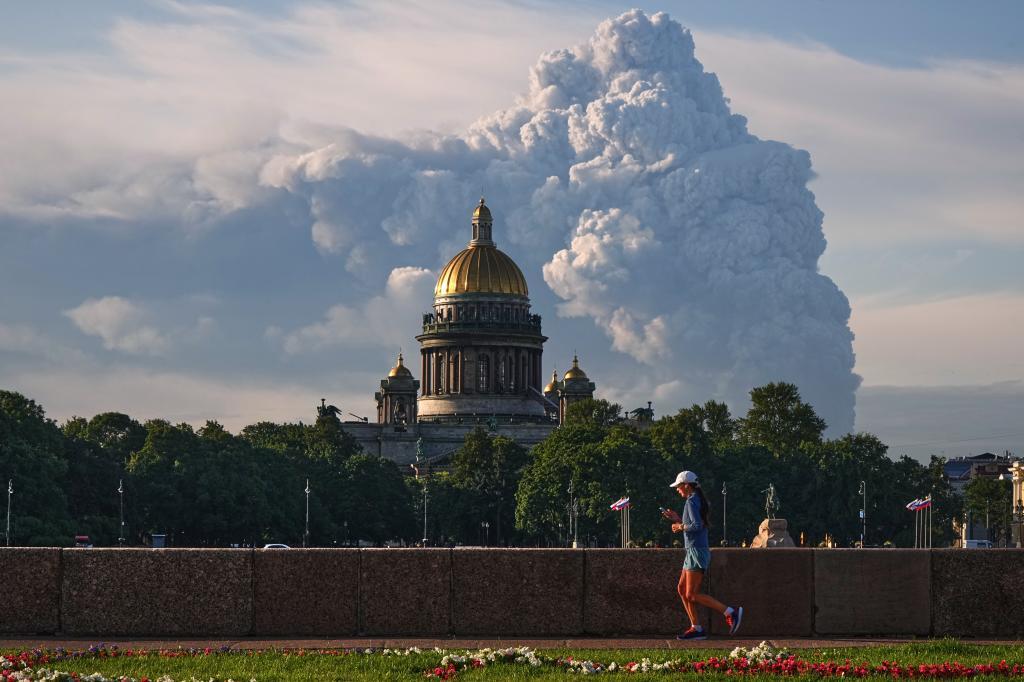
The news this year is that, in this mirror strategy, Ukraine can hit as severely as Russia does, although with a completely different strategy. While the Kremlin massively uses ballistic missilesbecause it knows that Ukraine has many difficulties in shooting them down (due to the absence of Patriot anti-aircraft systems in the market), Kiev uses swarms of cheap drones like Lyuti (similar to the Russian Shahed) to destroy refineries and distribution centers. Last night, they hit three large logistics spaces of the Wildberries company, a sort of Russian Amazon responsible for 45% of all online commerce in the Russian Federation: Kolédino, Podólsk, and the north of Domodédovo, projecting its smoke column over all of Moscow.
This effect, desired by Ukraine, aims not only to bring down the Russian logistics giant (and the banks that finance the small companies that depend on it), but also seeks for the Russian population to feel the war in their own neighborhoods, after years of suffering where the Ukrainian people have borne the consequences of the Kremlin's aggression without much of the Russian population taking notice. Statistics on attacks on Wildberries show 21 logistics sites affected by attacks, fires, or evacuations from July 18 to August 16, including the largest ones. The bombings could have caused damages of around $10 billion and more than 400,000 Russian sellers face losses in some cases catastrophic. Russia had been destroying Ukrainian logistics centers of companies like Nova Posta for years and now faces the same strategy.
Another undesirable consequence for the Russian people is the gasoline supply problem. The ongoing refinery bombings throughout the country, sometimes even 2,500 kilometers away from the front line, have put out of action nearly 40% of the refining capacity, causing kilometer-long queues throughout the country, but also in Moscow and St. Petersburg. Every week, Ukrainian drones destroy a new refinery or revisit one that has been repaired from previous bombings to put it out of action again.
Ukraine is increasingly manufacturing drones (launching around 300 to 400 each night) and challenging Russian anti-aircraft defenses. Although the Kremlin has tried to fortify Moscow, there are more and more occasions where Ukrainian drones manage to breach the Russian stronghold. Furthermore, concentrating almost all defense in the capital leaves vast territories (Russia being the largest country in the world) unprotected, which Kievexploits to carry out its economic warfare.
A barrage of drones struck three localities in the southwestern Russian region of Rostov, where five people died, according to local governor Yury Slyusar. The attack, with over 150 drones, damaged several homes and a train station, causing a forest fire. Another Russian citizen died in the Moscow region due to debris from a drone falling on his house.
Boris Aronstein, an independent oil and gas analyst, believes that "Ukrainian drone attacks have caused the most serious crisis in recent years, because the size, coordination, and repeated waves of drones prevent Russia from repairing the refineries before the next attack occurs."
Regarding the attacks on Wildberries, the think tank Chatham House states that "regardless of their military significance, these attacks are bringing the war closer to the Russian population. The options to mitigate these costs seem limited. A tax break for a company as large as Wildberries would impose additional unwanted pressure on the federal budget. Moving the logistics centers to ostensibly safer areas in the Urals or Siberia would be very costly. The burden of protecting commercial infrastructure from Ukrainian attacks is increasingly falling on the companies themselves."
Regarding the Russian economy and the damage from these attacks, Elina Ribakova from the Peterson Institute for International Economics believes that "the Russian economy has stagnated. It will have zero growth this year; at best, we have seen an economic contraction in the first quarter and also a contraction in industrial production. The contraction in industrial production also means that the defense sector has slowed significantly.