During his first term, Donald Trump surprised the world by talking about the "love letters" he exchanged with Kim Jong-un. "We fell in love", the US president said in 2018 about that unusual correspondence with a dictator who just a few months earlier threatened to launch nuclear missiles against the United States.
Eight years later, the letters continue to fly over the Korean Peninsula, although now the recipient of the most affectionate words from the North Korean leader is not in Washington, but in Moscow.
Kim wrote to Vladimir Putin a few days ago expressing that he felt "proud" of the strong ties between North Korea and Russia. The Russian president responded by celebrating that the relations had reached an "unprecedented level of comprehensive strategic partnership." The exchange of letters coincided with new information about North Korean soldiers and missiles sent to fuel Putin's war in Ukraine.
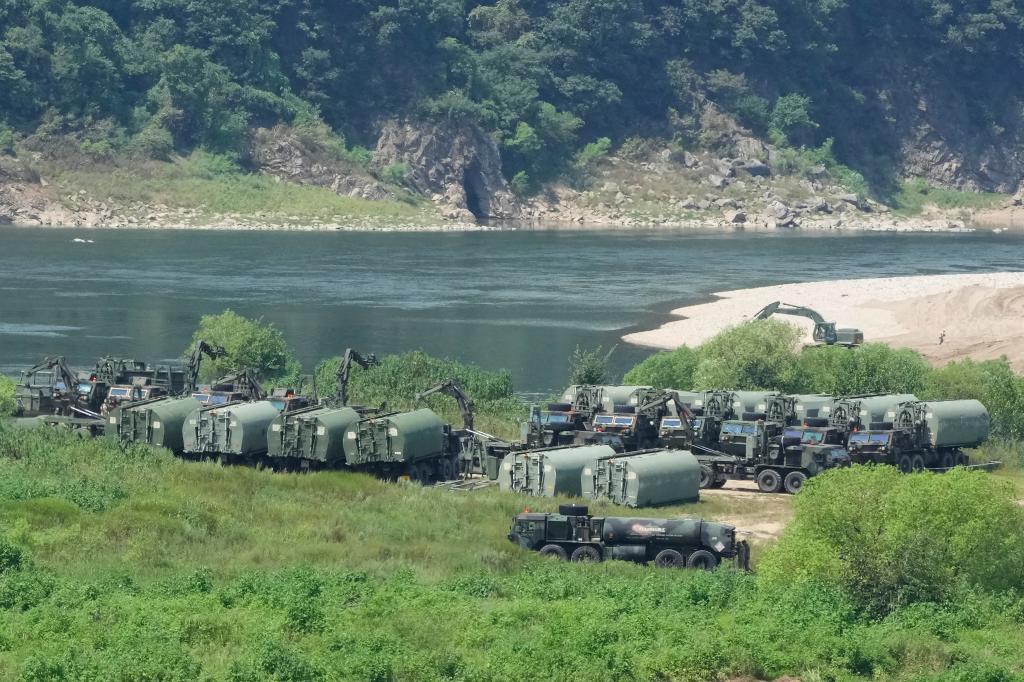
While Moscow and Pyongyang exchange compliments, on the other side of the Demilitarized Zone, a four-kilometer-wide strip that has divided the two Koreas for over seven decades, thousands of South Korean and American soldiers began their annual large-scale maneuvers this Monday.
The Ulchi Freedom Shield will last for 11 days and mobilize around 18,000 South Korean troops, in addition to US forces. The exercises include scenarios of drone attacks and cyber operations, but also a threat that until recently was not included in the manuals: North Korean soldiers returning home after gaining real combat experience in Ukraine.
Pyongyang has been denouncing these maneuvers for years as preparations to invade the North. Last Friday, its Ministry of Foreign Affairs once again described them as a "rehearsal for an aggressive war". This time, however, Kim has found an unexpected ally in questioning the exercises: the US President himself.
On Sunday, Trump announced that he had ordered Secretary of Defense Pete Hegseth to "substantially reduce" the joint military maneuvers with Seoul. "These exercises are not only costly, and a large part of these costs are paid by the United States of America - as always! - but they send a completely inappropriate and hostile signal," he wrote on his Truth feed. Although he acknowledged that it was already too late to cancel this year's exercises.
Trump's new outburst also had a second consequence that had little to do with North Korea. The President publicly reproached Seoul for refusing to participate in the US war against Iran. Washington had pressured several Asian allies to contribute to protecting maritime traffic through the Strait of Hormuz. South Korea, heavily dependent on the oil that passes through that route, responded cautiously and pointed out that a troop deployment abroad requires approval from its National Assembly.
Trump did not forget. In his Sunday message, he recalled asking the South Korean President if he wanted to join Washington in the "denuclearization" of Iran. The response, according to his version, was a brief: "No, thank you."
The Questioned American Umbrella
The reprimand comes at a particularly delicate moment for Seoul, which has been strengthening its military capabilities for years against a neighbor that has increased its missile tests and expanded its nuclear arsenal.
Around 28,500 US soldiers remain deployed in South Korean territory as the main deterrent. However, since his first term, Trump has been questioning how much it costs Washington to protect one of its main allies in Asia and demanding that Seoul pay more.
The uncertainty also fuels a very uncomfortable internal debate: to what extent can South Korea indefinitely rely on the American nuclear umbrella. Washington has been trying for decades to prevent Seoul from developing its own atomic bomb by guaranteeing that it will respond to any North Korean aggression. Every threat from Trump to withdraw troops, reduce exercises, or review the costs of the alliance reopens that discussion.
In this scenario, the South Korean government is trying to reach out to the North again. Last week, President Lee Jae-myung proposed resuming talks with Pyongyang to officially end a war that, on paper, never ended.
The Korean War was frozen in 1953 through an armistice. There was no peace treaty. The border between the two neighbors is one of the most militarized in the world, with artillery, mines, surveillance posts, and hundreds of thousands of soldiers on both sides. Lee wants political negotiation to regain a space that has been monopolized by missiles in recent years.
But the interlocutor north of the border seems more interested in Moscow today than in Seoul or Washington. Since the Russian invasion of Ukraine in 2022, Kim has found in Putin the partner he needed to partially break his isolation. North Korea supplies Russia with ammunition, missiles, and soldiers. In return, it receives food, energy, currencies, and, above all, access to Russian military technology that could accelerate its armament programs.
Military cooperation continues to grow. In recent days, Ukrainian intelligence has reported that a new North Korean unit has begun to deploy in western Russia and could operate up to 120 ballistic missiles and six launchers from the Voronezh region.
Kim and Putin are trying to wrap their alliance in a historical narrative. The recent letter sent by the Russian president on the anniversary of the liberation of Korea from Japanese colonial rule praised the joint efforts of both countries to ensure "regional security and stability." Kim responded by stating that he was proud to anticipate "an even better future" for bilateral relations.
This is the new balancing act around the Peninsula. Seoul is rearming while calling for dialogue. Washington deploys tens of thousands of soldiers while its president questions the cost of doing so and boasts once again of his "very good relationship" with Kim. Pyongyang denounces US "war games" while testing new missiles and sending troops to fight in Europe. And Putin writes letters to the North Korean leader thanking an alliance measured in soldiers, projectiles, and corpses on the Ukrainian battlefield.