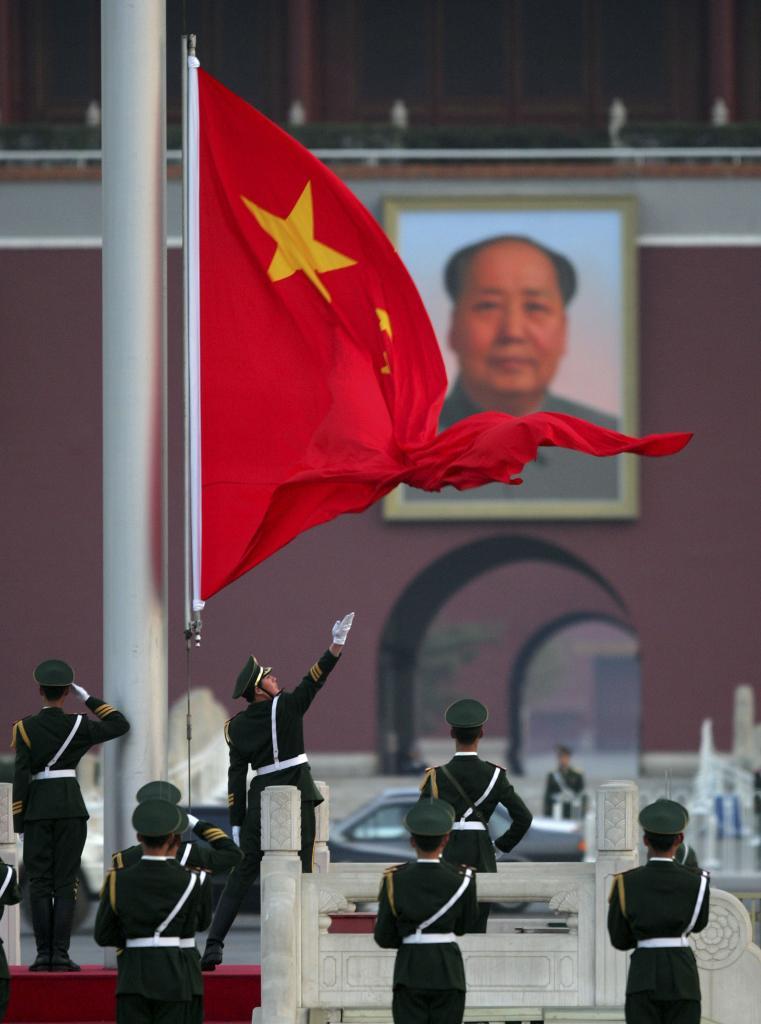
Red flags at half-mast in government buildings and discreet reinforcement of security in the political heart of Beijing. In a meticulously staged setting, China bid farewell on Tuesday to Zhu Rongji, the former prime minister who passed away last week at the age of 97. Images of the funeral were barely circulated, and on social media, censors monitored tributes that deviated from the official script.
Zhu was no ordinary leader: he was one of the major architects of the economic reforms that opened China to the world at the end of the last century. Remembering that era too much can lead to comparisons and criticisms that are not welcomed by the current Chinese leadership.
Just ask economist Zhao Jian, who posted on his WeChat channel, equivalent to WhatsApp, an essay recalling the years when the Chinese were "truly poor," but where "people could say what they really thought." The publication was censored.
The Chinese government is well aware of the danger of funerals where praises spiral out of control. Some of the biggest outbursts of discontent began around a wreath of flowers. The death of Prime Minister Zhou Enlai in January 1976 set one of the first major precedents for the Communist Party's fear of collective mourning. Months later, tens of thousands of people filled Tiananmen Square with wreaths, poems, and messages in his memory. The tribute soon took on a political dimension: praising the popular Zhou also became an indirect way to criticize the radical factions dominating the final months of the Mao era. When the authorities removed the offerings, the outrage led to protests and clashes with the police.
Over a decade later, the death of reformist Hu Yaobang once again demonstrated the political potential of collective mourning. His death in April 1989 was one of the sparks that ignited the student demonstrations in Beijing: tributes in his memory gave way to demands against corruption and in favor of greater democratic openness, culminating in the Tiananmen Square protests, crushed by the Chinese army on the night of June 3-4 in a crackdown that left a death toll that, almost four decades later, Beijing has yet to clarify.
The Communist Party took note of all this, and with the advent of social media, no public mourning escaped the censor's scissors. A more recent case was the death of former President Jiang Zemin in 2022. Jiang, who alongside Zhu Rongji steered the major economic opening of the late 90s and was the president who led the Asian giant into the World Trade Organization. His figure sparked an unexpected nostalgia, especially among young people who had barely lived through that era but viewed the past as a less rigid period with greater economic prospects.
The same nervousness resurfaced in 2023 with the sudden death of Li Keqiang, prime minister for a decade. Trained as an economist and advocate of some market reforms, for many observers, Li had ended up politically overshadowed by Xi. His death prompted spontaneous tributes and once again turned mourning into delicate ground: praising the former prime minister could be interpreted as an indirect criticism of the much more centralized direction followed by his former boss.
This mechanism not only affects major political figures. There is a long tradition of also managing the grief caused by disasters, accidents, and massacres. The priority is to prevent a tragedy from turning into a collective protest and for questions of responsibility to point towards institutions.
This was starkly evident after the mass hit-and-run in Zhuhai, in the south of the country, where a driver rammed his SUV into dozens of people around a sports center in 2024. 35 people died. In the following days, locals left wreaths and candles at the site of the massacre. The police removed the offerings while the authorities set up a controlled space within the complex that only family members could access. On the internet, criticisms of the delayed reporting of the tragedy were deleted.
It is in these moments that familiar figures emerge in major Chinese tragedies: the so-called "grief counselors." On paper, they are psychologists, social workers, and officials mobilized to support devastated families. In practice, they also serve a much more political function: ensuring that grief does not make too much noise, avoiding contact with journalists, and containing any public demands that could disrupt the Party's obsessive social stability pursuit.
After the crash of a China Eastern Airlines Boeing 737 in Guangxi in March 2022, which left 132 people dead, a relative of one of the victims recounted to this newspaper how those supposed assistants began by consoling him and ended up pressuring him to stop asking questions. When he later shared his experience on Chinese social media, his posts were deleted. Subsequently, he received calls from the authorities and even a visit to his home warning him that he could be arrested for "picking fights and causing trouble," one of the charges commonly used against activists and critical voices.
The most dramatic precedent dates back to the 2008 Sichuan earthquake, the greatest catastrophe suffered by China this century, which left around 88,000 dead. Among them were over 6,000 children who died in collapsed schools. When parents began to denounce the poor construction of many buildings and demand accountability, the authorities mobilized personnel to contain the protests. It was even recommended to monitor individuals deemed likely to "undermine social stability" or considered problematic.
That concept, stability, explains much of the obsession with controlling even something as intimate as death. Beijing does not fear flowers, candles, or farewell messages by themselves. It fears what can happen when thousands of people discover they share the same indignation. One victim can evoke compassion; thousands of citizens gathered around them can become a crowd. And a crowd, in the political memory of the Communist Party, always harbors a potential for disobedience.