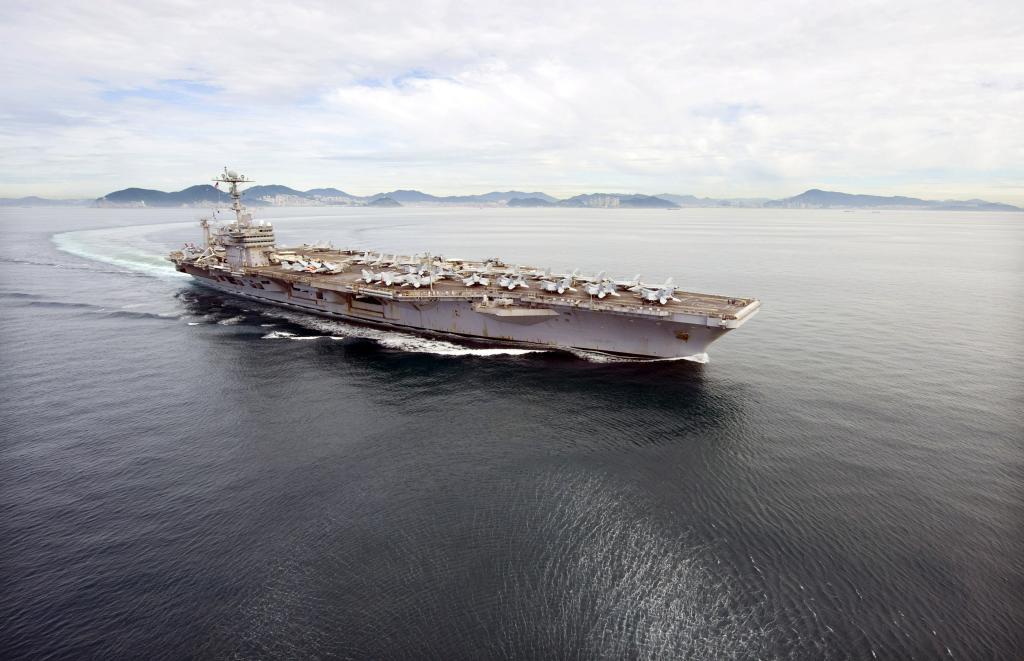
Over the past few weeks, the USS George Washington has sailed through some of the scenarios where the United States has been trying to remind China who remains the main military power in the Pacific.
The US aircraft carrier crossed the South China Sea, made a stop in Vietnam, and, accompanied by missile-launching destroyers, ended up heading towards the Strait of Malacca. But this time, it was not sailing for another show of force against Beijing. It was leaving.
The George Washington, the only US aircraft carrier permanently deployed in Asia and based in Yokosuka (Japan), has received orders to leave the Pacific and head to the Middle East to relieve the USS Abraham Lincoln.
For a time still difficult to determine, the US will be left without any of its 11 aircraft carriers in the region where the Pentagon has been asserting that the great strategic competition of this century will be decided.
The reason for this move lies in the prolongation of the war against Iran, which is putting increasing pressure on the US military machinery. The case of the Abraham Lincoln epitomizes this wear and tear.
US media have reported that the ship has been deployed for over 250 days and around 200 without making a port call. US lawmakers have denounced shortages of food and basic supplies, plumbing issues, and a deterioration of mental health among the crew.
Another of these vessels, the USS Gerald R. Ford, completed an 11-month deployment in May, the longest for a US aircraft carrier since the end of the Cold War. Although the US has 11 aircraft carriers, several are always under maintenance or in preparation, limiting those available to sustain prolonged operations.
In Washington, they have emphasized that they have submarines, bombers, destroyers, and tens of thousands of soldiers stationed in Japan, South Korea, Guam, and other points in the Indo-Pacific. But at a time when military symbols matter almost as much as actual capabilities, the US aircraft carrier is leaving just as Chinese ships are sailing farther away.
In early August, the Chinese military conducted joint air and naval combat patrols around Scarborough Reef, an atoll in the South China Sea disputed with the Philippines. The Chinese military command stated that the goal was to enhance their capability to defend "territorial sovereignty and maritime rights."
A few weeks earlier, a Chinese destroyer conducted live-fire exercises about 180 kilometers from Okinotori, within what Japan considers its exclusive economic zone, while sailing alongside Russian ships. It was the first time Tokyo publicly acknowledged a Chinese exercise of this nature in those waters.
Last week brought another uncomfortable image for Washington: China conducted naval maneuvers with Indonesia east of Taiwan. Jakarta tried to downplay its significance, stating that it was a routine navigation exercise without a combat component. Beijing presented it as a joint navigation exercise. Taipei directly labeled it as a "military provocation."
China already has the world's largest navy in terms of the number of ships. Aircraft carriers are the most visible showcase of this leap. For decades, the Asian giant could only watch as US carrier strike groups sailed along its coasts. Now it has three.
In November of last year, the Fujian officially entered service, the most advanced, with over 80,000 tons of displacement and electromagnetic catapults capable of launching heavier aircraft with more fuel and armament.
In June 2025, Japan detected the other two aircraft carriers, Liaoning and Shandong, operating simultaneously in different Pacific areas for the first time. One of them even penetrated the second island chain, beyond the belt formed by Japan, Taiwan, and the Philippines that had geographically contained the Chinese navy for decades.
"Crossing from the first island chain to the second sends a clear political message," warned Taiwanese Defense Minister Wellington Koo at the time. This year, Liaoning once again demonstrated how far Beijing intends to go. At the end of May, it was located east of the Philippine island of Luzon, where its aircraft and helicopters conducted around 170 takeoffs and landings in just three days.
The departure of the aircraft carrier George Washington also coincides with Donald Trump's order to "substantially" reduce major joint military exercises with South Korea, a decision announced as the president seeks to reopen dialogue with Kim Jong-un and prepares for an upcoming meeting in September with Xi Jinping.
For Japan, the Philippines, South Korea, and especially Taiwan, the question is not only how many ships their ally the United States retains in the region, but where they will be if a conflict erupts on their doorstep.