It is not the first time that Donald Trump threatens Oman with such virulence. When the US president warned the sultanate on Monday with bombing it "if it gets in his way" - a threat to thwart the agreement that Muscat and Tehran would have already finalized regarding the future transit through the Strait of Hormuz - he was only repeating the furious warning he launched in May: "Oman will have to behave or we will mercilessly bomb them. They will blow up," he shouted back then.
The war launched in February by Washington and Tel Aviv against the ayatollah regime has turned the status quo in the Middle East upside down, the most turbulent region in the world, and the economic consequences of the conflict are felt even in the farthest corners of the planet in the form of more expensive hydrocarbons, uncontrollable inflation, and shortages of certain raw materials. At the same time, it leaves us with unprecedented scenarios such as Oman, the nation in the south of the Arabian Peninsula that has barely made headlines over the decades in international media, suddenly finding itself in the crosshairs of an angry White House due to what is a dangerous game by the sultanate.
Because Muscat, long recognized as one of the most reliable, discreet, and reserved Arab mediators, highly valued for its good offices, began in the current crisis by adopting a strategic ambiguity to stay out of the conflict and a nearly impossible balancing act that involves not making enemies with either Iran or the US. But over time, it has shown a certain economic appetite that distances it from exquisite neutrality. As if the sultanate had seen a great opportunity to profit, albeit masked in the effort to reach a solution for the strategic Strait of Hormuz to regain normal navigation, it has been negotiating for weeks an agreement formula with Tehran that would mean a radical change in the governance of the Strait and would bring Muscat substantial long-term benefits. A juicy piece of the pie. Of course, Trump is not willing to allow the sultanate to seize a booty it had not dreamed of.
British media reported earlier this summer that Oman had contacted major law firms in the UK, specializing in commercial and maritime law, to seek a creative solution to the blockade of Hormuz. Unlike the unattainable demand of the ayatollah regime, the sultanate argues that navigation must be reopened and that charging fees for transit is illegal. However, inspired by what happens in other strategic passages around the globe like the Strait of Malacca, Muscat believes that there is room to impose a fee system that would apply to services such as navigation support, traffic management, security, or environmental protection. This would generate huge revenues for both the Arab country and Iran. Geographically speaking, the Strait of Hormuz belongs to both: the distance between the coasts on either side of the waterway is about 39 kilometers, with each side owning half of the territorial waters. Oman argues that its proposal would not discriminate against navigation, improve security in the corridor, as well as services, and that a more or less similar formula is what Indonesia, Malaysia, and Singapore apply today in charging fees to ships crossing the Malacca Strait funnel.
Muscat wants its solution to be accepted by all Gulf countries, needing not to upset the other Arab Petro-monarchies. And the signals being sent lately by powers like Saudi Arabia indicate that they would be willing to accept such an agreement, as long as normality returns, hydrocarbon exports flow as before the war, the battered coffers recover, and the nightmare suffocating the region comes to an end. But Trump says no, and sees the sultanate as a smart-alecky that stands in the way of his plan to maintain the blockade around Iran indefinitely, no matter the cost, convinced that the ayatollah regime will not be able to withstand much longer the dwindling revenues that suffocate it, even if in the process we all suffocate.
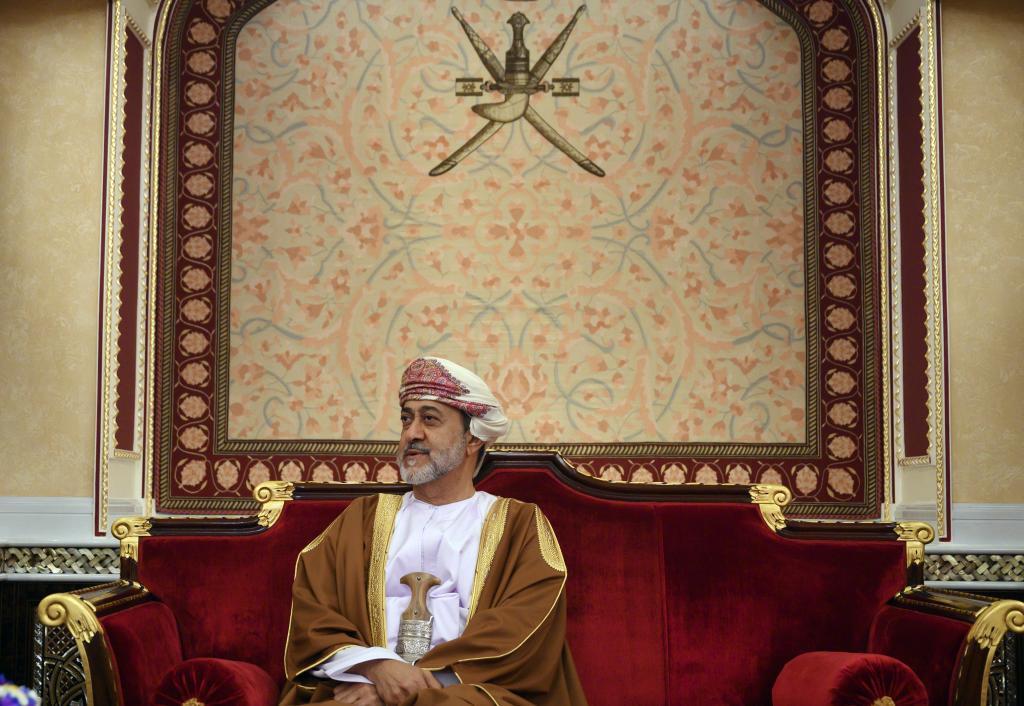
Behind Oman's current strategy is, naturally, its sovereign, Sultan Haithan Bin Tarik. He succeeded his cousin Qaboos on the throne after his death in January 2020. The 5.3 million Omanis considered him the father of the nation, as he reigned for almost half a century and oversaw the dramatic transformation of the poor, isolated nation with a subsistence economy that Oman was until the 1970s into a stable and thriving sultanate, although much less extravagant than its wealthy neighbors.
Haithan Bin Tarik has maintained the main lines of governance of his predecessor and has proven to be just as skilled a diplomat as he was, determined to ensure that his country maintains neutrality as its most identifying trait, with optimal relations with such antagonistic actors as the Houthi rebels in Yemen or Iran and the Gulf Petro-monarchies, not to mention Israel with which Muscat has had undisguised connections for decades, or beyond the Middle East with Washington and Moscow. Economically, it exports around 800,000 barrels of oil daily - representing almost half of its GDP. But it is far from being as wealthy a monarchy as others in the region. In fact, its proven oil reserves are not very large. Therefore, the sultan is promoting the so-called Vision 2040, the strategic plan that seeks to diversify income towards logistics, tourism, and agriculture, gradually reducing the weight of hydrocarbons. In this context, experts agree that the business that could open up with an agreement on fees in Hormuz as indicated would become a new windfall for Muscat.
Known as the Switzerland of the Middle East for its historical neutrality, Oman has been to date the least affected country in the entire region by the war and its aftermath, as it does not depend on the Strait of Hormuz to export its hydrocarbons, since its main distribution ports are located in the Gulf of Oman and the Arabian Sea, giving it direct access to the Indian Ocean. It has thus been able to navigate the severe difficulties that are severely damaging the accounts of its partners in the Gulf Cooperation Council.
In his frantic diplomatic efforts, Sultan Haithan traveled to Abu Dhabi on Monday to meet with the President of the United Arab Emirates, Sheikh Mohamed bin Zayed Al Nahyan. And just a few days earlier, he did the same in Doha, where he held high-level meetings with the Emir of Qatar, Tamim bin Hamad Al Thani. Behind what local media describe as "fraternal visits" is an intense desire to unite the wills of the Arab monarchs to end the Hormuz crisis. Because all of them are already convinced that Trump, the one who has gotten them into the current mess, is completely incapable of getting them out of it.
Haithan bin Tariq has maintained the core principles of his predecessor's governance and has proven himself, just as his predecessor was, a skilled diplomat, committed to ensuring his country maintains neutrality as its defining characteristic. He has cultivated excellent relations with such antagonistic actors as the Houthi rebels in Yemen, Iran, and the Gulf petro-monarchies, not to mention Israel, with which Muscat has had undisguised connections for decades, or beyond the Middle East, with Washington and Moscow. Economically, Muscat exports some 800,000 barrels of oil daily—representing almost half of its GDP. However, it is far from being as wealthy a monarchy as others in the region. In fact, its proven oil reserves are not very large. Therefore, the Sultan is promoting Vision 2040, a strategic plan that seeks to diversify revenue streams into logistics, tourism, and agriculture, gradually reducing the reliance on hydrocarbons. In this context, experts agree that the business opportunities that could arise from a tariff agreement in the Strait of Hormuz, such as the one mentioned, would become a new windfall for Muscat.
Known as the Switzerland of the Middle East for its historical neutrality, Muscat has so far been the least affected country in the entire region by the war and its consequences, since it does not depend on the Strait of Hormuz to export its hydrocarbons. Its main distribution ports are located in the Gulf of Oman and the Arabian Sea, which provide direct access to the Indian Ocean. It has thus been able to avoid the severe difficulties that are so seriously damaging the finances of its partners in the Gulf Cooperation Council.
In his frantic diplomatic efforts, Sultan Haithan traveled to Abu Dhabi on Monday for a meeting with the President of the United Arab Emirates, Sheikh Mohammed bin Zayed Al Nahyan. Just days earlier, he had done the same in Doha, where he held high-level meetings with the Emir of Qatar, Tamim bin Hamad Al Thani. Behind what local media describe as "fraternal visits" lies an intense desire to unite the Arab monarchs to end the Hormuz crisis. They are all now convinced that Trump, who has embroiled them in this current predicament, is completely incapable of extricating them from the impasse.
Haithan's political offensive in recent weeks has not been limited to the Middle East. On June 29, he made the first visit by a sultan of Oman to France in four decades. Although it was an economic trip, his meeting with Macron focused primarily on the Iranian crisis and the blockade of the Strait of Hormuz. The Élysée Palace conveyed concern about progress toward an agreement like the one Muscat and Tehran have been drafting, especially since its implementation would set a worrying precedent. The Sultanate, however, is striving to portray itself as having no other way out of this predicament.