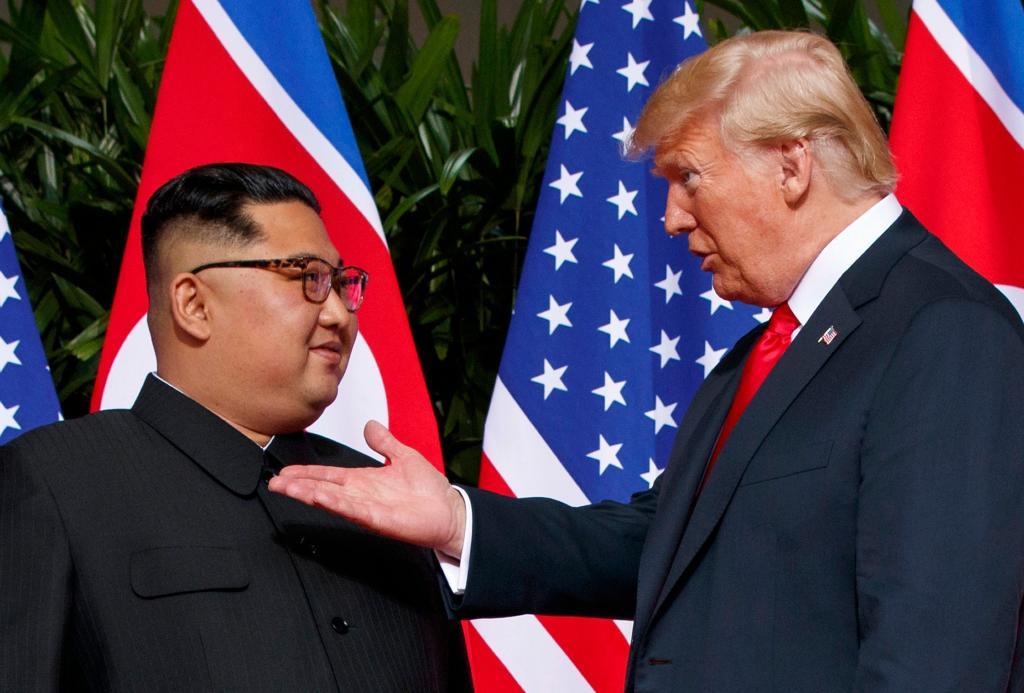
Donald Trump wants to sit down again with Kim Jong-un. Eight years after the handshake in Singapore that initiated an unprecedented face-to-face relationship between the leaders of Washington and Pyongyang, the U.S. President is reportedly pushing his advisors to organize a new meeting with the North Korean dictator this fall.
The scenario being considered aligns perfectly with Trump's diplomacy of grand gestures: taking advantage of a trip to Asia in November, where he is scheduled to attend the APEC summit in Shenzhen, to try to reestablish a personal relationship with the leader of North Korea.
As of now, as reported by the Wall Street Journal, there is no formal negotiation or confirmed summit, but U.S. officials claim that the President has privately raised the possibility of meeting Kim during the upcoming Asian tour.
Trump had attempted this less than a year ago. During his trip to South Korea for the APEC summit held in October 2025 in the city of Gyeongju, the White House explored the possibility of a quick meeting with Kim. The Republican even publicly offered to extend his stay to meet with his North Korean counterpart. Pyongyang remained silent, and Trump eventually admitted that they couldn't coordinate the timing.
Now he is trying again, this time accompanying his words with a much more tangible gesture towards North Korea. This Wednesday, Seoul announced that the military maneuvers being conducted with the United States these days will end on August 21, six days earlier than planned. Part of the on-site training will also be reduced, and the second phase, which included counterattack operations, has been eliminated. The maneuvers were expected to involve around 18,000 South Korean troops and 14 joint field exercises. The decision came after Trump ordered the Pentagon to "substantially" reduce its participation.
The message has an obvious recipient. Trump once again boasted on Sunday about his "good relationship" with Kim and linked the reduction of maneuvers to his attempt to resume dialogue. Pyongyang has been denouncing these exercises as rehearsals for an invasion for decades. During the thaw of 2018 and 2019, Kim had demanded that Washington suspend joint operations. Trump then agreed to limit some maneuvers, a concession that even surprised his allies in Seoul and Tokyo.
He is now repeating the move even before Kim has agreed to return to the negotiation table. This is where the concern in Seoul arises. President Lee Jae-myung's government publicly supports the resumption of dialogue and hopes that a potential conversation between Washington and Pyongyang will reduce tension on the peninsula. However, Trump's unilateral decision to cut military maneuvers has revived an old South Korean fear: that decisions directly affecting their security will be negotiated solely between Trump and Kim.
The concern is heightened because Kim would come to a potential negotiation much stronger than when he first met Trump. North Korea has expanded its nuclear arsenal, and its military ties with Moscow have reached an unprecedented level. Thousands of North Korean soldiers have fought alongside Russia, and Pyongyang has supplied weaponry for the war in Ukraine. At the same time, Kim has improved relations with Beijing: Xi Jinping visited Pyongyang in June and pledged to strengthen strategic cooperation.
Therefore, the starting point would be radically different from 2018. Back then, Trump still aimed to persuade Kim to give up his nuclear weapons. Today, Pyongyang considers its nuclear status irreversible. For Seoul, the worst-case scenario would be a limited agreement where Washington effectively accepts this reality in exchange for North Korea restricting weapons that directly threaten the U.S., especially its intercontinental ballistic missiles, while retaining short and medium-range projectiles capable of hitting South Korean territory. There is also the fear that Trump may use the presence of U.S. troops in the South as a bargaining chip.
Three Meetings, No Progress
Trump and Kim had three meetings during the first term of the Republican. The first, in Singapore in June 2018, was historic: never before had a sitting U.S. President met with a North Korean leader. They signed a declaration committing Pyongyang to work towards the "complete denuclearization of the Korean peninsula," and Washington offered security guarantees. However, the document did not establish a timeline, verification mechanisms, or a precise definition of what denuclearization meant.
The second meeting, in Hanoi in February 2019, ended abruptly and without an agreement. Kim sought a broad lifting of sanctions in exchange for dismantling one of his major nuclear complexes, while Washington demanded much broader nuclear concessions. Trump walked away from the table.
Four months later came the last photo op. Returning from the G-20 in Osaka, Trump extended an impromptu invitation to Kim on social media. The North Korean leader accepted. They shook hands across the demarcation line separating the two Koreas, and Trump took several steps into North Korea, becoming the first sitting U.S. President to set foot on North Korean soil. They then held nearly an hour of conversation and pledged to resume negotiations. However, that scene also did not lead to any nuclear agreement.