There was a time when Xu Jiayin traveled in a private jet, sat next to Chinese political elites, and led a conglomerate that built residential areas throughout the country, had his own football team, and spent millions on signing foreign stars. In 2017, his fortune was estimated at $43 billion, and the son of a humble peasant family from Henan became the richest man in China. His real estate empire, Evergrande, was then one of the great symbols of the country's rapid economic rise. Xu seemed to have reached a peak from which a fall was hard to imagine.
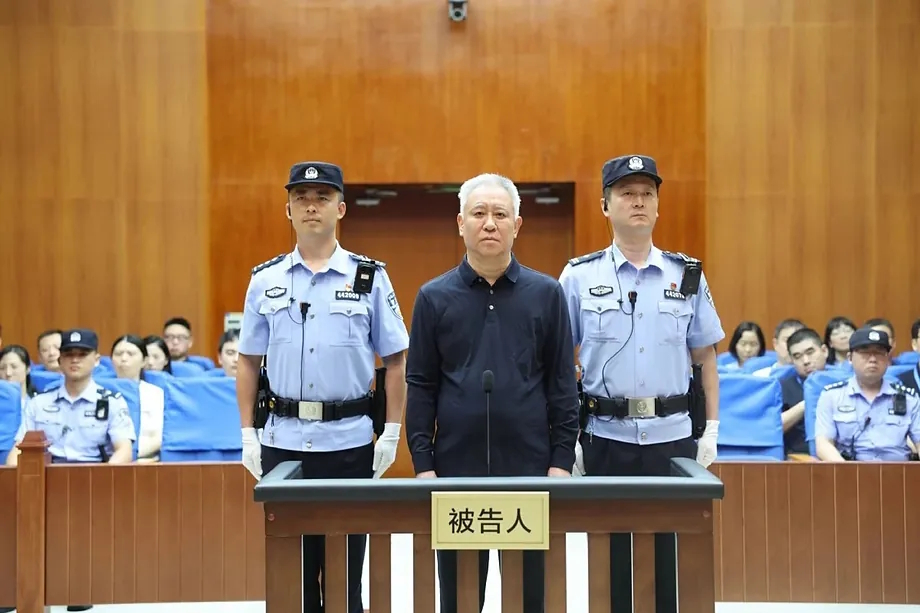
This Thursday, Xu, also known by his Cantonese name Hui Ka Yan, was sentenced to life imprisonment for a series of financial crimes, including fraud in fundraising, misappropriation of public deposits, and fraudulent issuance of securities. The court also ordered the confiscation of all his assets.
The sentence marks the judicial epilogue to a story that best summarizes the last four decades of China. Because Xu's biography is also that of a country that went from rural poverty to building more homes, highways, and skyscrapers than any other; that of a generation of entrepreneurs who amassed fortunes by taking advantage of that transformation; and that of an economic model that ended up accumulating mountains of debt until Beijing decided to put on the brakes.
Xu was born in 1958 in a village in Zhoukou, Henan province. His father, a veteran of the Second Sino-Japanese War, worked in a warehouse. His mother died when he was just one year old. During the final throes of the Cultural Revolution, he worked as a security officer in his village and sold coal and rice. He then studied Metallurgical Engineering in Wuhan and found employment at a state-owned steel factory.
Years later, he would recall that poverty to a group of students. He recounted how during university, he barely had a change of clothes, which he washed at night to wear again the next day, and when he had no money to eat, he would nibble on hard bread to trick his stomach. Then the reformist leader Deng Xiaoping appeared on television. His famous tour of southern China in 1992 accelerated economic reforms and convinced Xu that the future was no longer in a state-owned factory.
He left his job and headed to Shenzhen, the epicenter of the Chinese capitalist experiment. He ended up working in Guangzhou for a company dedicated to real estate business and in 1996 founded Evergrande. His first project had 323 apartments. They were sold in just 12 hours.
Xu had found the perfect business at the perfect time. Millions of Chinese were leaving the countryside to settle in rapidly growing cities. Local governments needed to sell land to finance themselves. Banks granted credit. Families bought apartments as their main form of savings. And developers discovered that they could sell homes even before building them and use that money to buy more land, launch new developments, and ask for even more loans.
Evergrande turned that wheel into a gigantic machine. In 2009, it went public in Hong Kong. It accumulated around 1,300 projects spread across more than 280 cities and had about 200,000 employees. Xu also did not want to limit himself to real estate. He bought a football team, Guangzhou Evergrande, which dominated the Chinese league for years; he invested in electric cars, theme parks, hospitals, nursing homes, bottled water, and dairy products. He even planned a monumental stadium for 100,000 spectators.
In record time, Xu had become one of the great symbols of the new Chinese capitalism, also cultivating his ties with political elites and becoming part of the Chinese People's Political Consultative Conference, one of the country's main advisory bodies.
But behind that expansion was a weakness that for years was hidden by growth: Evergrande needed increasingly large amounts of money to keep its machinery running.
The developer requested loans, issued bonds, raised funds, and sold apartments off-plan that did not yet exist. The money from new buyers was used to maintain previous projects while the group continued to buy land and launch promotions. As long as housing prices rose and credit flowed, the wheel could keep turning.
Until Beijing decided to stop it. Alarmed by the real estate bubble, Xi Jinping's government tightened financing conditions for developers from 2020 through the so-called "three red lines," limits aimed at reducing their debt. For Evergrande, it was like cutting off the oxygen supply. The company had gigantic obligations, but less and less access to the money needed to refinance them.
In 2021, the defaults began. Construction projects were halted. Suppliers demanded outstanding invoices. Investors demanded to recover their savings. And thousands of families who had invested a significant part of their assets to buy off-plan apartments began to wonder if they would ever receive the keys.
As the empire began to crumble, its liabilities exceeded $300 billion. Evergrande then became the international face of a much deeper real estate crisis. For decades, real estate had been one of the main drivers of the Chinese economy, around which construction companies, steel and cement manufacturers, banks, local governments, and millions of families who had invested their savings in a home revolved.
The business collapse also turned into a criminal investigation. The Shenzhen court now maintains that between 2016 and 2021, Xu and the companies under his control engaged in a "sustained and large-scale financial fraud," inflating assets and concealing liabilities. The sentence also states that Evergrande gained control of financial institutions and illegally diverted funds from credit and insurance to the conglomerate.
The judges also attribute to Xu the use of his position to organize financial frauds and appropriate corporate assets through dividend payments. The court considers that the amounts involved were exceptionally high and that the crimes caused significant economic losses and social harm.
The bill does not end with its founder. Evergrande has been fined 8.82 billion yuan, and its real estate subsidiary Hengda Real Estate with another 7 billion. In related proceedings, 56 other individuals linked to the conglomerate have received sentences ranging from 22 months to 18 years in prison.
Xu's fall takes on a dimension that goes far beyond the story of a billionaire. Evergrande, like few companies, represented the model that drove China's spectacular growth: accelerated urbanization, cheap credit, pre-sale of homes, local governments dependent on land, and families convinced that properties would never stop appreciating. That model was taken to the extreme.
The life imprisonment handed down in Shenzhen closes more than just the trajectory of a businessman. It also symbolizes the end of that golden age of an era when it seemed possible to build entire cities on debt and sell apartments before laying the first brick.