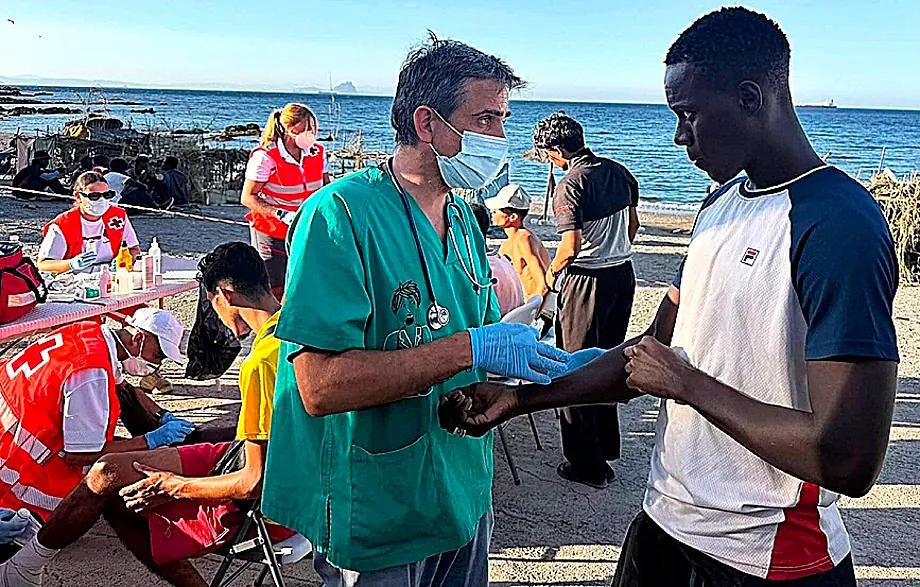
Although he admits that Ceuta is "close" to facing "a real public health problem" due to the impact of the 10,000 migrants who have been camping without food or hygiene for three weeks, cardiologist Fran García Lanzas acknowledges that this crisis is "far from being the toughest" he has seen in his "22 or 23 years" of medical cooperation, traveling around the world, "16 times to Africa," he explains, and adds: "Four months ago I arrived from Guinea Bissau and now I am going to Liberia."
For example, García Lanzas, a 44-year-old from Jaén, recalls arriving in Haiti "on the third day of the earthquake [in 2010], with a horrific scene: in the first 30 seconds of the earthquake, 200,000 people had died, and in the following months another 100,000." That, compared to what is happening these days in Ceuta, "is something very different," he says.
"But the reality is that in those places, I have not experienced even half of the psychological burden that I am feeling these days, this is affecting me psychologically much more. Even if you go to the other side of the world and empathize with people, the problem is that here it is your home that is at risk, it is your people who feel harassed. From your home, you hear people suffering, you hear fights, people dying nearby, in the sea... And here, in Ceuta, everyone is suffering: children, the elderly, the unemployed, mothers, fathers... The wear and tear is enormous and it is difficult to explain. People sleeping everywhere in the city... Ceuta is defeated, with very low spirits. Emotionally, this destroys you."
And also, probably, being one of the two only volunteer doctors who have attended to the migrants every day of these three weeks, in addition to the small Red Cross contingent: "I have gone every day to [the beach of] Trampolín, I have taken the motorcycle and gone to Tarajal, to Príncipe... Wherever you went, people came out asking for help. If no one went, as in many places where no one has gone due to lack of resources, then no one receives help." Remember that the forests and hills around Ceuta are full of migrants hiding like maquis from the Civil War. "Some colleagues have helped a few days here and there, and many have doubled shifts at the hospital and health centers, the effort has been very significant."
What have been the most common diagnoses? "The expected ones. At first, cuts and bruises. After four days, respiratory infections started, gastrointestinal infections, skin conditions, dermatoses. And then, as time passed and they became decompensated, chronic pathologies appeared: epilepsy, diabetes, hypertension, psychiatric disorders. We could hardly handle the acute cases, imagine with the chronic ones, but it has been very important to send three to five severe infection cases to the hospital every day. Thanks to that, the system has not collapsed."
Every day, in Trampolín, García Lanzas, the other volunteer doctor, and those from the Red Cross have attended to "between 400 and 500 patients," he explains. Apart from cases of scabies, García Lanzas says he has not seen "any exotic viruses or anything different from what was expected. The most common issues have been, logically, gastrointestinal infections, for obvious reasons: the lack of clean water and the overcrowding in the warehouses of Tarajal and Trampolín, where there were 3,000-4,000 fixed people and the same floating amount."
Red Cross has experienced losses of members for helping migrants in this crisis: "Politics are poisoned," he begins, "their work is essential, not only for providing food and medical assistance but also for the emotional support of all these people, to which Red Cross has contributed a lot. All of this has not gone to waste mainly thanks to them," he says. "Doctors Without Borders is now doing a very good job, but they arrived three days ago," he adds.
How does someone with so much experience in cooperation see the public reactions to the crisis? "Look, human beings, all of us, have empathy and solidarity, but also a threshold. And if you see your integrity threatened, one protects oneself, surpasses that threshold, and hatred emerges. We have all felt it these days, all of us, and it is normal. It's not that we have lost the possibility of going to the beach to have a beer, and that we have lost our summer. Even the most empathetic have been overwhelmed by this: this is as far as we go. It's human."
This Friday will be the first day that García Lanzas rests since the jump on July 30: "I can't take it anymore", he admits. He carries in his memory, as he has experienced many times in Africa -"where I lived for five years," he explains- the "goodness" of sub-Saharan Africans: "That's why I keep going there, they have other values. They are generous, they take care of family, of the elderly... And they know how to live. There is a reason why it is said that we have the clock, but they have the time."