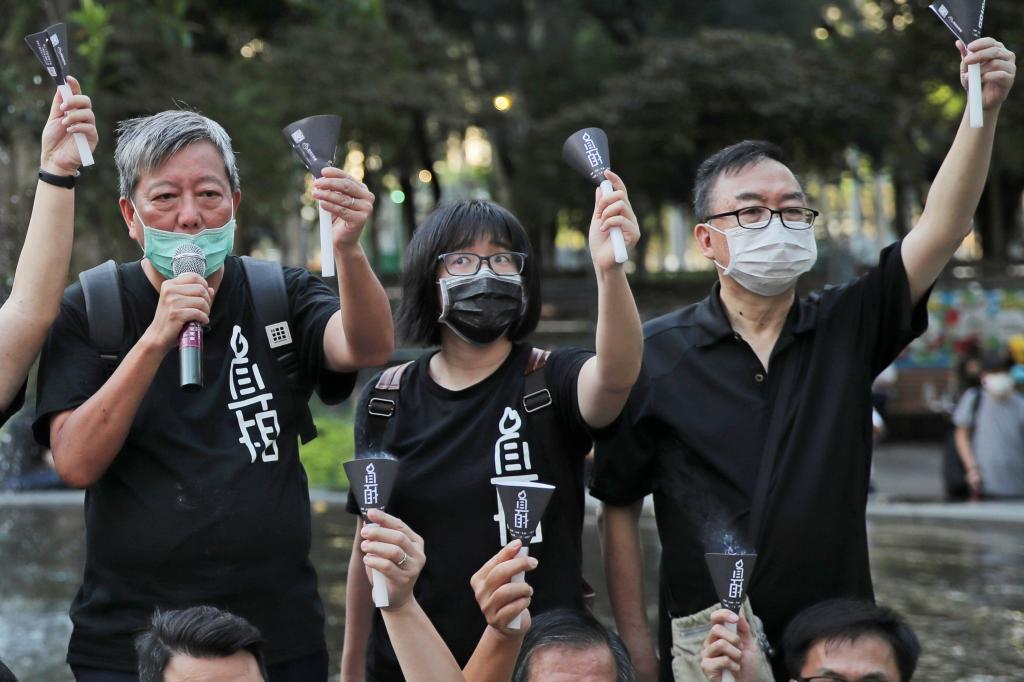
For three decades, every June 4, tens of thousands of small flames illuminated Victoria Park in Hong Kong. While in the rest of China any public reference to the Tiananmen massacre was censored, in the former British colony, the victims' names were read, songs were sung, and Beijing was urged to take responsibility for the 1989 repression. That vigil disappeared years ago. Now those who kept it alive have also been convicted.
The High Court of Hong Kong declared the now dissolved Hong Kong Alliance in Support of Patriotic Democratic Movements of China and two of its former leaders, Lee Cheuk-yan and Chow Hang-tung, guilty of inciting subversion on Friday.
The core of the accusation was not in any violent act but in one of the political goals the group advocated for decades: ending the "one-party dictatorship" in China and moving towards a democratic system. For the prosecutors, this demand posed a direct challenge to the Communist Party leadership. For the accused, it was simply a defense of fundamental political rights.
Lee, a veteran unionist and former lawmaker, and Chow, a lawyer and one of the most visible figures of the new generation of the pro-democracy movement, have been in prison for almost five years. A third historical leader of the organization, Albert Ho Chun-yan, has been detained for over four years and awaits sentencing after pleading guilty in January. The three face sentences of up to 10 years in prison.
The trial has ended up becoming much broader than a process against three activists. On trial was, in reality, a part of Hong Kong's political history. The Alliance was born immediately after the bloody Chinese Army intervention against the 1989 student protests. Since then, it made the memory of Tiananmen its main raison d'être: organizing vigils in Victoria Park, publishing magazines, managing a museum dedicated to June 4, and promoting events like the symbolic cleaning of the Pillar of Shame, the sculpture that for years reminded of the massacre on the University of Hong Kong campus.
For the prosecution, all those activities served to "promote and disseminate" an illegal position aimed at fueling rejection towards Beijing and overthrowing the central government under the pretext of defending democracy. The three judges had to decide, above all, whether demanding the end of the one-party system violated the Chinese Constitution, whose first article enshrines the Communist Party's leadership as a fundamental characteristic of the socialist system.
Lee tried to dismantle that interpretation during the trial. He explained that he was not seeking to eliminate the CCP, but to end a system where no citizen can choose an alternative government. The goal, he said, was for the Chinese people to decide who should govern them and for the party not to impose a "dictatorship."
Chow, who conducted her own defense, argued that calling for the end of the one-party regime does not equate to trying to forcibly remove the Communist Party from its leadership position. "Ending the one-party government," she argued, means ending a state where power has no limits.
The verdict comes when there is barely a trace left of the Hong Kong that for decades functioned as a political anomaly within China. Under the "one country, two systems" formula, the city retained freedoms nonexistent on the mainland after its return by the UK in 1997: fiercely critical newspapers of Beijing, opposition parties, independent unions, massive protests, and civil organizations capable of openly questioning the Communist Party.
This ecosystem began to crumble after the massive anti-government protests of 2019. Beijing responded in June 2020 by imposing the National Security Law, which punishes offenses such as secession, subversion, terrorism, or collusion with foreign forces. Authorities argue that the law restored stability to a city shaken by months of unrest. Critics argue that it provided the legal instrument to dismantle virtually all organized opposition.
Since then, dozens of pro-democracy leaders have been imprisoned or have gone into exile. Dozens of civil organizations have dissolved, and critical media outlets have closed. The Alliance eventually disappeared in September 2021 after the police demanded information about its members and activities, alleging suspicions that it was acting as a "foreign agent." Its most emblematic event had also disappeared. The last major Tiananmen vigil was held in 2019. The ones in 2020 and 2021 were officially banned due to pandemic restrictions. They never returned.
Amnesty International considers the conviction another turning point in this process. "This disheartening verdict underscores how the Hong Kong National Security Law is being used to punish people for peacefully remembering one of the darkest chapters in recent Chinese history," denounced Fernando Cheung, a spokesperson for the organization. The group argues that the decision represents "another grim milestone" in a deliberate campaign to erase the Tiananmen legacy and silence demands for truth and accountability.
Sarah Brooks, Amnesty's regional deputy director, was even more emphatic: she asserts that Lee and Chow "have not committed any recognizable crime" and considers them prisoners of conscience who must be released immediately. The NGO has been denouncing for years that the security legislation is being used against journalists, academics, activists, and civil organizations for activities protected by international law.
Thirty-seven years after tanks rolled into the center of Beijing and forcibly ended the Tiananmen protests, that night remains one of China's biggest political taboos. For a long time, Hong Kong was the exception: a corner of the country where it was still possible to light a candle and publicly question the Communist Party's political monopoly.