The square surrounding the Monument to the Unknown Sailor of Odesa is a platform that gathers couples, families, and tourists like Igor and Victoria at sunset. A bucolic space, entertained by a street musician playing the accordion, with magnificent views of the bay. But also of the war. It's 5:50 PM, and the dozen people gathered are surprised by the sound of anti-aircraft gunfire, the flyover of a plane, and the roar left by the Russian missile advancing from the right.
A few minutes earlier, another similar projectile had exploded in the sky when intercepted by a Ukrainian aircraft. This time, luck was not on their side. The rocket manages to surpass the bursts and ends up exploding a few hundred meters away.
"We just came back from vacation in Kiev, and look what we find!", Igor exclaims amid laughter. His partner shares the same dark sense of humor. "Scared? We came from Kiev! There we have fireworks! This is nothing!" she asserts.
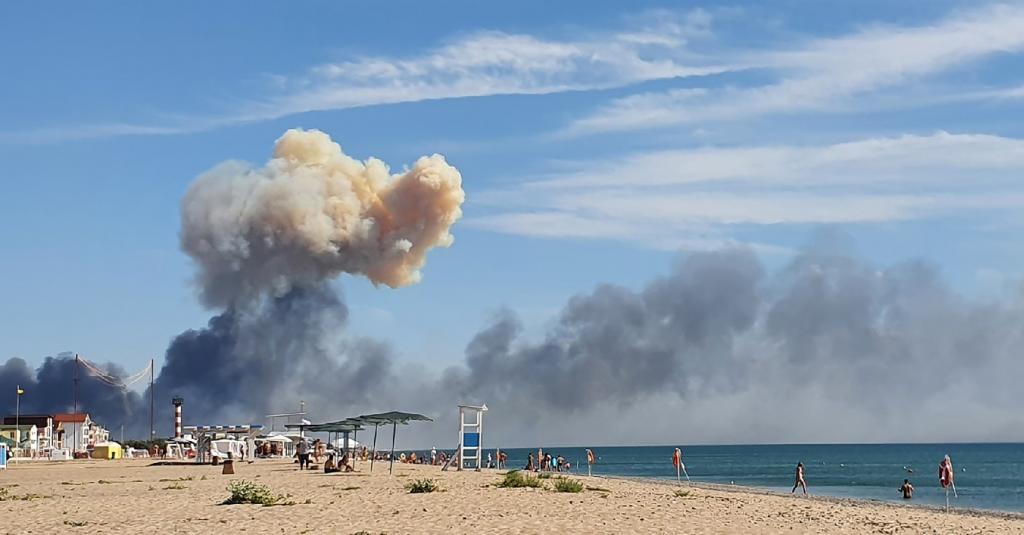
The scene from this past Monday fits the dual rhythm under which the Ukrainian metropolis and the entire coastal region surrounding it live, enduring a constant aerial onslaught of Russian drones (UAVs) and missiles while thousands of residents continue clinging to the beaches and summer parties.
Anastasia Svimid doesn't even put down her champagne glass when the explosions start to resonate not far from the terrace where she is sitting. The manager of Hotel 13, one of the most exquisite nightclubs in the area, only flinches slightly upon hearing the first detonation, just before 5:00 PM.
"In the club, we have a kind of anti-air shelter, but no one uses it. In any case, the explosions can't be heard over the music," she states with an ironic smile.
The interview with the entertainment venue manager also unfolds under the unique spirit that seems to guide this locality. Beachgoers continue heading towards the nearby Arcadia area - a popular destination filled with beaches and nightclubs - but the Ukrainians sharing a restaurant with Anastasia keep checking Telegram incessantly to stay informed about the "aerial battle" - as described on that social network - unfolding at that moment in the sky, just a few hundred meters away.
"I need to know where the drones are heading because I'm a mother of two", argues Anastasia herself, almost simultaneously ordering a second glass.
One of the videos that has just been released shows how one of them falls from the heights, engulfed in flames, just a few meters from the beach. Another video shows a house on fire in the nearby town of Chornomomorsk. Online channels report about a score of unmanned aerial vehicles and numerous missiles. The nearby explosions are recurring at intervals.
"To the shelter!" reads in capital letters in the messages. Neither Anastasia nor her table neighbors seem to heed the call. "People have normalized the horror", she admits with some resignation. "They keep going to the nightclubs amidst all this because they want to breathe and relax. Maybe when this is over, I'll end up being the manager of a madhouse, but right now, this is our life," she adds.
Moscow's aerial offensive intensified in July and, starting on the 22nd of that month, effectively blocked all ports in this southern region.
"Since July 1, the adversary has been massively using jet drones and ballistic missiles. Only between July 1 and August 11, 88 attacks were recorded against port facilities, 48 against civilian ships in the ports, and 39 against ships in the maritime corridor (navigating the Black Sea). That is, almost half of all attacks recorded in 2026 are concentrated in July and August," stated the Administration of Ukrainian Maritime Ports, based in Odesa, in response to questions from this newspaper.
The docks in the Odesa region handle 90% of national exports, especially the majority of grain and iron shipments. Economists have warned about the monumental blow that the suspension of this activity would represent for the already struggling local economy.
Two experts in the field, Mykola Ryzhenkov and Oleksandr Shepotilo, from European universities, have conducted a study on this crisis warning that Ukraine could lose up to 6% of its GDP.
The National Bank of Ukraine estimated on the 7th of this month that this loss would reach $2 billion, a significantly lower figure compared to the opinions of other analysts. The newspaper ZN, for example, calculated days ago that the decline could range between $4,000 and $8,000 million.
Local media already speak of a "second battle of the Black Sea" recalling that Moscow already managed to interrupt local exports in the first year of the general invasion when it repeatedly targeted facilities in Odesa, Chornomorsk, or Pivdennyi, the main port enclaves on this coast under Kiev's control.
"The situation is much worse than in 2022 because then the crisis occurred at the end of the harvest when many farmers had already sold their products. Now we are at the beginning. There is also a difference from those years. The alternative of the Romanian port of Constanza or the Danube River ports (which channeled part of the exports in 2023) is not an option due to the drop in river flow. Resorting to alternative routes (trains or trucks) we could only send 30% of what we usually export. We are facing a very serious problem," acknowledges Dmytro Kazanin, owner of Teus, one of the stevedoring companies that used to operate in the Odesa area.
According to the Ukrainian Ministry of Agriculture's own figures, agricultural product exports have been cut by 54% this year, and wheat exports - on which the supply of countries like Egypt depends - by 53%.
The recurrent attacks have also led to the shutdown of several iron derivative production factories, and the president of the main local steel firms association, Oleksandr Kalenkov, admitted that this sector has no viable option to replace trade through Odesa.
"Access to the sea is the most important factor for the survival of our industry", he stated to a local media outlet.
But unlike 2022 and 2023, Russian actions have found a Ukrainian response, which has also intensified its operations against the ports controlled by Moscow in the Black Sea. Under the principle of "an eye for an eye," UAVs have targeted strategic facilities in the Black Sea such as Novorossiysk, Taman, or Kavkaz. In early August, the Unmanned Systems Forces of the Ukrainian army stated that they had attacked over 200 Russian fleet vessels in this maritime space since early July.
On the 12th of this month, hundreds of Ukrainian drones and rockets suddenly bombarded the facilities of Novorossysk, one of the largest Russian ports in the region, the headquarters of its Black Sea Fleet, and at the same time a key platform in its grain shipments. Many of the targets were warehouses holding millions of tons of agricultural products, which burned for hours.
Writing in the local newspaper Pravda Ukraine, MP Yulia Sirko warned of the possibility that this confrontation could trigger a global food crisis. She noted that in the last two and a half years, more than 8,000 ships had passed through the ports of Odesa, "carrying nearly 200 million tons of goods to 50 countries around the world." Since July 22, that trade has been reduced to "zero," she added.
Sirko further stated that this de facto blockade—which she likened to the one affecting the Strait of Hormuz—threatens to "create another food crisis in Africa and Asia, where 400 million people depend on Ukrainian grain and soybean oil," and that it will also affect Europe, where, in her opinion, "prices and the cost of living will rise."
Waves of Russian aircraft and rockets were a constant presence during this newspaper's three-day visit to Odesa. On Sunday, a UAV struck a huge shopping mall on the outskirts of the city, creating a fireball and injuring more than half a dozen people.
One of the facility's managers, Viktor, was recovering near the complex, breathing oxygen supplied by rescue workers.
"I inhaled a lot of smoke. I was inside, but on the opposite side from the explosion. Everything shook. I went outside and saw the fire. We started putting it out and evacuating people," he said.
On Monday, the city faced several intermittent attacks by Russian warheads. From the city center—crowded with pedestrians—the explosions could be heard shaking the sky as night fell.
Military observers note that Moscow is resorting to the latest additions to its arsenal to try to decide the outcome of this conflict.
According to Vladyslav Vlasiuk, a high-ranking official in the Ukrainian administration, who spoke to Bloomberg on July 31, 80% of Russian attacks against ports in the Odesa region are now carried out with the new Banderol missiles, a low-cost rocket that, along with the also new Geran-5 drones—jet-powered aircraft capable of reaching speeds of 500 kilometers per hour—overwhelm the interception capabilities of local defenses.
"The Russians know this and are taking advantage of this opportunity to put pressure on the civilian population," says Yuri, an officer with the 160th Air Defense Missile Brigade involved in combating UAVs.
The officer is pictured next to a Ukrainian-made Spitfire drone. The same ones they use to shoot down most of the Russian Shahed or Geran drones that lack turbojet engines. "This aircraft can't catch them. We're working to increase its speed," he admits.
The war from the coast
Beachgoers in the area have become unwitting witnesses to the confrontation. The beaches of this area of Arcadia are the main entry point for Russian drones. On June 23, a 26-year-old woman died in one of these recreational spots after being struck in the neck by shrapnel. She bled to death under the umbrellas.
One of the dozens of civilian victims of this latest episode of warfare. The Odesa port authority specified that 31 people died in July alone. An unprecedented level of human losses during the entire period of large-scale warfare [since 2022]."
Despite the continued Russian incursions, thousands of people still converge daily on Arcadia or on Chornomorsk beach itself. Just a few kilometers from the coast, one can see charred buildings, enormous craters caused by Russian projectiles, and dystopian structures like the one protecting a group of fuel depots with massive metal fences.
Destinations like Ibiza, Ithaca, and Hawaii remain packed with young people dancing like mad every weekend. There are go-go girls dancing in some bars, groups of girls recreating K-pop scenes to post on social media, and those who end up losing control and have to be told to stop dancing on a rooftop.
Vikingo, a 37-year-old former soldier who runs Solo Playa—another venue with spacious sunbeds in the area—admits that for many months after returning from the front, he couldn't process the contrast between what he had seen and the euphoria of a crowd that seemed straight out of Ibiza, Spain.
"I spent six months popping antidepressants. Now I don't care anymore," he says.
It's 7:00 PM on Sunday the 16th. Barely two hours have passed since the last airstrike, and dozens of women dressed in tight leggings and shorts are crowding around DJ Takarta.
"It's a sunset race and rave party. It's the fifth time we've done it," explains the woman, who is also keen to show off her excellent physical condition.
The idea is to run behind a mobile stage that Takarta uses to blast repetitive music that deafens the surrounding area. The group—about 150 people—trots and dances intermittently along the coastal edge of the aforementioned Arcadia area. There's a young woman dressed as a butterfly on roller skates and another in a devil costume, complete with horns. They all seem oblivious to the passing jeeps equipped with anti-aircraft anti-drone machine guns that patrol the area.
"People ask me, 'How can you dance in a war zone?' I tell them, 'We don't know if we'll be alive tomorrow, so we have to make the most of it,'" she says before she starts jumping and shouting.