The blood is still dripping. It has created a long trail after overflowing the bus's entrance steps. The marks of the viscous liquid have left their trace along the vehicle's aisle, filled with tiny pieces of glass from the windows, almost all shattered by the blast.
The bags carried by the victims, also stained in red, remain stacked next to one of the seats.
"One of the deceased was a 90-year-old grandmother. She had been picked up at a stop where she arrived shouting: 'Stop, stop, wait for me, I'm old and can't run!'. She would have saved her life if she hadn't waited."
Oleg Kuznienko has barely recovered from the shock. Less than two hours have passed since the minibus he was driving was attacked by a Russian drone. The unmanned aerial vehicle (UAV) dropped an explosive on the public transport covering line 47 of Jersón. Connecting the neighborhoods of Tavriiskyi and Korabel.
The action caused a massacre. The corpses of four passengers lay on the ground. Dead on the spot. The other four were riddled with shrapnel.
"I looked back and saw several bodies lying there. One of the women had half her torso sticking out of the window," recalls the driver.
The 58-year-old Ukrainian has not been able to erase that scene from his memory. He recounts the event in great detail. "I heard the drone flying and saw how the soldiers were shooting [to bring it down]. I tried to accelerate to enter the network tunnel [the mesh that protects many of the streets in this town], but I didn't make it in time," he asserts.
The device left a huge hole in the roof and filled everything with smoke. Oleg was the only one who escaped without major injuries, although a piece of metal embedded next to his leg. "The wounded started screaming asking me to open the doors. I told them no. I drove straight to the hospital. I was with the dead and the living, and the bus was dripping blood on the sides," he says.
Vira Prihodko, 74 years old, had her face, lung, and intestines torn by metal fragments. "When I heard the explosion, I thought: 'Vira, don't die, your husband [her husband is disabled] needs you!'", recalls the woman from the hospital bed.
But Oleg Kuznienko's impromptu decision saved her life. "She would have bled to death. All of them are seriously injured, and two of them are in intensive care," explained shortly after Dr. Inna Zaharchenko, head of the emergency department at the Regional Hospital of Jersón.
It is not even noon, and the health facility has already received five dead and eight injured. "Another drone has attacked a taxi, killing the passenger. The driver is seriously injured, with his jaw shattered by shrapnel," points out the specialist.
The fatalities from last Wednesday are part of the "brutal escalation" - expression of a local resident - that this southern town of Ukraine has been experiencing since the beginning of the summer, as confirmed by authorities and all those consulted during the three days that this newspaper visited the town.
Since 2024, Jersón has been the target of the so-called "human safaris" that were denounced as war crimes by a United Nations investigative commission at the end of 2025. However, Moscow's UAV actions have turned into a "tsunami," in the words of one of the military personnel stationed to defend this enclave. Only on the 19th, the region was attacked by around 1,000 drones, when before they used to be just over 400.
"It's true, we used to receive about 2,500 drones a week. The current average is 5,500. If last year we counted about 95,000, in these six months we have already exceeded 100,000," specifies the regional governor of Jersón, Oleksandr Prokudin.
The same interview with the high-ranking official reflects the precarious reality that the town is experiencing, where about 60,000 people still reside. At the end, both the official and the journalists have to wait hidden until a group of uniformed personnel shoots down one of the Russian UAVs. The signal to return to the car in a hurry is the explosion heard in the vicinity. The drone has been shot down.
In reality, journeys through the metropolis are a constant shock. Sprints are common as soon as the dreaded buzzing in the heights is heard, residents can be seen hiding under trees, looking up - trying to guess the course of the device - or being surprised by the bursts of patrols trying to shoot them down, which is a common sight in the town. It is also not uncommon to come across burnt-out vehicles.
The charred remains of a huge food supply truck, destroyed days ago, remain tucked away next to the supermarket where it was unloading. There are several more car wrecks in the town center. "We no longer collect burnt cars from some neighborhoods. It's too dangerous," admits a local official.
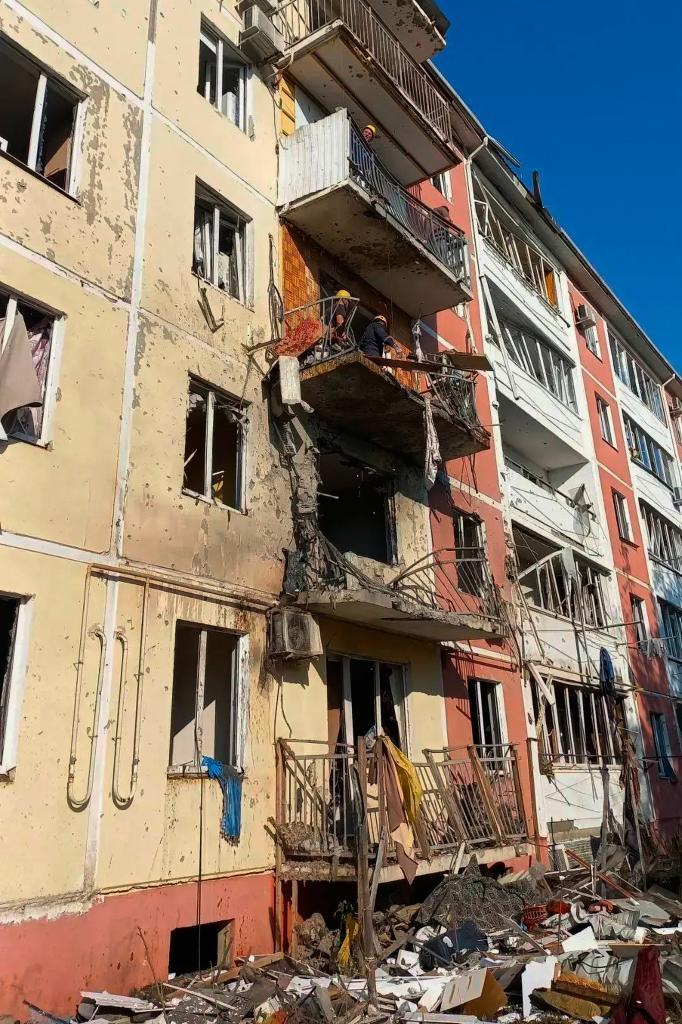
On Wednesday, two drones passed just meters from the windows of the house where this newspaper's team was staying before exploding nearby. "They have started attacking private homes with drones. They cause huge fires where dozens of houses burn," indicates Oleksander Gonchar, a local activist.
Hours earlier, customers at Café 11/11 were surprised by another huge explosion in the sky. The business owner, Oleksii Haiduk, rushed into the establishment showing the video he had just recorded. The footage showed the close flight of a Russian drone, disintegrating into a large fireball when hit by one of the Ukrainian interceptors.
Café 11/11 has had to face up to a dozen similar incidents in recent months. "They have forced us to change milk and ice cream suppliers because the ones we had decided not to come to Jersón anymore," he points out.
Oleksii keeps another recording showing the umbrellas on the terrace burning or the one where the UAV clearly crashes into a car parked next to his. "I've sold it because now it's too risky to drive in Jersón. It's better to walk," he says.
His perception is shared by the few pedestrians seen in the town center. Here, almost all businesses are closed, and Ukrainians always move seeking the shelter of trees. Everyone walks hurriedly and silently. The crisis seems to have multiplied the presence of solitary drivers, who prefer electric scooters, less ubiquitous than cars or minibuses.
For the first time since the liberation of the enclave in November 2022, the repeated harassments - which also include the use of the feared KAB bombs, hundreds of kilograms of explosives - have caused power outages, water shortages, and internet cuts. The noise of generators is another sound that many in the suburbs have had to get used to.
Russian airstrikes against buses, taxis, ambulances, NGO vehicles, and government vehicles have become commonplace. "Since the beginning of the year, the Russians have attacked more than 100 buses and trams. They have wounded six drivers," says Vadim Melnyk, 43, director of public transport in Kherson. "They also attack scooters, but it's true that for weeks now they've been obsessed with buses. They're hunting them down," says Dr. Inna Zaharchenko.
According to Oleksandr Prokudin, since the beginning of the year, the Russians have killed 13 bus passengers and wounded another 146. "They have received orders to attack all forms of public transport," he adds.
Vitaly Boreykos, 51, a driver on bus line 47, was wounded on April 3. The explosion tore his leg and hip. He has undergone seven surgeries "and I have many more to go."
"I remember looking in the rearview mirror and seeing a group of birds, but one wasn't moving. I thought, 'That's strange.' I shouted, 'Watch out, there's a bird that might be a drone.' I tried to park the bus, but it exploded next to my door," he recounts.
Reflecting the absurd situation Jersón is experiencing, public transport drivers travel encased in bulletproof vests and helmets, and carry drone detectors. It's also not uncommon to see the last of these vehicles without windows, shattered by the explosions. Some have replaced them with wooden boards.
"We are bus drivers. Our salary is 15,000 hryvnia [about 300 euros]. Why are they attacking us? They are terrorists," Vitaly adds.
The Russian aggressions have created a distressing dilemma for Ihor Chornyi and the members of the NGO Strong because we are free, who organize a taxi service for the most disadvantaged residents of the metropolis or disabled people.
The group of volunteers makes between 15 and 20 trips a day, taking people to the hospital, the doctor, or the bank. "The UN requires us to display the NGO logos for identification. But the Russians are looking for precisely that: marked cars. They've already wounded six members of our group, damaged six cars, and completely destroyed two others," says the 37-year-old Ukrainian.
For Mykola Stavitsky, an officer with the 34th Marine Brigade, the alarming increase in Russian attacks against civilian targets is due to the significant shift that, he says, has occurred on the Dnipro River front: Ukrainian forces, and especially his unit, have managed to decimate the positions held by the Russians on the islands in the river.
"We've destroyed up to a hundred artillery pieces since March and 90% of the soldiers they had on the islands. We've stopped a possible assault on Kherson. Now they're the ones mining the riverbank to prevent our landings," he says.
"Their only response is to increase the killing of civilians," he adds.
The drone pilots commanded by Stavitsky have transferred the same precarious situation seen in Kherson to the other side of the river, following the pattern in which Moscow is forced to endure attacks just like Kyiv.
Anton, a Marine drone pilot and native of Olevshki—a city still occupied by Moscow's forces on the left bank—faced the dilemma of having to attack enemy positions in the very building where he lived.
"It was a bittersweet feeling. It was my house, burned down, but I also knew that several Russian soldiers had died," he told a photographer from this newspaper.
"The Russian soldiers dress in civilian clothes and live among the civilians. They are the ones putting civilians at risk," his superior, Mykola Sbougbskyi, seconded him.
During the reporter's visit to the UAV operators' position, the trio led by Anton destroyed yet another piece of artillery with one of their aircraft, as could be seen on his computer screen.
The Russian occupation authorities in Kherson have denounced the Ukrainian assaults on Olevshki and declared that the population is in a "critical" situation.
This latter assessment is perhaps one of the few points on which both sides agree. For Tetiana Hasanenko, the Ukrainian head of the military administration in Olevshki, the town is "catastrophic. It's a hell on earth."
As she explained by telephone, the town has not received any supplies since May 26. "On June 2nd, another convoy tried to enter, but three drivers were killed. I don't know who attacked it. People are eating fruit from the trees or what they've grown on their plots of land," she says.
The Ukrainian official estimates that of the 40,000 inhabitants the town and surrounding villages once had, only about 6,000 remain. "Russian soldiers are stealing what little food the civilians have because they are trapped too. No one can enter or leave the town. All the roads are mined," she declares.
On June 25th, the UN Human Rights Monitoring Mission in Ukraine confirmed the critical situation facing both Olevshki and Goliya Prystan, another town occupied by Russian forces in the vicinity.
The organization's report states that at least 29 civilians have been killed and another 54 wounded in these two towns, mostly by drones.
"These attacks took place in territory under the control of the Russian Armed Forces, under attack by Ukrainian drones. But, as in other cases, we have not been able to determine responsibility for the individual attacks," the text read.
Oleksandr Prokudin asserts that the Kyiv authorities have offered "dozens of times" to evacuate the Ukrainians trapped in Olevshki. "The Russians have always refused. They are using them as human shields. Moscow has opted for total war."