It is well known that things are not going as desired for Vladimir Putin in the war he launched with the full-scale invasion of Ukraine in February 2022. But if the Kremlin has to resort to miracles, perhaps things are even worse than assumed.
In a climate of social despondency, with 60% of citizens experiencing high levels of anxiety and depression due to the consequences of the conflict, as indicated by surveys, with growing distrust towards the government and harsh economic conditions affecting wallets, Putin has once again showcased Russian glory by paying tribute to Grand Prince Dmitri Donskoi, who ascended to the throne of the Principality of Moscow in 1359, as his remains have just been found in such an extraordinary state that political and religious authorities of the country have deemed it a supernatural event.
A genuine miracle, whether true or not. And, of course, politicians and high-ranking officials linked to the Kremlin have taken the opportunity to emphasize the symbolic significance of the discovery coinciding with such a decisive moment in what they call the military campaign in Ukraine. They argue, as if living in an atmosphere reminiscent of Divinas Palabras by Valle-Inclán, that the uncorrupted body of Prince Dmitri will boost the morale of the troops. The thousands of unfortunate souls sent to the frontlines as cannon fodder may have a different opinion, but naturally theirs is not reflected in any Russian media.
The bones and flesh still attached to Dmitri Ivanovich Donskoi had been safely kept since his death almost seven centuries ago in a sarcophagus, alongside those of other nearly contemporary princes, Ivan Krasny and Dmitri Zilka of Uglich. The three were located in the Cathedral of the Archangel Michael, built in the early 16th century, one of the temples within the Moscow Kremlin complex. However, it was during emergency restoration work on the Cathedral due to the collapse of some floor tiles threatening to crumble, that the workers discovered the sarcophagi. The Orthodox priests were so amazed upon opening Donskoi's sarcophagus that they immediately urged Putin to come and witness the miracle of the non-decomposed corpse with his own eyes.
While the presence of the remains was documented, the relics had never been exhumed. "The combination of historical data, the archaeological context of the burial site, and the results of an anthropological study have confirmed the authenticity of the remains," stated a source from the Russian Orthodox Church to the TASS news agency.
It is worth noting that Dmitri Donskoi was canonized by the Russian Orthodox Church in 1988 for his services to the nation and the pious life he apparently led. His contemporaries highlighted his piety, Christian generosity, mercy towards the needy, and noble moral qualities. Therefore, finding his uncorrupted body now further enhances his aura of sanctity.
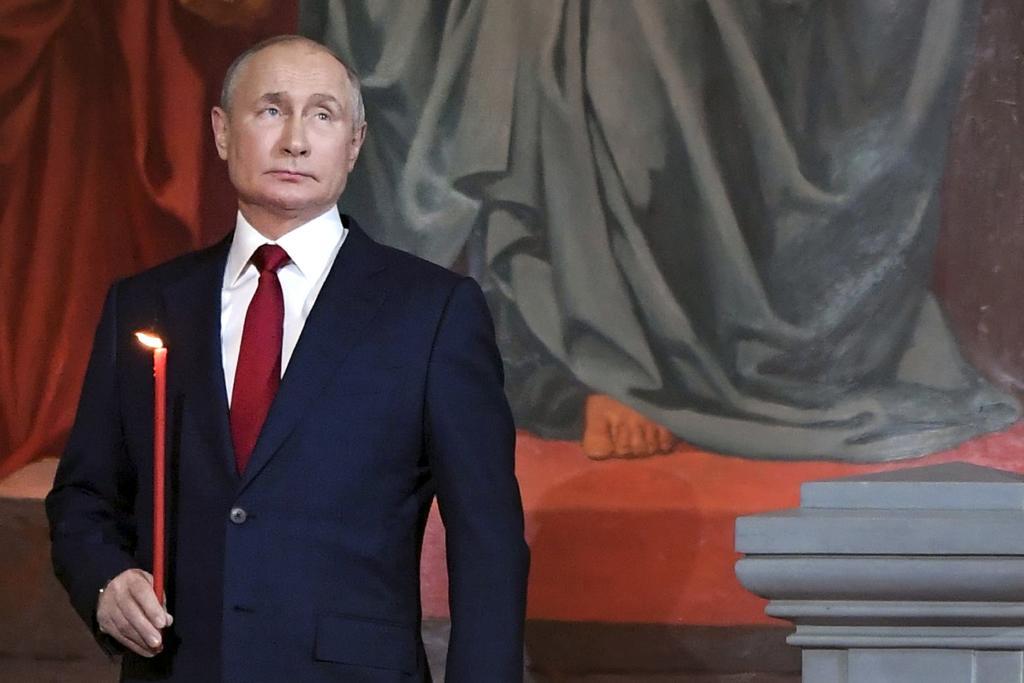
"It is a unique and miraculous discovery. This reinforces the foundations of our history," emphasized Putin himself after marveling at the bones, before they were returned to the sarcophagus. The Russian autocrat took part in a tribute to the prince and a religious ceremony presided over by Patriarch Kirill of Moscow and all Russia, who also blessed three fragments of relics that were removed and placed in three reliquaries to be venerated by all believers from now on.
Dmitri Donskoi has gone down in history as the first prince of Moscow to openly defy Tatar authority in Russia. His significant victory against the Golden Horde - the Mongol state that encompassed, among other territories, parts of present-day Russia, Ukraine, and Kazakhstan - in the Battle of Kulikovo (1380) is legendary, even though Moscow remained under Mongol rule until the 15th century.
History recounts how this prince ordered the laying of the first stone of the Kremlin, which would become the largest fortress in the northeastern region of Russia. No wonder Putin today seeks his protection and tries to capitalize on the miracle of the saintly prince for inspiration.