From the observation tower of Fangchuan, in the easternmost part of China, simply turning one's head slightly allows a glimpse of Khasan, a small town in the Russian Far East on one side. On the other side, the North Korean mountains lead to the city of Rason. The Tumen River winds through the center, turning into a liquid border in its final kilometers before flowing into the Sea of Japan.
Chinese tourists line up to take photos in front of a huge sign that summarizes the main attraction of this remote corner of Jilin province: "One eye, three countries". From here, three nuclear powers can be simultaneously seen: China, Russia, and North Korea.
Also visible in the distance is the railway bridge that connects Russian and North Korean territory. It is a seemingly tranquil border scene that, however, harbors some of the major tensions transforming the balance of power in Northeast Asia.
There is also a geographical paradox. From Fangchuan, China can gaze at the sea, but cannot touch it.
Chinese territory ends just before the river mouth. A narrow strip where Russia and North Korea share about 17 kilometers of border prevents Beijing from having a direct outlet to the sea at this point. The anomaly dates back to the 19th century when a weakened Qing dynasty ceded extensive territories to the Russian Empire. The Beijing Treaty of 1860 further solidified Russian dominance and left China enclosed just a few kilometers before the coast.
More than a century and a half later, that border still has strategic consequences. Beijing has been trying for decades to ensure that Chinese vessels can navigate the final stretch of the Tumen to open waters. For the industrial provinces of the northeast, it would mean a new commercial gateway to the Pacific. But it would also place China directly in waters where Vladivostok, home to the Russian Pacific Fleet, is located, and beyond that, Japan and South Korea, two of the main military allies of the United States in Asia.
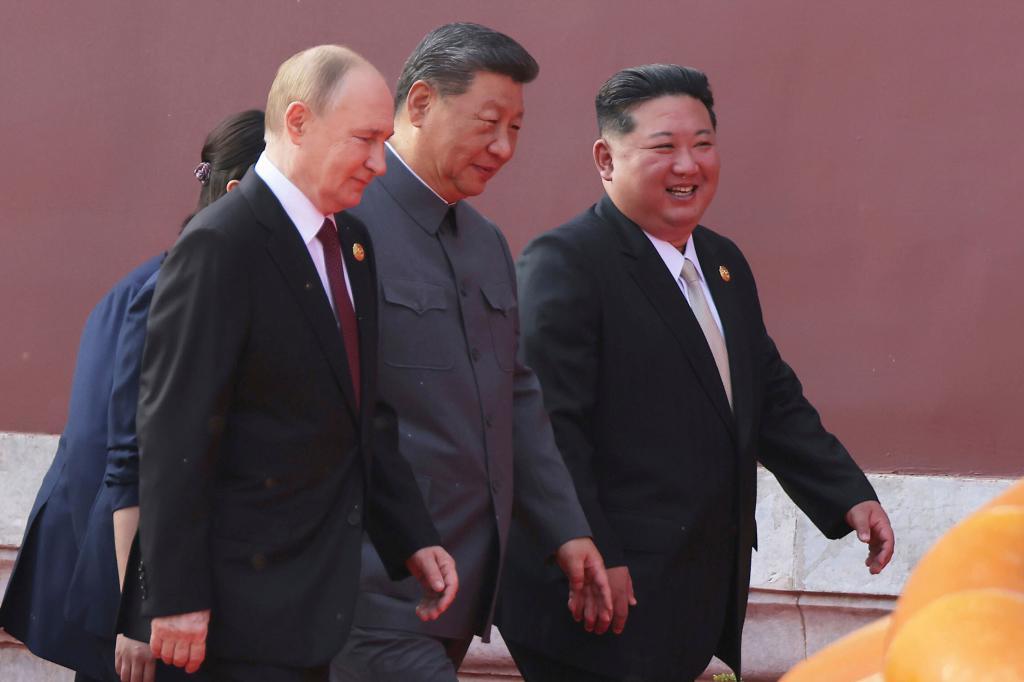
The Tumen also serves as a barometer of a close yet complex relationship: that between Xi Jinping, Vladimir Putin, and Kim Jong-un. Over the past few years, the three leaders have increasingly displayed unity in the face of Washington and its allies. However, observed from this border, their interests do not always align.
The most visible evidence is currently being built over the river. Russia and North Korea are completing their first-ever road bridge, an approximately one-kilometer infrastructure built near the old railway link. Moscow and Pyongyang began the project in 2025, claiming it will boost trade and tourism.
The bridge could also become the physical highway of a military alliance that until a few years ago seemed unlikely. The Russian invasion of Ukraine has pushed North Korea to become the Kremlin's most significant military support.
Pyongyang has sent millions of artillery shells, ballistic missiles, and thousands of soldiers to support Russian forces. In early August, Ukrainian military intelligence reported that a North Korean unit was deploying in the Russian region of Voronezh and could operate up to 120 ballistic missiles and six launchers against Ukraine.
In exchange for soldiers and weaponry, Kim obtains something that international sanctions had hindered for years: Russian oil, currency, and military technology. The new Tumen bridge can now accelerate these exchanges. Some analysts monitoring military movements between the two countries argue that road traffic is more challenging to monitor by satellite than the trains currently crossing the only railway link.
China is also observing the construction of the new bridge from just a few kilometers upstream. For decades, Beijing was North Korea's main economic patron, exerting an influence over Pyongyang that no other government could match. Now, Putin offers Kim something that Xi could hardly provide without openly confronting the international sanctions regime: a close military alliance.
But China also seems to be increasingly leaning towards closer ties with Pyongyang. Last June, President Xi traveled to the North Korean capital for the first time in seven years, reciprocating the visit made by his North Korean counterpart to Beijing in September of last year. In the North Korean capital, the Chinese leader promised to maintain "close strategic communication" with Kim and expand cooperation in trade, agriculture, construction, science, and technology.
That visit aimed to remind that, despite the bond between Kim and Putin, China remains the indispensable neighbor. After years of coolness and a border practically frozen during the pandemic, passenger trains between Beijing and Pyongyang have resumed service, and direct flights have been restored.
"One of Beijing's priorities is precisely to counter the growing Russian influence over Pyongyang. Restoring military channels would also allow China to better understand what technology Russia may be transferring to North Korea," says Victor Cha, head of the Korea Chair at the Center for Strategic and International Studies (CSIS).
China, Russia, and North Korea share adversaries and a rejection of the U.S.-led order, but their interests do not always align. Putin needs Kim to fuel his war; Kim needs Putin to advance his nuclear program and reduce his economy's dependence on Beijing; and Xi needs to maintain a balance between his two neighbors so that Moscow does not end up displacing China's historical influence over the always unpredictable Pyongyang.