In Kiev, they have also learned that electronic warfare systems can be as decisive as artillery and that attacks on power plants, telecommunication networks, or ports can paralyze a country long before its main cities fall. Nearly 8,000 kilometers away, Taiwan has been studying these lessons for four years with a very specific question: which ones would help survive a Chinese invasion.
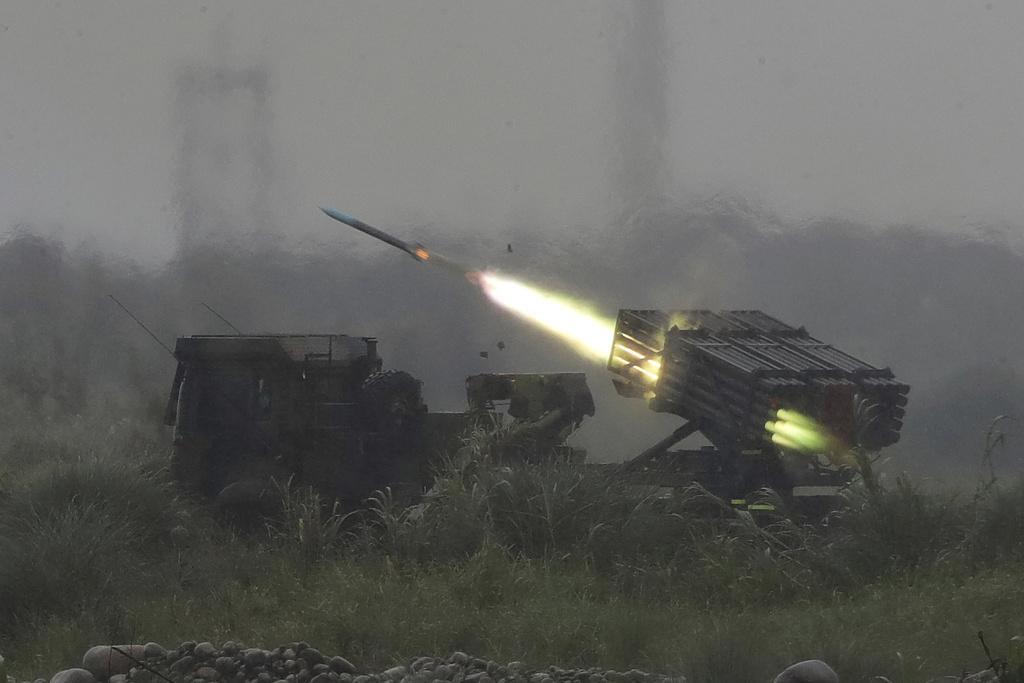
Some answers have been seen during the island's recent military maneuvers. This August, for the first time, Taiwanese operators launched small FPV drones, which soldiers pilot through goggles, against real armored vehicles.
Other units of the Taiwanese army have practiced how to maintain communications after an attack disables part of the mobile networks. They also rehearsed how to respond to a blockade of their ports, and the brigades deployed on the Penghu Islands, in the middle of the disputed strait, simulated a layered defense against a Chinese landing.
Taiwanese officials acknowledge to this newspaper that Russia's war against Ukraine has become an enormous military laboratory. And applying its teachings costs a lot of money. The Taiwanese government presented its budget proposal for 2027 this week, which includes an 18% increase in defense spending to 1.1225 trillion Taiwanese dollars - about 30 billion euros - surpassing a trillion for the first time and raising military effort above 3% of GDP.
It is a historic high for an island of 23 million inhabitants living under the threat of China but preparing for a future conflict quite different from what their generals imagined just a decade ago.
The transformation stems from a conclusion that the Ukrainian and Russian armies have learned in the most painful way: large, expensive, and easily locatable platforms are extremely vulnerable in a battlefield saturated with sensors, drones, and precision missiles.
Taipei does not give up its F-16 fighters, Abrams tanks, submarines, or Patriot systems acquired from the United States, but it is shifting an increasing part of its resources towards smaller, mobile, and hard-to-destroy capabilities: drones, mines, anti-ship missiles, portable air defenses, and communication systems capable of continuing to operate after an initial attack.
The FPV drones used during the recent exercises mimic one of the weapons that has most transformed the war in Ukraine: cheap machines that allow observing the front and launching directly against enemy positions. The idea is particularly attractive for an army that would have to face overwhelmingly superior Chinese forces in terms of the number of ships, planes, and missiles.
But Taiwanese specialists warn that copying Ukraine does not simply mean filling arsenals with small devices. "Many people think that learning from the war in Ukraine means buying more drones, but the important thing is everything around them," explains Holmes Liao, advisor to the Taiwan Space Agency and defense analyst. "The key is to build an ecosystem capable of connecting satellites, radars, sensors, electronic warfare, drones, missiles, and command centers so that they can all exchange information and react quickly to what happens on the battlefield."
The Ukrainian experience has precisely shown that new weapons must be used under constant interference. Russia has repeatedly targeted power plants, energy networks, and telecommunications to try to degrade Ukrainian resistance. In Taiwan, where a large part of critical infrastructures are concentrated in a territory similar in size to Extremadura, strategists assume that a Chinese offensive could start precisely there.
Last week, authorities conducted an unusual test in several cities around Taipei: they deliberately slowed down the mobile network to leave only basic services available. ATMs, traffic lights, landlines, and domestic connections continued to function.
Then the sirens sounded, and the streets were practically empty for half an hour. Millions of people participated in drills that seek to blur the line between military defense and civilian resistance. The goal was to see how the island would continue to function if Chinese missiles destroyed antennas, communication centers, or essential infrastructures.
Another Ukrainian lesson reaches the workshops. Taiwanese forces are experimenting with 3D printers to manufacture components and repair drones near the operational zones. "This is very important when supply chains are disrupted or battlefield needs exceed conventional logistics capacity. On an island that could be surrounded by China, being able to repair a damaged drone and quickly return it to combat becomes even more important," explains Su Tzu-yun, researcher at the Taiwan Institute for National Defense and Security Research.
This search for greater self-resilience also responds to pressure coming from Washington. The United States remains Taiwan's main arms supplier, and its support is essential for the island's deterrence capability, but it has been demanding for years that Taipei contribute a much larger share to its own defense. With Donald Trump in the White House, this demand to reduce dependence on the American military umbrella has become even more explicit.
The budget increase will first have to overcome an internal obstacle: a Parliament controlled by the opposition. This year, opposition parties have already demonstrated their ability to hinder some of the Executive's plans and have questioned several of its military spending proposals. The debate revolves not only around how much Taiwan should spend but also on which weapons to invest in so that each dollar truly increases the cost for China to try to conquer the island.
Beijing is observing this entire process from the opposite shore of the strait. Its Ministry of Defense has dismissed the latest Taiwanese maneuvers as a "useless farce" aimed at "stirring up war panic." While China maintains its almost daily pressure around the island, Taiwan draws a final lesson from Ukraine: against a much more powerful enemy, it is not enough to have more weapons. One must be able to continue fighting when communications fail, drones arrive, and ports close.