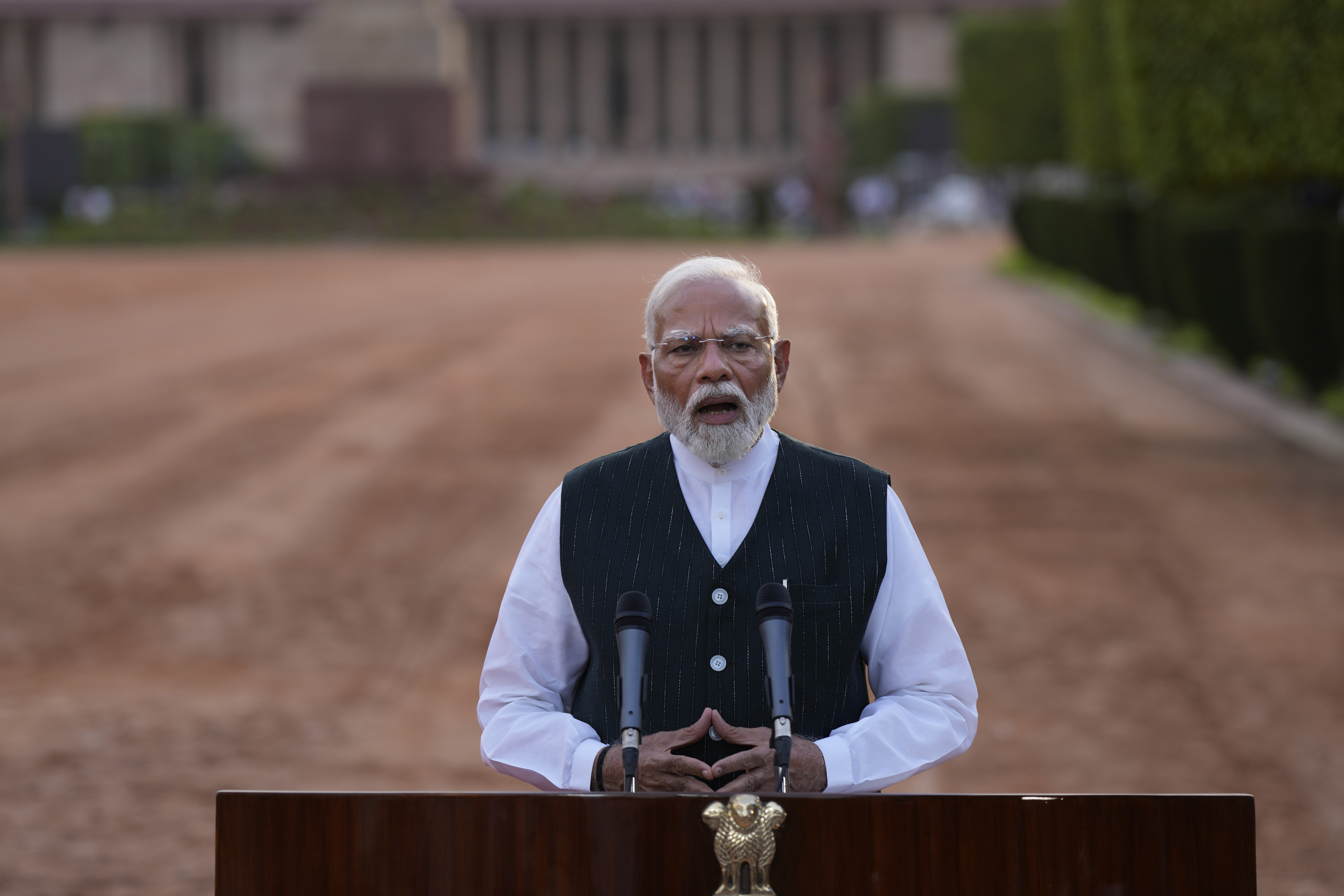
Narendra Modi appears on Instagram wearing a biker jacket, sunglasses, and rap music in the background. In another video, the Indian Prime Minister is shown in a series of casual and relaxed scenes, accompanied by the unmistakable tune of Friends. A montage plays with the lyrics and spirit of the series: the idea of being there when others need you. These are short, lighthearted clips designed for social media, far from the solemn staging that has accompanied India's most powerful leader for decades.
At 75, Modi is changing his skin. And he is not doing it by chance. The veteran Hindu nationalist leader is now trying to conquer a territory that has rebelled against him: that of Generation Z.
This shift is dragging the rest of the Government along. Ministers and senior officials have taken to posting more friendly and less formal videos on social media in recent weeks. Behind this digital offensive lies a deep-seated electoral concern. More than half of India's population is under 35 years old, and Generation Z will be one of the major voting blocs in the upcoming 2029 general elections, when Modi could be aiming for a fourth term.
For now, what has erupted in India is primarily a cultural rebellion. A generation that grew up with Modi in power is starting to build its own political codes outside of the parties: memes instead of rallies, influencers instead of spokespeople, irreverent humor against solemn speeches, and movements born on Instagram and Facebook that can spill onto the streets within hours. The big question is whether this cultural change will also lead to a change at the polls.
12 years at the helm of the world's most populous country
Since coming to power in 2014, Modi has built a formidable political machinery around his figure. His party, the Bharatiya Janata Party (BJP), dominates the Government and possesses one of the most sophisticated electoral and digital networks on the planet. Critics also argue that these 12 years have been accompanied by a democratic deterioration: Freedom House classifies India as "partly free," Reporters Without Borders ranks it 157 out of 180 countries in its press freedom index, and the Swedish institute V-Dem directly speaks of an "electoral autocracy."
Modi built his success precisely on the opposite promise: to return power to the common citizen against the elites of New Delhi. Son of a tea seller, a leader for years in the state of Gujarat, and unrelated to the major political dynasties that have traditionally ruled India, he presented himself as an ascetic with no family interests or material ambitions. A strong man capable of cleaning up a corrupt system and making an ungovernable country work.
That image has recently begun to crack because of some "cockroaches." It all started with an insult. In May, Surya Kant, Chief Justice, compared unemployed youth to "parasites" and "cockroaches." Abhijeet Dipke, a 30-year-old Indian studying in Boston and with experience in political communication, decided to appropriate the term. "What if all the cockroaches came together?" he asked on social media. He then created the Cockroach People's Party (CJP), a parody that quickly became a social phenomenon.
The final trigger was the leak of questions from a medical school entrance exam. Over two million aspirants were competing for around 140,000 spots. The exam was canceled, and students had to retake it. The scandal hit families that had invested years and a significant portion of their savings in preparing their children. At least twenty students took their own lives amid the crisis.
In June, Dipke landed in Delhi with a copy of the Indian Constitution in hand and headed to Jantar Mantar, the traditional protest corner of the capital. It started with a few hundred people. Then the well-known activist Sonam Wangchuk arrived, starting a hunger strike to demand the resignation of Education Minister Dharmendra Pradhan.
The police response ended up multiplying what they intended to contain. In mid-July, officers forcibly evicted Wangchuk and other protesters after 20 days of hunger strike. The images spread on social media. Tens of thousands of young people then flocked to Jantar Mantar. When the protesters marched towards the Parliament, the police responded with batons, tear gas, and pellet guns.
The protest spread to other major cities like Kolkata and Mumbai. In Delhi, Jantar Mantar took on a carnival atmosphere: memes, music, banners, and jokes against Modi. What started as a mobilization against a rigged exam ended up becoming a symbolic bonfire against the Prime Minister's political brand. The Government eventually gave in and pushed Pradhan to resign.
Many Indian analysts concluded that this outcome was a small humiliation for Modi, a leader accustomed to setting political timelines. It was also a lesson in humility. Because while the BJP has formidable influence over traditional public discourse, the "cockroaches" organized their own political sphere on social media, where influencers and content creators speak a language much harder to control from the top.
India boasts being one of the fastest-growing major economies, but millions of educated young people cannot find employment that matches their expectations. Anthropologist Craig Jeffrey coined the term timepass to describe that endless wait between studies and work that characterizes Indian youth. For many families, it means years of academies, fees, and competitive exams after spending savings or mortgaging land in the hope that a degree will allow their children to move up socially.
The challenge for Modi is particularly delicate because this dissent does not only come from sectors that never voted for him. Among those who have mobilized are urban, educated, Hindu youth from higher castes belonging to families that have long been part of the BJP's social base.
If the rupture goes beyond a temporary protest and becomes a lasting loss of identification with Modi, the movement would have found a much more dangerous crack: it would be splitting a new generation from the very bloc that has supported the Prime Minister until now.