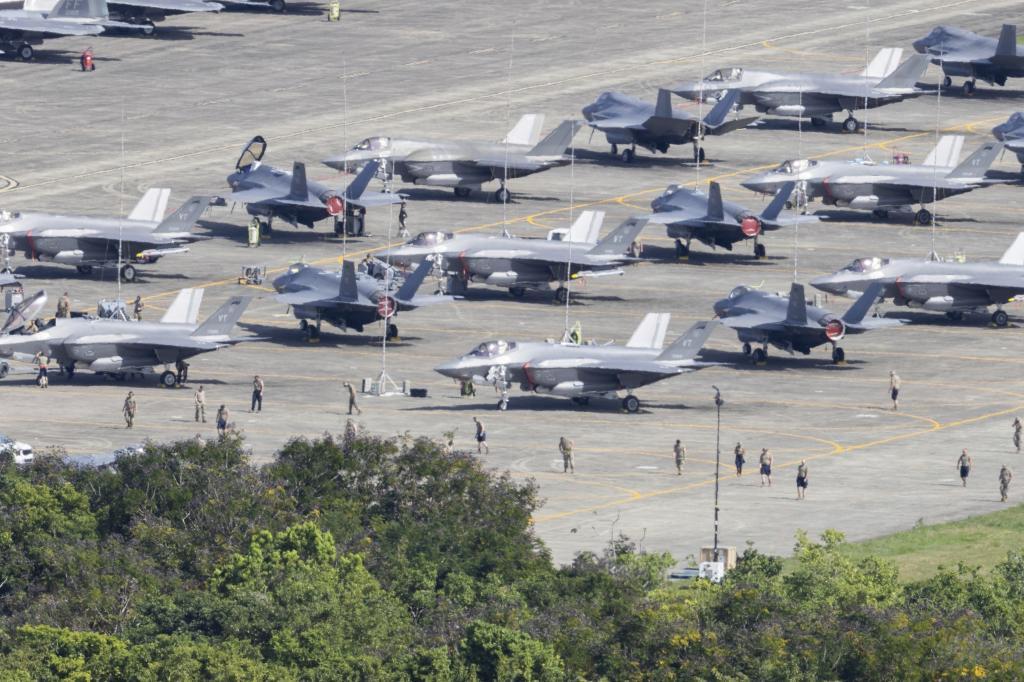
The sky over Puerto Rico is once again pierced by supersonic fighters. Daily life is interrupted by the advance of tactical vehicles amid growing tensions this summer between the United States and Cuba, especially after Donald Trump's warnings of not ruling out military intervention. A pressure that has been looming over the region since the US captured dictator Nicolas Maduro on January 3.
"Planes take off almost every day, even at night. It seems to be to have them ready for combat, and everything stops when they are in those practices," says Manuel Martínez, a resident of the municipality of Ceiba, in eastern Puerto Rico. There lies the Roosevelt Roads Naval Base, unused since 2004 and marked by years of abandonment, but which, since November 2025, was reactivated with a projected investment of $79 million for military maneuvers. Since then, some areas have been transformed for this purpose. All under the banner of Operation Lanza del Sur, reinforced by the Littoral Combat Force-24, a tactical unit in the Caribbean with over 1,300 Marines. The arrival of these military forces solidifies a reality: Puerto Ricans are once again living under a military deployment dictated from abroad and driven by the Donroe doctrine that justifies US intervention in the Southern Hemisphere.
This deployment is not temporary, as confirmed by Puerto Rico's governor, Jenniffer González Colón, who announced military exercises on the island involving over 8,100 soldiers between May and August of this year. According to statements by the governor to Telemundo, these maneuvers are logistical and do not involve the use of weapons or bases in Vieques or Culebra, two towns on the island marked by past wars.
However, military tension in the region escalated after the Havana regime reinforced the security of Raúl Castro and Miguel Díaz-Canel out of fear of a US operation, according to The New York Times. As a result, military activity has been constant this summer. On June 17, marines from the 24th Expeditionary Battalion conducted nighttime drills at Roosevelt Roads. These exercises took place just days after Secretary of Defense Pete Hegseth traveled to Guantanamo Bay, Cuba, on June 10 to meet with US Central Command troops, as reported by Efe.
While this unfolds, the memory of what the Ceiba base was like resonates with those who noticed its reactivation in 2025, with the arrival of the US Southern Command before Maduro's capture. During those days, F-22 squadrons took off from Puerto Rico, and the USS Iwo Jima docked off the coast of Ponce (southern part of the island). While Ceiba residents noticed an increase in deployments in the area, residents of other towns perceived similar activities.
For some, the military presence is alarming, as with Sonia Santiago, spokesperson for the organization Mothers Against War: "Puerto Rico has never declared war on any country. However, over 200,000 Puerto Ricans have fought for the US." This is due to its status as an Unincorporated Territory of the US.
"Normally, there are little planes flying, but from that night (the day of the capture), full days of activity started. Much of what went there (Venezuela) came from Ceiba and Salinas because they cover all four cardinal points of Puerto Rico," recalls Manuel Martínez, leader of the Ceiba Economic Development Alliance. After the arrest, multimillion-dollar investments have been announced, confirming long-term settlement, something not unusual for Puerto Ricans. Since the transfer from Spain to the US in 1898, Puerto Rico has been a gateway to Latin America. Something that Santiago remembers well: "From Puerto Rico, in 1965, US Armed Forces left to invade the Dominican Republic. In 1983, they invaded Grenada. In 1978, they went to depose the president of Panama and removed him."
Operation Lanza del Sur reopens the wound of Vieques. "We were left in a catatonic state because the movie plays in your mind again," says Hilda Bonilla, a member of Vieques al Rescate. During World War II and the Cold War, the US Navy expropriated communities in Vieques for weapon testing. Although troops withdrew in 2003, environmental restoration was delayed, and the cancer incidence is 25% to 40% higher than the rest of the island, according to Efe. "In Vieques, there is a 26% higher cancer rate than in the rest of Puerto Rico, and they have not finished cleaning up," says Santiago.
Puerto Ricans protest against militarization in front of Muñiz base.ALEJANDRO GRANADILLOAP
In addition to social unrest, there is an environmental crisis. Lorena M. Estrada, from the Health for Vieques scientific team, led a study to measure soil toxicity, funded by the US Environmental Protection Agency, but it was halted during the current Trump Administration: "They canceled this project when we had already used 90% of the funds." In Vieques, residents do not access certain areas due to fear of contamination. On the other hand, the Armed Forces clean the land through a dangerous practice: open detonation. "They do not detonate in capsules; they group the bombs and explode them at once. That goes back into the atmosphere," says Bonilla.
The remilitarization of Puerto Rico did not happen overnight; the first signs were seen in August 2025 with the arrival of planes flying over and foreign vessels on the coasts. By that time, the governor of Puerto Rico acknowledged an increase in military aircraft but clarified that there was "no official management to reactivate the bases." Shortly after, her government signed an agreement with the US Navy for the logistical use of Roosevelt Roads (Ceiba), Ramey (Aguadilla), and Muñiz Air Base (Carolina), coinciding with the exercises of the 22nd Marine Expeditionary Unit, according to the local outlet El Nuevo Día.
By September 2025, armored vehicles landed on El Faro beach in the town of Arroyo in the south of the island, according to the Center for Investigative Journalism. "The military practiced with rifles and shots and set up a provisional base there," says Hilda Bonilla. The presence was felt once they were on the coast. "The community found out through helicopters and movements at sea," says Arroyo Mayor Eric Bachier to El Vocero.
Later, the governor confirmed the agreements at the bases, something not new on the island. In response, activist groups joined forces: "We have been protesting since September 2025," says Santiago. Since then, visits from figures like Secretary Hegseth, Chairman of the Joint Chiefs of Staff General Dan Caine, and others have increased.
Now, months after Maduro's fall and with less definitive threats to Cuba than in late spring, the intervention places the territory as a security pillar and promises a significant economic impact. Martínez refutes this: "They said the Navy would bring economic prosperity. It's not true." "In Roads, there are 1,400 abandoned buildings since the Navy left in 2004," he denounces. But opinions vary. "We saw enthusiasm in a sector of the community," says Bonilla.
According to a report presented by the Government of Puerto Rico, the military presence in Puerto Rico represents an investment of €720 million by 2026, with a total estimated economic impact of €1.762 billion on local production. This investment will generate approximately 12,346 jobs and €220.3 million in wage income. Today, while fighter jets patrol the Caribbean skies and military bases absorb millions of dollars, history is repeating itself on the island.