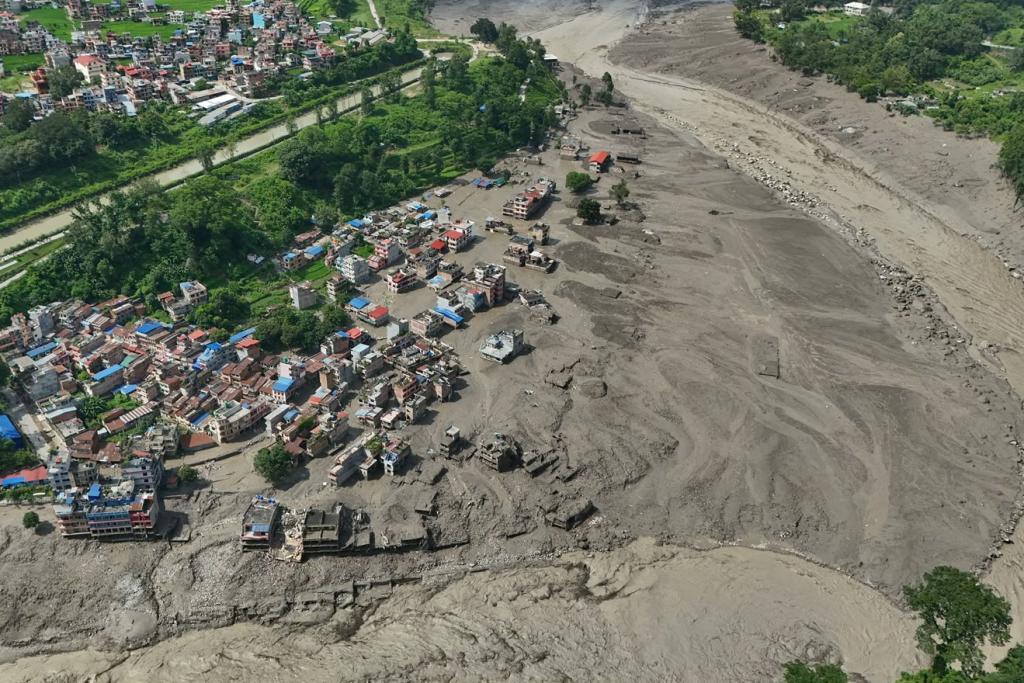
Nearly 400 pilgrims are missing in Nepal after a sudden flood hit several towns and damaged roads and other infrastructures near the border with Tibet (China). Security cameras in the area captured the exact moment when the border crossing between Nepal and China was literally buried by a devastating landslide.
The disaster was triggered by seismic activity in the border region. Nepal's Foreign Minister, Shishir Khanal, stated that the sudden flood was caused by an earthquake that led to a massive landslide blocking the Bhote Koshi river. During a meeting in the House of Representatives in Kathmandu, as reported by the local media Ratopati, Khanal detailed the origin of the flood: "An earthquake occurred at 8:37 (02:52 GMT) today and, as a result, a massive landslide blocked the river, which seems to have caused the flood."
The large mass of water accumulated rapidly and reached the Bhote Koshi river from the Tibetan area around 9:15 local time. The torrent hit the towns of Timure, Rasuwagadhi, and Syabrubesi in the Rasuwa district with great force. At this point, the flood severely affected villages, markets, roads, and hydroelectric works, completely disrupting traffic on one of the main land communication routes connecting Nepal with Tibet. Additionally, the torrential floods have caused road closures, communication disruptions, and power outages throughout this remote and inaccessible Himalayan area.
The main concern of local authorities and rescue teams is locating the numerous foreigners who were on a pilgrimage route to Mount Kailash and Lake Mansarovar in Tibet, a journey considered sacred by Hindu, Buddhist, and Jain religions. At least 384 travelers, including 291 foreigners, are missing after the floods. The director-general of Touch Kailash Travels company, Bashu Kumar Adhikari, reported that contact has been lost with a group of 390 pilgrims, nearly 300 of whom are foreigners.
Nepal Army spokesperson Rajaram Basnet stated that at least 29 people had been rescued alive after the Bhote Koshi river overflowed. Six helicopters from the national Army and eight operated by private airlines have been deployed for search and evacuation operations.
However, the challenges of the terrain greatly complicate assessment efforts. Basnet mentioned on-site, "It is difficult to assess the damages at this moment, but both the damages and the number of victims could be considerable." The tragedy has crossed Nepal's borders, prompting an immediate response from the neighboring superpower. Chinese President Xi Jinping urged intensifying search efforts for the missing individuals and strengthening surveillance and early warning systems to prevent secondary disasters along the border region.