In a matter of minutes, the sextet led by Wahabi, as the Ukrainian military calls himself, has deployed their unique operations center near a plantation.
The phones have been turned off to avoid being located by the Russians, but communication is ensured with a Starlink satellite, powered by a generator. The soldiers continue to take gadgets out of their two vehicles: fuel canisters, cables, and drones.
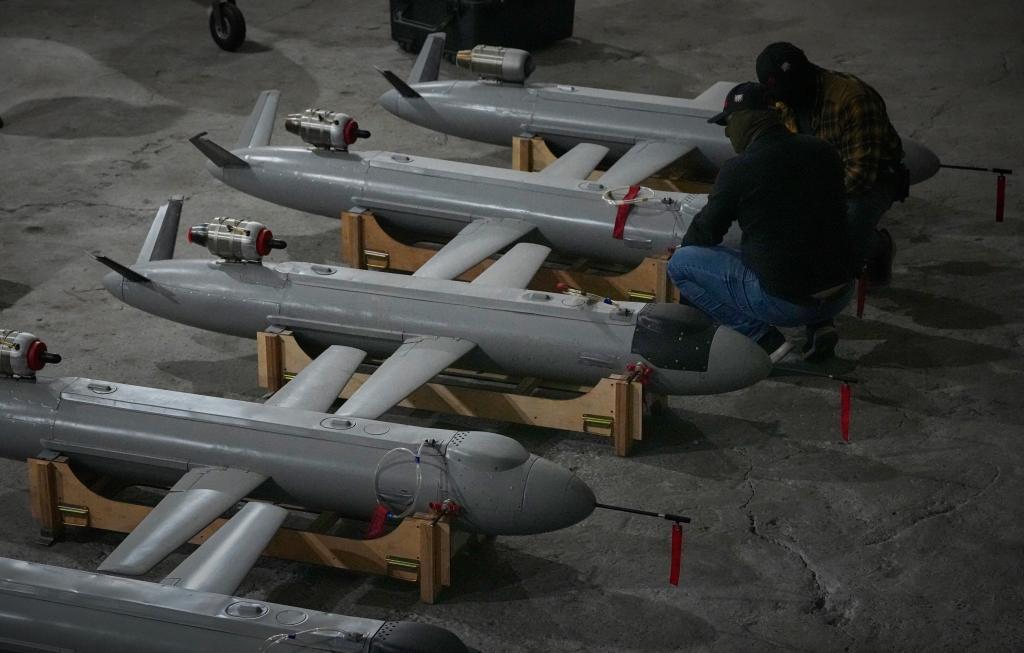
They are unmanned aerial vehicles (UAVs) of the Zozulya type. A gadget over three meters long. The soldiers attach the wings to it as if they were assembling a toy, in this case, a deadly one. They all move under the cover of darkness.
"Today we launch four," explains Wahabi, 38 years old. The aircraft take off at five-minute intervals. Everything is concluded around 10:30. The soldiers pack up their gear, and shortly after, the agricultural wasteland is deserted once again.
This is one of the now famous "medium-range" attacks - as they are called - aimed at undermining the logistical support of Russian troops. However, Wahabi's group, the 422 Regiment of Unmanned Systems, specializes in destroying the sophisticated electronic interception complex "Volna Kupol Garant" (VKG), an inhibitor capable of blinding the Starlink systems widely used by local armed forces.
Preparation of a pneumatic take-off ramp.Alberto Lores
"If that were to happen, it would drastically complicate our work," admits Wahabi.
One of the country's most popular military technology experts, Serhiy Beskrestnov, an advisor to the Ukrainian Ministry of Defense, warned in June about the "massive use" of these gadgets, precisely to try to stop drone attacks on their supply lines.
Beskrestnov explained that these complexes, which require up to six mobile containers, can interfere with satellite connections in an area of 20 square kilometers.
The operation with the Zozulya on June 15, in which Wahabi's team participated, resulted in the "immediate" destruction of four of the six containers. "The other two ended up burning over the hours. As soon as we carried out the attack, the Starlink signal stopped being blurry," explains the military.
Ukraine's dependence on Starlink has been highlighted on several occasions. The country's president, Volodymyr Zelensky, requested permission from Donald Trump and Elon Musk in July to try to use these satellites on their drones and thus target ballistic missile launchers, as an alternative to the lack of interceptors that can shoot them down, but the technology magnate does not seem to have accepted such a hypothesis.
The impact of their use on the front line was also the origin of the momentary shift that occurred in the conflict starting in February when Musk blocked their illegal use by the Russians in Ukrainian territory, significantly disrupting their military operations.
"The Russians completely lost the war management system," comments the head of the 422 Regiment of Unmanned Systems, Mykola Kolesnyk.
According to the Ukrainian officer, his group has destroyed three Volna Kupol Garant complexes since June and assisted in the elimination of a fourth in Crimea. "The missiles shot down our drones, but that distracted the Russians, and the special services achieved their goal, to destroy it," he says.
Moscow has sought an alternative and has begun deploying its own satellite network, the Rassvet, although its implementation lags far behind the capabilities of Starlink.
However, Ihor Lutsenko, another military officer and co-founder of the Center for Air Intelligence Support, believes that the advantage Ukraine had with the use of Starlink is destined to disappear. "The Starlink window is closing. Russian interference systems do not block it entirely, but they make it less effective. We need to have our own satellites that allow us to replace Starlink. Without technological sovereignty, we have no future," he opines.
The intergalactic struggle is just a fraction of the array of military strategies unfolding in this war, which has revolutionized the way armed conflicts are approached and has turned Ukraine - reluctantly - into a kind of laboratory to test new military technologies.
"Here, tactics and weapons change every three months," explains Anton Zemlianyi, a researcher at the Ukrainian Center for Security and Cooperation think tank.
Final adjustments on a drone before launching.Alberto Lores
The analyst clarifies that the Russians have responded to local strategies of bombings in their rear with an array of weapons focusing on the Ukrainian army's weak points. The "Volna Kupol Garant" or the Rassvet satellites are part of these resources, but also the now massive use of jet drones like Geran-4 and Geran-5, a new low-cost rocket called Banderol, and ballistic missiles that take advantage of Kiev's lack of means to halt their course.
Both Geran and Banderol can reach 600 kilometers per hour, a speed that exceeds the capabilities of the defense drones developed by Ukraine so far.
"Right now, the only way to destroy them is with aircraft or anti-aircraft defense systems with missiles. Ukraine has very few aircraft, and our stocks of interception missiles (the famous US Patriots) are at a minimum. We are facing several very difficult months," acknowledges Zemlianyi.
Moscow is recurrently using Banderol and Geran against Odesa, and these gadgets have been the main cause of the current port blockade facing the country.
A senior Ukrainian official, Vladyslav Vlasiuk, stated at the end of July that around 80% of Russian attacks on Odesa's port and maritime export infrastructure in the previous month and the month before were carried out with Banderol.
According to the spokesperson for the Ukrainian Air Force, Yuriy Ignat, the Russians also used jet drones "five times more" in July than in the previous month.
Medium-range drones from the 422 Regiment of Unmanned Systems.
The intelligence services of this country have informed local media that Moscow is producing up to 3,000 jet drones each month, and in June, the then top military official, General Oleksandr Syrsky, estimated that very soon these devices could constitute 50% of all Russian UAVs of that type.
Zemlianyi acknowledges that the "euphoria" sparked by the "medium-range" attacks or assaults against Moscow and other Russian territories, located deep within that state, "has ended."
President Volodymyr Zelensky estimated this past weekend that the Russians can produce up to 1,300 ballistic missiles per year. In other words, dozens of them per month. And against that, Ukraine currently does not have enough interceptors.
"This upcoming winter will be the toughest of the entire war," adds Zemlianyi, anticipating the Russian offensive against Ukrainian electricity and heating facilities that all analysts are warning about.
Mykola Kolesnyk, however, says he never participated in that "euphoria." "I like to be realistic. The Russians are very serious enemies," he says. The meeting with the head of the 422 Regiment takes place in the middle of a dimly lit deserted street. Journalists wait in their vehicle until the car driving the military breaks the silence of the night.
A law graduate, Kolesnyk is one of those unique figures this conflict has spawned who have established their own military units, compelled by the Russian invasion. A former paratrooper during the Soviet era, Kolesnyk was involved in business until Moscow decided to sponsor the start of the war in 2014.
At that time, Kolesnyk was closely linked to the political circle of Jewish magnates like Hennadii Korban and Ihor Kolomoyskyi, an association that might seem at odds with the name he chose for his group: Luftwaffe. That name and the unit's emblem, reminiscent of the one used by the Nazi German air force, have drawn considerable criticism, which he rejects.
"I was deployed in Germany (when I was a paratrooper). That's where my admiration for that country comes from. Luftwaffe means air force in German. The current German air force is also called the Luftwaffe. In the 422nd Regiment, there are soldiers who have fought in the Israeli army (meaning they are of Jewish origin). Those who look for another meaning in this name are the ones who only get their information from the Russian Wikipedia," argues Kolesnynyk.
The soldier does believe that this war will be decided by "whoever introduces technological advances most quickly," but he anticipates a swift response to jet drones and the aforementioned Banderol. "A year ago, we couldn't shoot down the 'Shaheed' (Iranian-made propeller drones, predecessors of the Geran). Now we destroy 95 percent of them. In this war, what is effective today is useless tomorrow," he points out.
As confirmation of their analysis, Ukrainian authorities announced on the 21st the entry into operation of the first jet-powered interceptor drone, created specifically to stop the latest generation Geran drones.
Both Koloesnyk and Anton Zemlianyi agree that with Ukraine transformed into a military testing ground, the only ones failing to capitalize on this situation are the Western nations.
"NATO doctrine is obsolete. They won't be able to stand up to the Russians," Zemlianyi concludes.