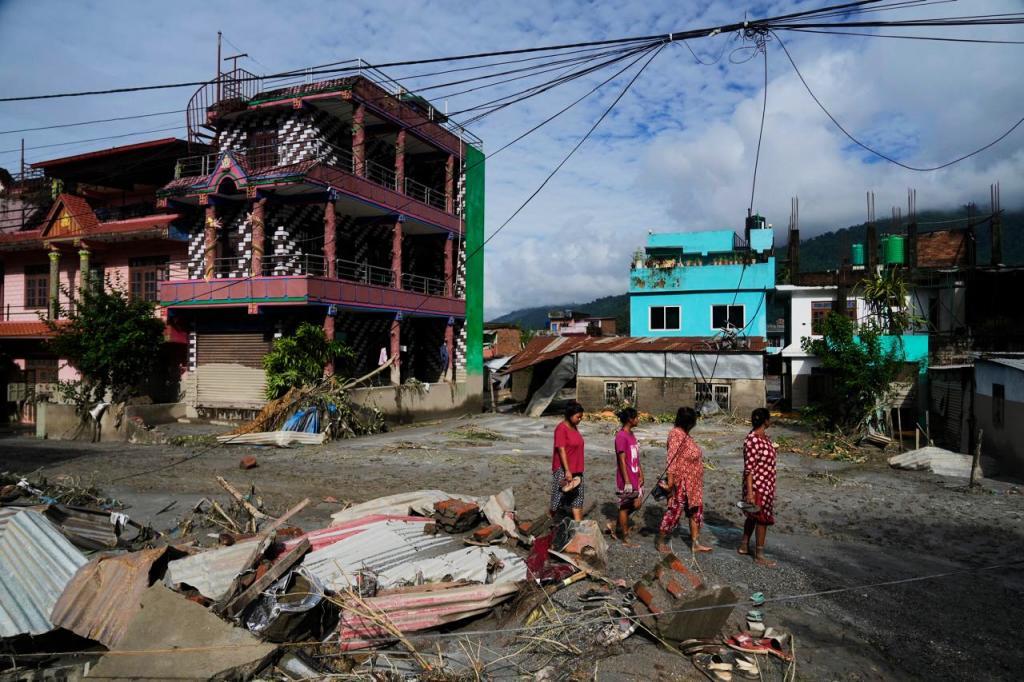
Among the affected are tourists of multiple nationalities, and the Spanish Ministry of Foreign Affairs has confirmed the presence of Spanish citizens in the area with whom contact has not yet been established.
The Spanish Minister of Foreign Affairs, José Manuel Albares, acknowledged this morning that there are four Spaniards unaccounted for in the disaster-affected area. Despite the extreme uncertainty surrounding the emergency situation, Albares wanted to convey a message of caution by publicly stating, "We have no information about any fatalities."
Search and rescue efforts are being carried out in an extremely challenging context where the number of missing foreigners is very high. It is estimated that at least 800 of the total missing are foreign citizens from countries such as Portugal, Italy, the Netherlands, the United Kingdom, Australia, India, Japan, and the United States, among others. Likewise, the latest figures from tourism and police authorities confirm that among the 826 missing persons in Nepal, nearly 600 are foreigners, while those missing in Tibet currently amount to 558, of which 260 are foreign citizens.
The technical origin of this immense natural disaster has been verified by the United States Geological Survey (USGS). According to the analysis by this organization, the main cause was the collapse of a glacier in the Himalayan range. This ice detachment triggered a seismic tremor of magnitude 5.2 and a subsequent landslide that completely blocked the Lhende Khola riverbed. Water accumulated massively behind this natural dam until it broke, causing the huge mass of water to rush with devastating force towards the Bhotekoshi and Truishuli rivers.
The search and rescue operations are being carried out under very adverse weather and geographical conditions. On the Tibetan side, rescue efforts resumed before dawn, greatly hindered by persistent rain and the extreme difficulty of access in a mountainous terrain completely devastated by the wall of water. To address the emergency on the ground, a contingent of 2,000 Nepalese soldiers has been deployed in the districts of Rasuwa and Nuwakot, identified as the areas most severely impacted by the flood, with active collaboration from police forces.
Given the magnitude of the disaster, the international community has begun mobilizing aid, with support from countries such as India, China, the United States, Sri Lanka, and Australia, as well as an offer of assistance from the European Union through the President of the Commission, Ursula von der Leyen. The extreme violence with which the water struck the area has been vividly captured. A security camera (CCTV) located at the border crossing between Nepal and China showed how a monumental wall of water and mud completely destroyed several buildings while a group of people tried to flee the scene.