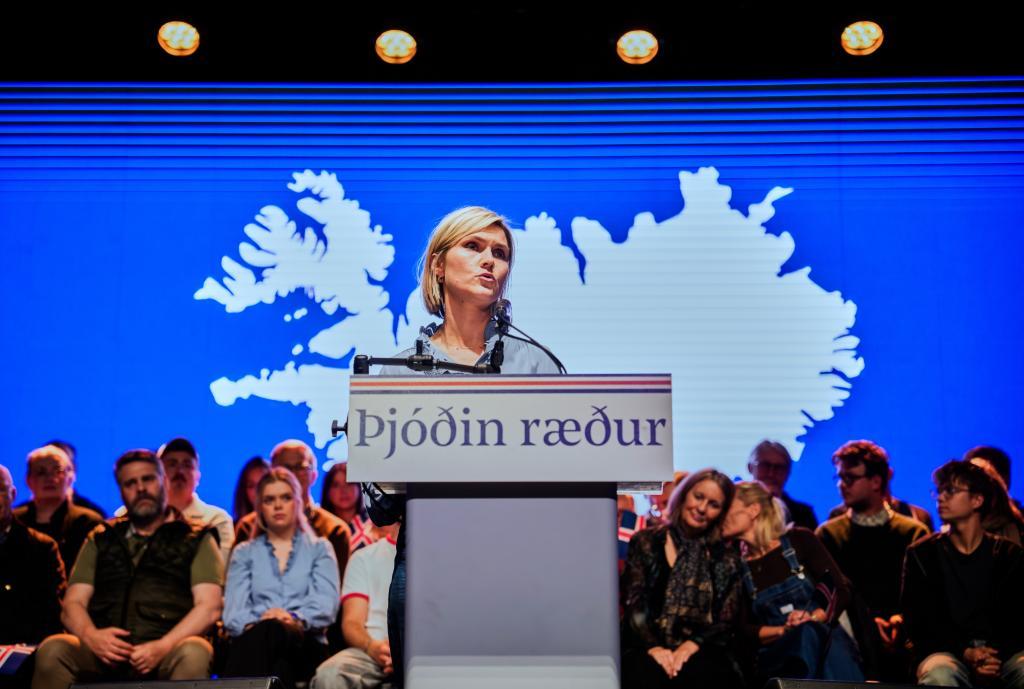
Iceland decides the day after tomorrow, Saturday, whether to open the door to the possibility of joining the European Union in the future. It does so in a referendum marked by three parameters: economy, sovereignty, and security. And, as is usual when these three areas are touched upon, the reaction is a combination of pragmatism, patriotism, nationalism, and particular interests.
All of this is the perfect recipe for massive participation. However, it also leads to tension, especially when the yes and no are tied in the polls. After a month since the start of early voting, the 111 polling stations in the country - along with those in different embassies abroad - already had 41,000 ballots by Tuesday night, according to the official figures from the National Electoral Commission. That represents around 15% of the 272,690 Icelanders of legal age and residents in the country who can participate in the consultation. A consultation that, like the Brexit that decided the UK's exit in 2016, is not legally binding, but politically so. Therefore, whoever wins, Iceland's future will have been sealed, at least for a few years.
Icelanders are not voting on whether to join the EU, but only on whether to open negotiations with the EU to join it. If those discussions lead to an agreement - which, in the most optimistic scenario, would take 18 months - there will be another referendum to decide whether to accept it or not. And in that potential consultation, the no would win, according to current polls.
In other words: Icelanders do not know if they want to negotiate. But if they decide to do so, they prefer not to reach an agreement. If this were to happen in Spain, we would say that we are a country without a solution, without a democratic tradition, and without the ability to decide anything. But as it happens in a Nordic country, it is a great celebration of participatory democracy.
The main difference between the supporters of the yes and the no is the importance that each side gives to these three parameters of economy, sovereignty, and security. This is a thesis of Hälldor Jorgen, 62, former CEO of Microsoft in Iceland and in favor of the yes.
Iceland from an economic perspective
"If you prioritize the economy, especially inflation control, you are in favor of joining the EU, hoping that this will curb inflation and lower interest rates," explains Jorgen. Iceland has a significant price problem. Inflation was at 5.3% in July. Official interest rates are at 8%, after the last increase by the central bank last Thursday. And mortgage rates are at 9%-10%, that is, at the levels Spain had in 1996.
The fight against inflation leads to the second part of the coalition government's plan led by Prime Minister Kristrún Frostadóttir of the Social Democratic Alliance: joining the euro and abandoning the national currency, the Icelandic krona, which Jorgen sarcastically refers to as a "nanocurrency that we cannot use outside the country and, therefore, is subject to tremendous fluctuations."
This computer expert is part of the Yes to See movement that advocates voting in favor in the referendum and then seeing what agreement has been reached and deciding whether it is worth entering the EU or not. "It's a very good name, it reveals good marketing," comments businessman Guðmundur Fertram, founder and CEO of the company Kerecis, which has developed a revolutionary burn treatment system with the help of, among other funders, the EU itself. And he supports the no.
What would happen to sovereignty?
Fertram's main argument points to sovereignty. "When Iceland was part of Denmark, it was Copenhagen that made the decisions. The same would happen with the EU. What is the distance between Luxembourg and Germany?" he asks. The paradox is evident. The Grand Duchy has practically the same population as Iceland. But it is in the heart of the EU. In contrast, the shortest distance between the North Atlantic island and the 27 is 1,080 kilometers: the same as from Madrid to Paris in a straight line.
Geography is key in this referendum. On the one hand, it impacts the economic argument, directly affecting Iceland's second most important industry, with which the country's population also has a huge emotional connection: fishing. Foreign Minister Þorgerður Katrín Gunnarsdóttir told the Financial Times that any EU accession agreement must grant full sovereignty to Reykjavik in the management of fishing resources. Brussels, however, has not responded. Iceland's fishing policy is also crucial for Spain and its high seas fleet.
The other element that geography contributes to the referendum debate is that of security. Iceland is closer to Greenland than to the EU. And at the same distance from Svalbard - a Norwegian archipelago but over which Russia has certain sovereignty rights - as from Brussels. This places it as the key to the North Atlantic and much of the Arctic, a position it has held since its independence in 1941 when it was invaded and occupied not by Nazi Germany but by the UK, which wanted to prevent Adolf Hitler from taking it over.
The security surrounding the EU
Geostrategy is the third leg of the referendum. It is no coincidence that Frostadóttir advanced the consultation, initially scheduled for 2027, to this year, nor that she announced the change of plans in January when Donald Trump was threatening to occupy neighboring Greenland. For the government, being part of the EU will strengthen the country's sovereignty. For the no supporters, that idea is not sustainable because the EU is an economic and political organization, without military weight.
The referendum comes at a time when the Arctic is heating up, not only from a climate perspective but also from an international political standpoint. The consultation takes place while NATO conducts maneuvers in Iceland and China proudly announces the opening of the 'Arctic Silk Road' to transport goods by sea from the Far East to the UK. Economy, sovereignty, and security are three very complex pillars to make any decision. On Sunday morning, we will know what the Icelanders have done with this triple puzzle.