After Björk, Kristján Loftsson is probably the most famous Icelander abroad. Not for his songs or acting skills, but for something much more controversial. Loftsson is the world's last great whaling entrepreneur outside of Japan. This year, the Icelandic government has granted his company Hvalur hf. (literally Whale, Inc.) a quota to hunt 150 fin whales, the second largest animal on Earth. Yesterday, his two whaling ships (Hvalur 8 and Hvalur 9) had caught 59.
Loftsson is 84 years old, but judging by his physical appearance, he could easily pass for 30 years younger. And obviously, he will vote no tomorrow in the referendum on negotiations for Iceland's entry into the European Union. "The EU not only banned whaling but also the use of products derived from these animals in 1973. Look at what happened in Spain," he explained to EL MUNDO yesterday while having a cup of coffee in Reykjavik.
Indeed, the Galician company Massó killed its last whale in October 1985, less than 75 days before Spain entered what was then the European Economic Community. It was a 17.7-meter-long female fin whale, as explained by University of Barcelona professor Álex Aguilar in his book Chimán, about modern whaling in Spain.
The whaling entrepreneur embodies the quintessential no voter in the referendum. The older people and those who make a living from the sea and the countryside oppose even opening negotiations for EU accession. The young people and the residents of Reykjavik, the capital, are in favor. "I thought the yes would win," explains a 32-year-old Slovakian working as a tourist guide this summer, who does not want to give his name. "But I changed my mind this weekend when I went with my girlfriend to visit my sister in Akureyri," which, with its 20,000 inhabitants, is Iceland's second-largest city and is located at the other end of the country, about a six-hour drive away.
"We saw so many hay bales with stickers saying 'EU? No, thanks' that now I'm not sure," he commented while sitting in the café where his girlfriend, of the same age and nationality, works. She is more certain: "My impression is that the no will win."
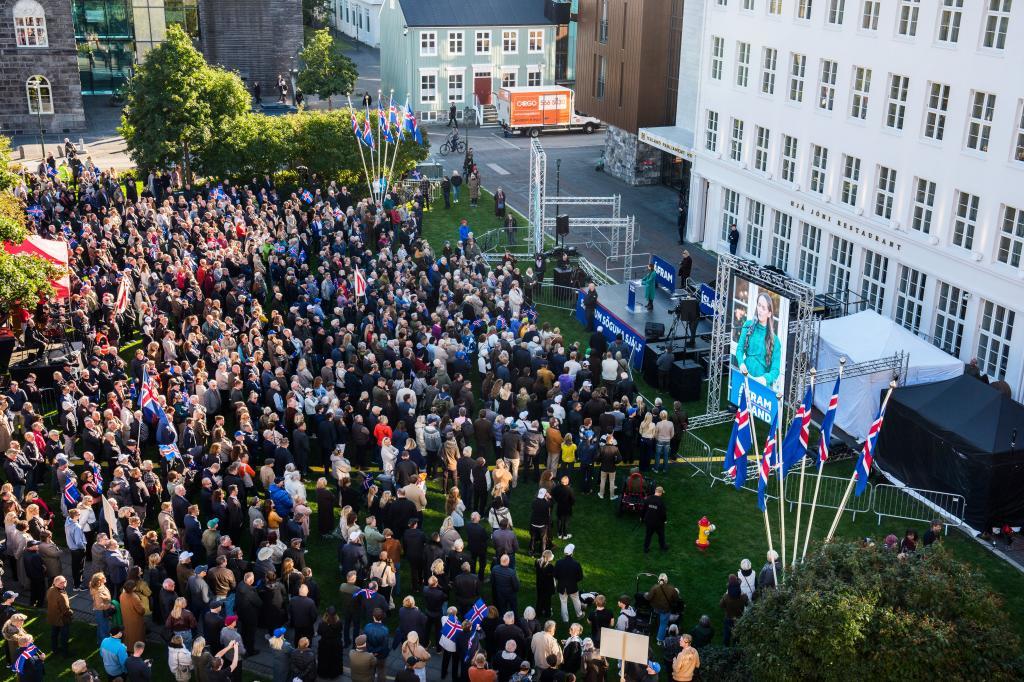
The antithesis of Loftsson is Aron, a 34-year-old business administration graduate and employee at a software company, who yesterday at five in the afternoon was walking down Bankastraeti street towards the yes rally at the old Tónabíó cinema. "It makes no sense to vote against. The referendum is only to negotiate with the EU. We have nothing to lose; it's absurd to reject this possibility in advance," he declared.
When the opinion of the Slovakian couple was mentioned to him, he reacted by setting aside the question of who will win, suddenly defeated by a healthy envy. "See? I want that too. To be able to travel and work throughout Europe, and have the euro, instead of a currency that no one wants and that forces me to mentally calculate prices in Icelandic krona every time I leave the country. It wouldn't be difficult for me to be a digital nomad," he lamented. With the sadness on his face, one would lose the desire to explain to poor Aron that Slovaks spend their lives traveling from country to country and doing temporary jobs.
The comparison between the whaler and the young software executive reflects the differences between the two worlds that will be decided by a vote in a plebiscite where there will be no automatic recount, although the difference may be minimal. Aron's desire to travel is far from Loftsson's vision, who, repeating a phrase from British Brexit leader, Nigel Farage, said that "the European Union has become the Soviet Union". These are two opposing and hardly compatible views, with the 34-year-old man stating that whaling "is a dying activity because there is no market, not even in Japan," and Loftsson telling the journalist, "If we catch one while you're in the country, I'll call you to come and see how the butchering is done."
It's the same fracture experienced throughout the West. Aron wants to be a nomad, like the Slovaks. Loftsson, on the other hand, believes that "in Iceland, we have too many foreigners, who also take all the benefits." Around 20% of the country's population is immigrants. And part of the debate on social media is whether this is the reason for the increase in crime in the capital, leading Reykjavik residents to do unusual things in the rest of Iceland, like not leaving the car with the doors open and the keys in the ignition. Tomorrow they will have to decide whether to turn the key to start the process of joining the European Union or to continue independently.