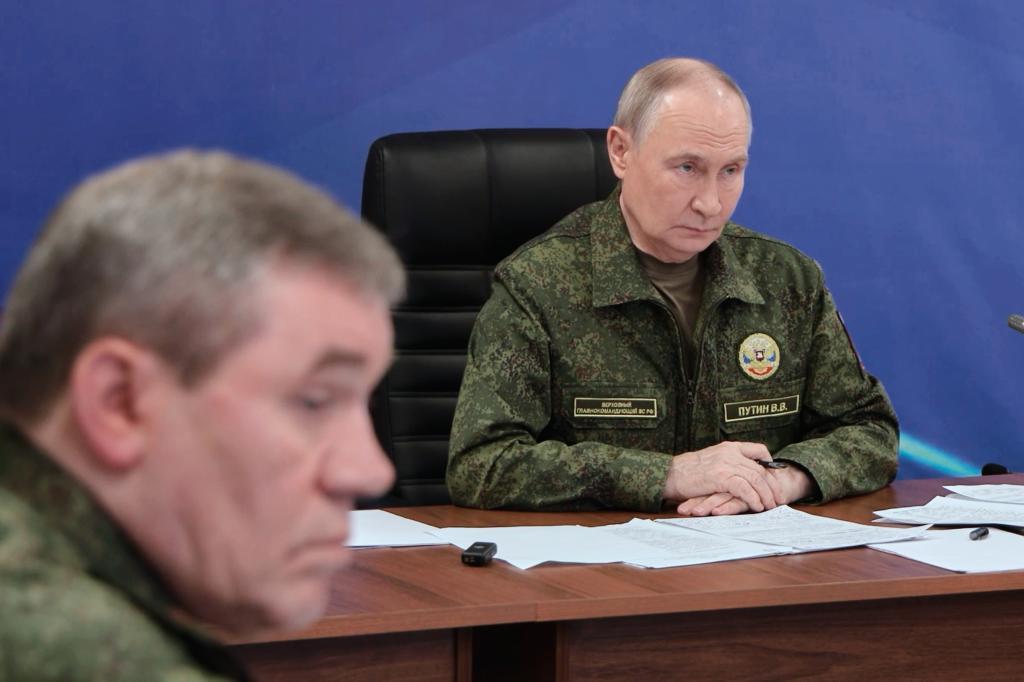
Waving the nuclear scarecrow has been a frequent resource for the Kremlin since the beginning of its so-called "Special Military Operation." In the first three years of the invasion - from February 2022 to early 2025 - Russia issued a total of 135 nuclear threats, of which Vladimir Putin personally made 27: five in 2022, nine in 2023, and 13 in 2024, with a clearly increasing trend each year. The rest came from other high-ranking regime officials, especially Dimitri Medvedev, and the usual Russian propaganda chatterers.
Over time, thethreats have been losing strength and credibility: at the beginning of the war, each nuclear comment dominated headlines and shook markets. Now, after 135 warnings, they barely move anything. Until yesterday.
A new publication, this time from the economic media Bloomberg, once again talks about nuclear threats, although it does so by speaking with three Kremlin sources with some closeness to President Putin. It is not the typical bragging of Dimitri Medvedev, but an internal and genuine concern of his own circle. Even though we are not in that scenario, it is scary that it is being considered as such.
In the Bloomberg report, consistent with the current climate of Kremlin frustration, it is recounted how Moscow has concluded that peace talks are useless at this point and that negotiations have been exhausted. The current phase is not the peak of escalation but the beginning of a new, more intense phase of increasingly powerful ballistic missile attacks on the center of Kiev. Furthermore, Russia increasingly views Ukrainian attacks on its oil infrastructure as bombings by NATO member states because the allies supply weapons and intelligence. It is not a new narrative, but it is being used more and more.
When it comes to nuclear fear, Bloomberg is cautious: it does not say that Putin will use tactical nuclear weapons immediately, but rather that a growing number of Russian officials believe it could reach that point. It is a sign that the internal debate in Moscow has reached a worrying level that did not exist before, where the use of atomic missiles to subdue Ukraine is being weighed as a real option.
What are tactical nuclear weapons and what purpose do they serve in a long-stalled war? In simple terms, strategic nuclear weapons (with great destructive power, like those of Hiroshima or Nagasaki) are built to win wars, while tactical ones are designed to win battles, as they have less power, shorter range, and are designed for use in the war zone against specific targets, such as a military base, an industrial area, a supply line, or a set of fortifications. During the Cold War, artillery projectiles were developed, fired from a cannon, that could destroy military concentrations in a single blow and are still available.
How many tactical nuclear weapons does Russia possess? The Bulletin of the Atomic Scientists, in its March 2026 report, estimates that Russia has an arsenal of approximately 4,400 nuclear warheads assigned for use by long-range strategic launchers and short-range tactical nuclear forces. Of that total, approximately 1,794 are non-strategic warheads - that is, tactical - stored but not deployed. There is no evidence that any of them have even been moved from their storage, something that could be verified with satellite imagery.
In the case of strategic atomic weapons, the world knows their dramatic history in the two Japanese cities that suffered them, but no army has ever used a tactical nuclear weapon and there are reasons for that. The first is that it creates an escalation problem: there is no guaranteed mechanism to prevent a tactical nuclear exchange from escalating to a strategic one. If Russia launches a tactical warhead on a concentration of Ukrainian troops, no one can guarantee that NATO's response would also be tactical and not strategic. In fact, Europe does not have tactical nuclear weapons, only France and the United Kingdom possess strategic ones. Escalation can be automatic.
The second reason is the contamination of the battlefield: tactical nuclear weapons generate radiation, electromagnetic pulse, and uncontrollable radioactive fallout that affect both the attacker and the defender. The devastated territory can become militarily unusable, a contaminated no man's land.
The third reason is political: the use of any nuclear weapon, even tactical, crosses the threshold that has maintained nuclear peace since 1945. The diplomatic, economic, and military consequences of this crossing are unpredictable. If Russia were to use this resource, its Chinese and Iranian allies might permanently distance themselves from Moscow.
U.S. intelligence has considered the possibility of Russia using these weapons on occasion. William Burns, former CIA director and the person most knowledgeable about Putin's nuclear thinking, commented in a recent interview with Foreign Affairs: "Our analysis is that if a situation arises where there is a rapid Ukrainian advance that jeopardizes Putin's control over Crimea, that would be a circumstance in which he would at least consider the possibility of using tactical nuclear weapons."
General Ben Hodges, former commander of the U.S. Army in Europe, believes that "Russia is very unlikely to use nuclear weapons in the conflict unless the Russian leadership judges that it faces an existential threat to the regime."
Is this one of the future scenarios we may face in Europe?