At five in the morning, the music can still be heard on the Sfiha Beach (Alhucemas). The Ossiano Beach closes at that time; the Havana and the Golden Beach never close in August. Just 700 meters away from rental sunbeds, loudspeakers at full volume, jet skis, and foreigners of many nationalities drinking mojitos, there is a Spanish military post. This is the Peñón de Alhucemas, a 480-meter islet where, in the past, soldiers stationed there, known as 'gaviotos', used to queue in front of the command post's telescope to see the parties and beach bars across the way.
Despite the decades that separate them, the stories of veteran ex-military personnel over 70 years old and the young soldiers passing through there today share a common bond: the experience on a small islet considered the last frontier of Europe. Another rock joins this enclave, the one of Vélez de la Gomera, located in front of Badis, a small Moroccan coastal town of 103 inhabitants completely unaware of the music and beach bars of Alhucemas. In addition to the Perejil islet, with no regular presence, and the Chafarinas Islands.
The focus returns to these rocks due to what happened this summer on that same coast, the arrival in Ceuta of nearly 80,000 people and the call on Moroccan social media for a second attempt on August 15, a day when the city woke up under lockdown. Days before this second assault, the Moroccan Minister of Justice, Abdellatif Ouahbi, had stated on Saudi television Asharq News that his country continues to claim Ceuta and Melilla and maintains this demand "in the long term." Alhucemas, Vélez de la Gomera, the Chafarinas Islands, and Perejil are the most forgotten, yet coveted, pieces of a board that Morocco claims for its Greater Morocco, the territorial expansion desired by Mohamed VI.
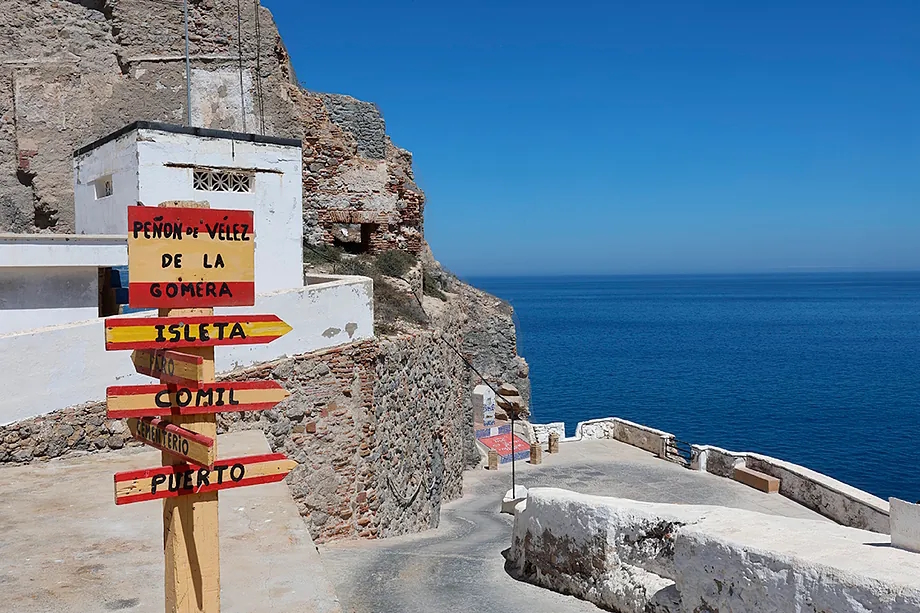
It was around this time, centuries ago, when the Spanish army took control of both places. The garrison of the Peñón de Vélez de la Gomera has been there continuously for 462 years, since September 6, 1564, when it was taken by Felipe II. It was then an islet, which became connected to Morocco by a land bridge after an earthquake in the 20th century. The border is a rope and is the oldest continuous Spanish possession in North Africa after Melilla, taken in 1497. Alhucemas has been Spanish since August 28, 1673, when it was taken during the reign of Carlos II.
Where now there are beach clubs with afro house music and an "Ibiza atmosphere," as celebrated in the reviews of foreign tourists, there used to be the Mediterranée, a French holiday club in front of the nudist beach highly mentioned among different forums of ex-military personnel stationed in Alhucemas. This is still a vivid memory for Juan José, a political prisoner who was there in '73, and for all the recruits who passed through there during the 20th century. Ramón, a former soldier stationed there in 1972, recalls how the French women at the club "were smaller than ants, but some enjoyed more the imagination than what could be seen through the chief engineer's telescope."
On the rock, the week was not marked by the calendar, but by the ship. On Friday mornings, the troops would go down to the dock to unload what came from Melilla — supplies, mail, the package of cold cuts that would later be distributed on tables, letters from the wives and children of the soldiers — and as soon as the last box touched land, the entire islet was declared free time until Monday. Then, the other side of the garrison began, a barracks that turned into a playground: soccer games, cards, a pack of cigarettes per table after lunch, 100 Pipers whiskey, Africa beer, and impromptu boxing matches in the dining room with the troops forming a circle.
Rafael, a Sevillian soldier stationed between late 1982 and early 1983 with the task of planning daily menus with the sergeant, nostalgically remembers a Moroccan neighbor in the area known among the troops as El Talet. He would approach in a small boat to exchange fresh vegetables for bottles of whiskey.
Discipline, however, was an unbreakable rule that should not be violated under any circumstances. Josep Lluís, a sailor from the Marine Company who was there in 1972, recalls the binge that the entire troop had to celebrate the birth of twins to a lieutenant's wife, an invitation from the officer himself that ended with consequences: "Who said that a whiskey binge doesn't have a hangover? The next day we were arrested and made to run with the CETME [a legendary Spanish assault rifle]. I thought the whole island was shaking as much as my head was."
Both rocks were both barracks and prisons. They were known as "minor outposts," where historically political dissidents, exiles, and common prisoners were sent from the Peninsula. According to historical accounts, they were the government's preferred destination for the most troublesome criminals and, above all, for political prisoners sentenced to exile. There, they worked forcibly on construction and performed other tasks: nurses, clerks, school teachers, and even officers' servants.
There were more prisoners than civilians and military personnel combined. This context led, on November 15, 1838, to the Carlist lieutenant Pedro María Quintana, classified as a great conspirator and who had been transferred to the rock for that reason, to incite the troops and most of the confined individuals to take over the military post of Alhucemas. The escape plan failed: they wanted to reach Castellón by sea to join Cabrera but were arrested by French authorities on the Algerian coast.
On May 6, 1907, both rocks ceased to be prisons, and the prisoners were sent to the mainland. Little trace remains of that time. In Alhucemas today, among the lighthouse, the old hermitage that once housed the Virgin of the Rock, the governor's house with its clock tower, and the alleys hidden among the stones, the old dungeons and underground galleries that are still explored, as well as the cemetery of the adjacent islet known as La Pulpera, which is practically on the edge of the abyss, are still present.
Meanwhile, 700 meters from the Moroccan speakers of Sfiha, the garrison of the Peñón de Alhucemas continues to stand guard under the Spanish flag, just like the one in Vélez de la Gomera and the Chafarinas Islands.