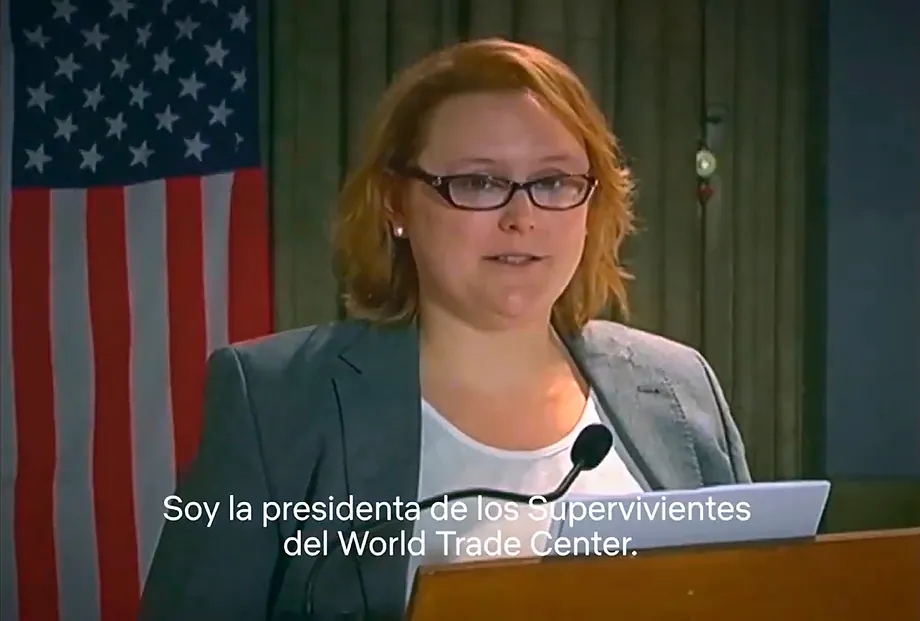
At one point in The Survivor, its protagonist carefully prepares to transform into the character she portrays. Suddenly, the viewer is faced with a strange paradox. Convinced, as the movie itself constantly reminds, that they are watching a documentary, yet the central figure around whom everything revolves is embodied by an actress who, as expected, plays a role. It's fiction, therefore. However, a role was what the person (not the character) whose life is being told played every day; a person who undertook the immense task of becoming a big lie to be nothing more than a character. And so, reality dangerously blurs with fabrication. And vice versa. It sounds labyrinthine, and indeed, that's what it is. "Using an actress is a decision that may seem strange, but I thought it was the best way to show in a single sequence what all this is about. It's true, but a lie. It's a lie, but it has the privilege of truth," explains the director of all this, Kike Maíllo, with a mix of graphic, mysterious, and enthusiastic tone.
To set the stage, the movie tells the story of one of the most peculiar victims of 9/11. So unique and strange that, strictly speaking, she was not even a victim of the brutal attack that brought down the Twin Towers of New York in 2001 and forever changed contemporary history. She was not among the nearly 3,000 dead, had no family relationship with the deceased, and was not even counted among the agonizing survivors during the catastrophe. And yet, Tania Head moved the world with her story just moments after everything happened. She claimed to have been on the 78th floor of the South Tower. She said her husband, whom she had married after meeting in the lobby of one of the buildings, worked in the other tower and could not be saved. She said that from the tragedy, in addition to the deep and invisible pain of feeling guilty for living amidst so much death, she was left with a horrible scar on her arm. She told and showed the wound. Day after day, she recounted all this with meticulous preparation, just like the actress in the movie. Her name, Tania Head. Just one detail: everything she told was a lie. Her real name was (and is) Alicia Esteve Head. When everything was uncovered, she, for better or for worse, became what she had never been up to that point: another victim of 9/11. Peculiar, shameful, perhaps ridiculous, but a victim nonetheless.
"I have always been passionate about these contradictory characters who are on the edge of illegality and morality, but who ultimately carry venial sins. They have not killed anyone and have not destroyed anyone's life, but what they have done is a misdeed," comments the director to explain the devotion he feels, like any storyteller, for lies. In 2022, Maíllo dedicated another film to Oswald Aulestia Bach, the mastermind behind one of the most pursued art forgery schemes. "I would say," he continues, "that there are two main reasons that make Tania's story [he still refers to her by the false name] fascinating. On the one hand, her story, though extreme, is that of all of us. We all have a mask that we shape according to the image we want to project to others. In the case of Oswald or Tania, there is also a component of escaping from a reality that does not satisfy them. And there is a desire for transcendence that is very respectable, I believe. They are characters who refuse to accept that life consists of working from eight in the morning to eight at night and nothing more. They desire and carry out a plan to have a deeper experience of their passage through the world. And they invent another life. I am definitely very interested in the life of the pirate, the life of those who try to immerse themselves in other seas."
And the second reason? "The lie, the lie itself. Right now, it is the big theme. All conversations, on social media or outside of it, revolve around whether what we see, read, and are told is true or not. And with AI, distrust has been exacerbated. We have reached a point where if I don't like what I see or hear, I say it's a lie. And nothing happens." Pause. "Lying is no longer socially penalized. And this is especially noticeable in the Anglo-Saxon world. Catholics have always had a more complex and relaxed relationship with the truth, but for the Anglo-Saxons, until recently, it was a red line. Clinton was impeached for lying, not for abusing an intern. Now all of that has collapsed. Just look at Trump. We are still not aware of the consequences of that debacle," he asserts without even letting his breath interrupt.
There might even be a third argument to further validate the subject addressed in The Survivor: cinema itself. "The construction this woman made is exactly the same as what any filmmaker and creator faces in their work, which is to investigate and create a plausible fiction," says Maíllo, and indeed, he is right. After all, cinema, all of it, starts from the premise that everything it offers is a lie, but no one has to say it out loud. We believe it convinced that only fiction saves. Reality condemns. And it's not us who say it, but, for example, Javier Cercas throughout 'The Impostor,' to finally reach the opposite conclusion. And as proof, he presents the final scene of Don Quixote in which Alonso, the good man, finally renounces his years-long delusion. And he is saved. The path of cinema, and even of storytelling itself, is similar. Perhaps identical to that of Tania, not Alicia.
And then there is the matter, so shared by all, of loving and being loved, the oldest aspiration of the human being. Tania/Alicia lied, it is confirmed, but there is no way to detect in her performance - that was radically - any economic interest, let's say, quantifiable. She did not make money, nor did she use her public exposure to negotiate with it, she asked for nothing, she offered everything... "In reality," Maíllo speaks again, "she did something she knew how to do very well. She grew up in the Catalan upper bourgeoisie and had an incredible gift for people and leadership. She did not hesitate to call the warden of New York if necessary. She was trained to navigate in those environments. It should be noted that she came from a family with a lot of money and that her father was one of the first convicted of corruption in Catalonia for the Planasdemunt case of fake promissory notes... The incredible thing is that she was the one who initiated and gave life to the survivors' association. Everyone said she had an incredible light... Obviously, nothing had happened to her." Pause. "But why did she do it? It's complicated. Some experts talk about wounded narcissism. But there are many factors and causes."
It is impossible not to remember precisely the other great deceiver, the subject of Cercas' cited book. Indeed, like Enric Marco, the man who pretended to be a survivor of the Nazi concentration camp of Flossenbürg, Tania lied using the raw material of others' pain. "Over time, after 25 years have passed, some of the victims have forgiven her and recognized her work. For my part, my feeling is that she has paid dearly for her guilt. She has spent many years wandering from job to job without a penny. And always pointed out. She, however, denies the whole thing and insists that everything was exaggerated...," Maíllo concludes.
And meanwhile, the actress, who obviously is not her, embodies her in an effort to be more of herself than she is. All lies. All truth.