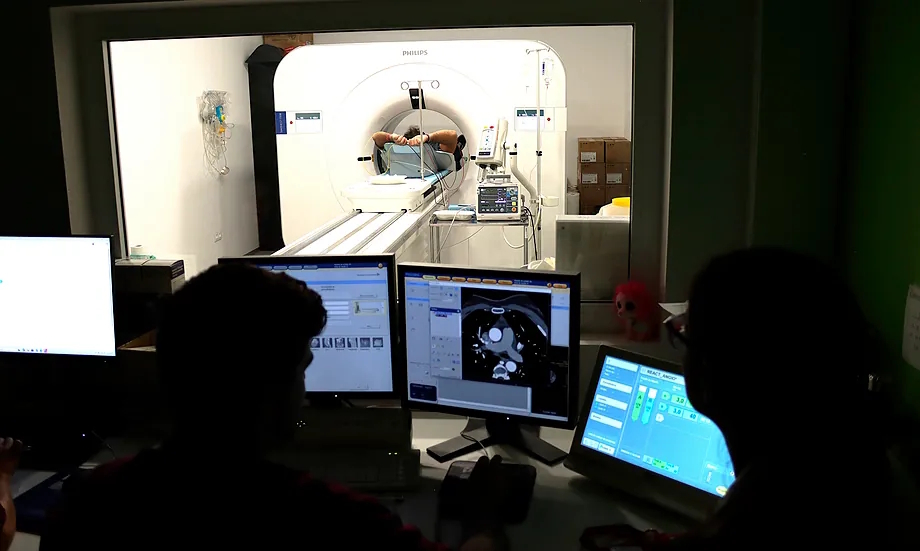
Heart attacks and strokes may seem sudden disorders; sudden attacks that appear without warning and can be devastating. However, these problems are actually the result of artery damage that has been silently developing over the years.
Atherosclerosis, the accumulation of plaques inside blood vessels that causes their progressive narrowing and hardening, is a much more common phenomenon than previously thought and can be detected in apparently healthy young adults, as just demonstrated by a study led by scientists from the National Center for Cardiovascular Research (CNIC).
According to the data from this study, one in 13 young people aged 18 to 29 has silent atherosclerosis in some artery of their body. "It is alarming that, as we have seen, almost 9% of the males analyzed in that age group and practically 7% of the young females have silent atherosclerosis. In general, we have seen higher percentages of affected individuals than previously thought," explains Borja Ibáñez, scientific director of the CNIC and leader of this research, the conclusions of which are presented in one of the highlighted sessions of the European Society of Cardiology Congress and are simultaneously published in the journal The New England Journal of Medicine.
"Currently, atherosclerosis is diagnosed and addressed when it is already very advanced. What the results of this study show is that we need to move towards a new way of preventing cardiovascular disease," Ibáñez explains, who is also a cardiologist at the Jiménez Díaz Foundation Hospital in Madrid and head of a group at the CIBER Cardiovascular Diseases (CIBERCV).
Alongside Henning Bundgaard, a Cardiology professor at Rigshospitalet in Copenhagen (Denmark), Ibáñez has coordinated this ambitious research, called REACT, which has analyzed the cases of over 16,000 patients aged between 18 and 70 to map the existence of silent atherosclerosis in adulthood.
The ultimate goal of the study, as Ibáñez explained to this newspaper when the trial was in its early stages, is to generate the necessary evidence to completely change the way cardiovascular prevention is done, redirecting it to act early.
"According to current clinical guidelines, the evaluation and treatment of atherosclerotic cardiovascular disease is mainly recommended in people over 40 years old, usually after many years of exposure to risk factors such as high cholesterol levels, high blood pressure, smoking, or obesity. But this prevention strategy is not working. A change is needed," Ibáñez explained at the time.
The results of the first phase of the research have shown that silent atherosclerosis is very common. 57.1% of the people studied had atherosclerotic plaques in their arteries despite not showing symptoms or having a cardiovascular disease diagnosis.
Conventional risk estimation methods are not sufficient
The percentages of atherosclerosis detected in people aged 18 to 29 are striking, with 9% in males and almost 7% in females, but the proportion of affected individuals progressively increased with age, reaching 9 out of 10 people between 60 and 70 years old.
The study also found significant differences between men and women. They observed that in men, the disease progresses quite rapidly in the early decades of adulthood and appears 5 to 10 years earlier than in women. In women, however, the most pronounced increase is seen between 40 and 60 years old, a period that coincides with menopause. In women, atherosclerosis progresses more slowly in the early decades of adulthood and then shows a very significant growth. "We are going to carry out specific studies on the effects of hormonal changes on cardiovascular disease," Ibáñez anticipates, emphasizing another important point of the research.
"We have seen that over 80% of the subjects with coronary atherosclerosis also have it in the carotid or femoral arteries, so that with a study of these vessels, for example with an ultrasound, it can be determined if that person has coronary disease. This finding is important in terms of screening, because the study of carotid and femoral arteries with an ultrasound is easy, quick, and non-invasive," notes the researcher.
Additionally, the study also showed that the methods currently used to estimate cardiovascular risk - such as the SCORE2 risk scales - only identify a small proportion of people who already have silent atherosclerosis.
"A change in approach is needed," the researcher points out, clarifying that the second phase of the project, starting in 2027, will take a step further and study whether a prevention strategy guided by imaging techniques can more effectively reduce the occurrence of heart attacks, strokes, and other cardiovascular problems.
"Being able to intervene much earlier than is currently done will likely result in a significant reduction in cardiovascular disease," Ibáñez concludes.
For Ignacio Fernández Lozano, president of the Spanish Society of Cardiology (SEC), this research "is the most relevant atherosclerosis atlas we have today. That is why it is published in The New England Journal of Medicine, which is the most prestigious medical journal. It will probably be one of the most referenced articles in the coming years regarding cardiovascular pathology because everyone will consider this study as a reference atlas," he points out.
"Fundamentally, what changes for us cardiologists today is the finding that coronary disease is rarely an isolated event and that most patients with atherosclerosis have it in several areas of their body. This should be a message not only for cardiologists but also for neurologists, vascular surgeons, or general practitioners who treat these patients to actively screen for atherosclerosis in various areas of the body," he notes.
Furthermore, he continues, this study could also be a first step towards future changes in clinical practice. "The CNIC is considering conducting studies in the future that change the clinical treatment strategy and begin to assess whether seeking subclinical atherosclerosis and then treating it translates into an improvement in cardiovascular health and a reduction in the number of events. It could be a fundamental step to change the prevention strategy and implement a more aggressive strategy for searching for atherosclerotic disease in the general population," he concludes.