Nancy Grace Roman (1925-2018) was the first Chief of Astronomy at NASA and the first female executive of the US space agency. In tribute to her, NASA launched a sophisticated space observatory named after her on Sunday with a mission to investigate the hottest fields of astrophysics: from exoplanets to the mysteries of energy and dark matter.
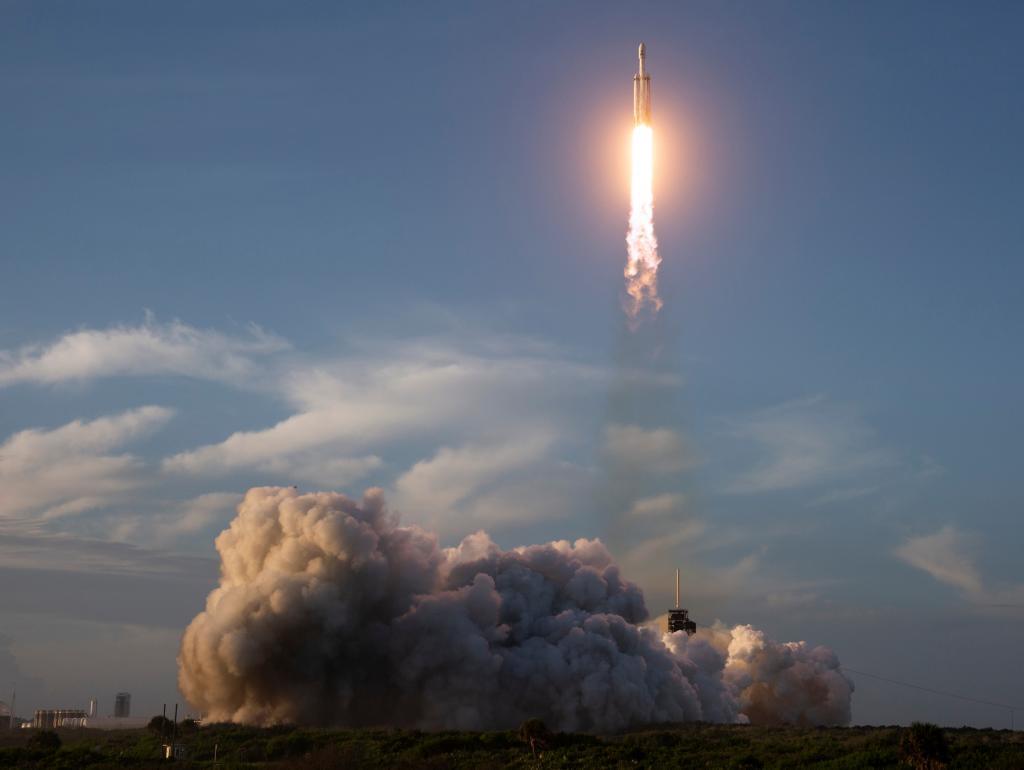
As planned, the Nancy Grace Roman Space Telescope lifted off at 13:26 (Spanish peninsular time) aboard a Falcon Heavy rocket from SpaceX from Launch Complex 39A at Kennedy Space Center.
Fifteen minutes after liftoff, the rocket's first stage returned to Earth for a controlled landing. At 14:06, NASA confirmed that the second stage of the rocket had separated from the spacecraft correctly, and the Nancy Grace Roman is now traveling towards the second Lagrange point between the Sun and Earth, known as L2, located approximately one and a half million kilometers away.
NASA has invested $4.3 billion (about €3.7 billion) in this telescope designed to operate for at least five years, with expectations for up to 10 years of operation. Despite facing challenges due to significant budget cuts proposed by the Trump Administration last year, which were not supported by the US Congress, this sophisticated space observatory has successfully moved forward.
Known as "the mother of the Hubble Space Telescope," scientist Nancy Grace Roman is hailed for her contributions to astronomy. The telescope bearing her name has a field of view at least 100 times greater than that of the Hubble, which is still operational. "It will revolutionize the way we observe the cosmos... It's a wonderful day," stated Nicky Fox, NASA's head of scientific missions, after the successful launch.
"Roman is exactly the success story we want to see throughout NASA," noted agency director Jared Isaacman. "Delivered ahead of schedule and within budget, this mission reflects over a decade of dedication from NASA workers and our industry partners. Now, Roman will provide us with a new atlas of the universe, pushing the boundaries of discovery and demonstrating what is possible when the US space program combines bold ambition with disciplined execution."
According to NASA, it will be able to measure the light from a billion galaxies over its lifetime. It can also block starlight to directly observe exoplanets and planetary formation disks, conduct a statistical census of planetary systems in our galaxy, and address essential questions in the areas of dark energy, exoplanets, and infrared astrophysics.
If all goes well, NASA expects the first images to arrive by early 2027.
The capabilities of the new space observatory complement those of the Hubble and, especially, the James Webb, the most powerful telescope sent into space, which has been revolutionizing our understanding of the cosmos since its operation began in 2022.
These missions will work together to provide the most comprehensive view of our universe to date. With their observations, the Roman telescope is expected to discover interesting targets for the Hubble to observe using infrared, visible, and ultraviolet light to offer a more complete view. NASA's James Webb can then use its larger mirror and more powerful vision to provide even more detailed and sharp observations. The Roman telescope can track regions around objects that Hubble or Webb observe to provide context.
Collaboration extends to missions like Euclid from the European Space Agency (ESA), which can observe a larger area of the sky than Roman, albeit with less detail. As their study areas overlap, scientists can use the higher-quality data from Roman to make corrections to Euclid's data and then extend these refinements over Euclid's much larger area.
Scientists can also combine Roman's infrared data with visible light observations from the Vera C. Rubin Observatory, based on the ground.
By directly imaging Jupiter-like exoplanets, NASA hopes the Roman telescope will contribute to its project to build the Habitable Worlds Observatory, a space telescope designed to photograph Earth-like planets in other solar systems for the first time in history.
As usual, the US space agency has invited citizens to symbolically participate in this mission by offering the opportunity to send their names to be included on a memory card attached to a plaque on the spacecraft. More than 1.3 million people did so, and their names will travel alongside the space telescope.
The Legacy of Nancy Grace Roman
Known as the "mother" of the Hubble Space Telescope, Nancy Grace Roman played an even broader role in driving NASA's Great Observatories program, which included the Hubble along with the Chandra X-ray Observatory and the now-retired Compton Gamma Ray Observatory and Spitzer Space Telescope.
"Her vision and leadership helped establish NASA as a world-class scientific institution and laid the groundwork for generations of space telescopes that continue to expand humanity's understanding of the cosmos," emphasizes the space agency.