Past midnight, after a final round of fireworks, a shirtless guy with shoulder-length dreadlocks and a beer in hand dances to reggae while dodging a surfboard lying in the middle of a terrace facing the beach. Next door, a group of twenty-somethings toast with cocktails under neon lights. A few meters away, some girls take selfies in front of a Volkswagen van converted into a bar.
Welcome to Riyue Bay, a small tropical corner of the Chinese island of Hainan that for years was a refuge for backpackers, hippies, and hustlers and is now discovering the consequences of becoming trendy.
The night in this small Chinese Ibiza revolves around a street parallel to the sea where practically every facade seems to compete for attention. Cafes, cocktail bars, restaurants, surf shops, small hostels, graffiti, and surfboards nailed to the walls.
In one place you hear reggaeton; in the next one, electronic music; a few meters ahead, there is a party with Chinese pop music in the background. Young people from big cities like Shanghai, Beijing, or Shenzhen pass by the terraces dressed in a carefully casual style that costs quite a bit of money: oversized t-shirts, surfer brand caps, designer sandals, and brand-new surfboards.
Riyue Bay retains something unusual for China. Here, one can walk barefoot on the street, enter a bar still wet after surfing, and spend hours sitting by the sea. In a country obsessed with productivity, schedules, and competition, that indolence almost constitutes a small rebellion.
But the veterans of the place claim that true rebellion died a long time ago. "Before, this was much more fun and authentic," says Jay, a forty-something who has been surfing in Riyue Bay for 20 years. He speaks of a not-so-distant time - just before the pandemic - when this corner of the east coast of Hainan was mainly a backpacker territory. There were impromptu parties, very cheap accommodations, and much less surveillance.
"It was even easy to find marijuana," Jay recalls. That helped fuel the reputation of a small permissive and bohemian bubble far from disciplined mainland China. "This was a fishing village and a hippie town," he jokes.
That story belongs to another Riyue Bay. The popularity on Chinese social media changed the ecosystem. First came the influencers. Then the investors. And finally the crowds. With them, business supervision and police surveillance increased. Controls are now much more visible, and those who have been living here for years agree that certain illegal activities have disappeared.
Now, the nightlife fauna is also changing. The classic sunburnt surfers remain. But they share the bar with a new tribe: urban youth coming from mainland big cities looking for a carefully packaged version of the hippie life for a few days. "Before, you came here because you wanted to surf. Now many come because they want to take a photo saying they have come to surf," summarizes Yang, another regular in the area.
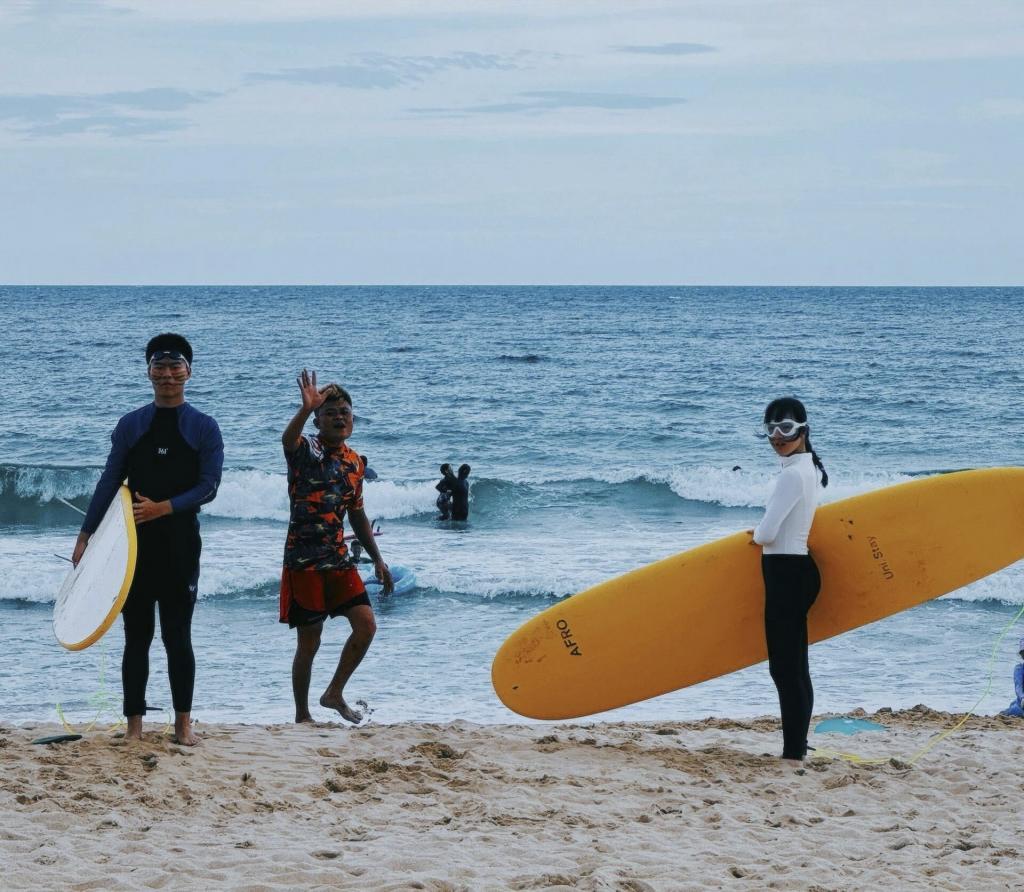
Many of the new visitors are university students or young professionals working in finance, tech companies, or advertising in Shanghai or Beijing. But when the holidays come, they put on a tropical shirt, rent a surfboard, and post a picture on Xiaohongshu - the trendy social network - looking at the horizon from the water. This phenomenon is becoming more common in the giant Asian country: when an alternative place becomes trendy, those attracted by its authenticity end up contributing to its destruction.
Local authorities have been trying to promote Riyue Bay's tourist success as China's surfing capital. Wang Shisan, manager of the Riyue Bay Shaka Surf Club, explains that the beaches offer over 200 surfable days a year and that a national training base is located here, along with competitions. And nearby, an Olympic-level artificial wave pool capable of producing 23 types of waves has been built.
Late into the night, the music continues in some venues. A group staggers out of a bar while another discusses where to continue the party. The lights from the bars reflect on the surfboards parked along the street. At dawn, before the tourists fill the place, Riyue Bay regains some of that old refuge. Only the sea and the most veteran surfers waiting for a good wave are there. It is probably the moment when it most resembles the place that those who arrived here before influencers and organized tours still nostalgically talk about.
Chen, a surfer who has been entering the water in this bay for years, remembers when there were only a few cheap hostels and small businesses set up by people who had come from other provinces to live by the sea. "I'm sorry that the excessive success of this place on social media has completely changed the visitor profile; now many more weekend tourists, affluent young people from big cities, and groups looking to replicate the viral images they have seen on social media arrive," he says. In his view, Riyue Bay is now a cleaner, more organized, and prosperous place, but also much more commercial. "Before, it was an alternative community; now it seems like a theme park," he adds.
Not everyone shares that nostalgia. For Zhu, a local resident, idealizing those times means forgetting that behind the romantic image of a surfer town, there were also families with very few resources and limited opportunities to make a living beyond fishing.
"The massive influx of tourists has allowed many residents to open restaurants, rent rooms, work as surf instructors, or find employment in hotels and shops," he explains. "It is unfair to ask residents to give up development to preserve the paradise that the first backpackers found." His argument could be summarized as follows: for those who came on vacation, the old Riyue Bay may have been more authentic; for many of those who lived there, the new one offers a better life.
Riyue Bay became famous because it seemed to escape from the China of identical shopping malls, fake sets, and massive skyscraper developments. Its appeal lay precisely in the disorder. Now it tries to preserve that spirit while eliminating much of what made it possible. Authorities want hippies, but hippies who follow the rules. They want an alternative culture capable of attracting young people from Shanghai and Beijing, but without the excesses that historically accompanied similar enclaves in Bali, Goa, or Ibiza.