Seven years ago, Kim Jong-un left Hanoi empty-handed. He had traveled to Vietnam convinced that his good personal relationship with Donald Trump could help break North Korea's isolation and obtain relief from sanctions in exchange for concessions on its nuclear program. The summit ended abruptly, without an agreement, and with the U.S. president walking away from the negotiations. For a regime that controls every detail of its leader's image, that scene was an extraordinary humiliation.
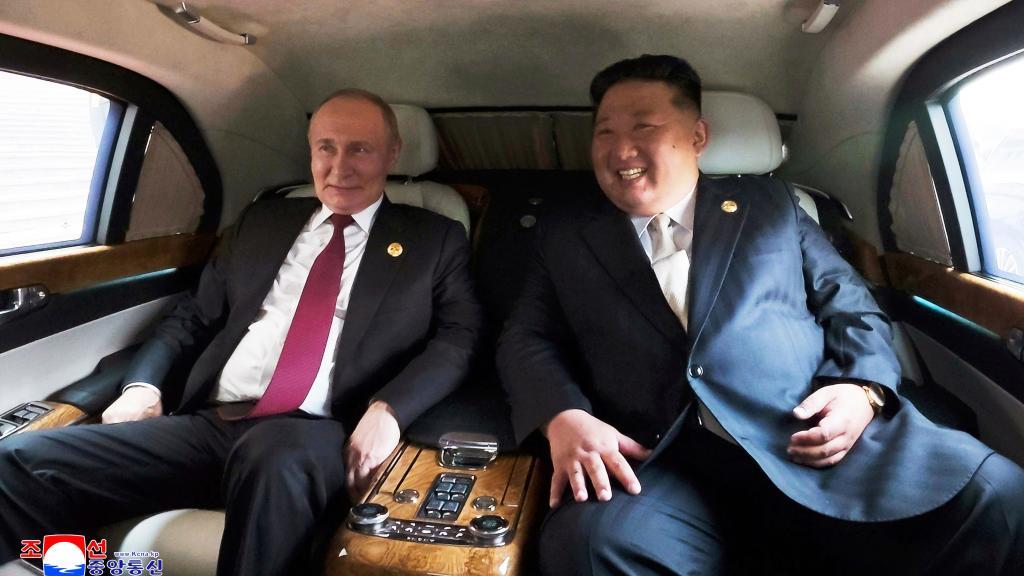
The Kim of 2026 lives in a very different world. He is no longer the young dictator of a suffocating economy who needed to convince Washington to break out of isolation. Now it is Vladimir Putin who buys his projectiles and receives his soldiers. Xi Jinping has rekindled the old relationship with Pyongyang, and Trump insists he wants to meet with him again before the year ends.
"Kim is being courted simultaneously by the leaders of the United States, China, and Russia", summarizes Sung-Yoon Lee, a senior researcher at the Sejong Institute in Seoul.
Against almost all predictions, Kim now reaches the peak of his strength since inheriting power after his father, Kim Jong-il's death in December 2011. His country remains one of the poorest and most secretive on the planet, but the war in Ukraine has rescued Pyongyang from years of isolation. Additionally, the international sanctions system that was supposed to strangle it is leaking, with Russia and China using their veto power to block new punitive measures at the UN. And let's not forget that its nuclear program continues to advance.
The change is also starting to be seen on the streets of the capital. When the Chinese president visited Pyongyang in 2019, beyond some monumental avenues, there was little to show. This year, during his visit last June, Xi Jinping found a city dotted with new neighborhoods of apartment towers, restaurants, shopping centers, electric cars, illuminated streets, and leisure spaces.
"Pyongyang has become visibly more prosperous and consumer-oriented", explains Rachel Minyoung Lee, a researcher at the Stimson Center. "This is reflected in the proliferation of skyscrapers, cars, illuminated streets, and shopping centers selling luxury Western products, as well as increased activity in public spaces in general."
Measuring the country's economy remains an exercise in approximations because North Korea has not published regular economic statistics since 1965. But estimates from Seoul point in the same direction. The Bank of Korea estimates that North Korea's GDP grew by 3.5% in 2025, the third consecutive year with an expansion exceeding 3%. It is a turnaround that was hard to imagine a few years ago: one of the most sanctioned economies in the world has been growing at a rate higher than its prosperous neighbor to the South for three years.
The explanation leads directly to Ukraine. Pyongyang has turned a European war 7,000 kilometers away into its best foreign business in recent history. The South Korean National Security Strategy Institute estimates that between August 2023 and December 2025, the North Korean regime received between $7.7 and $14.4 billion in currencies and goods in exchange for weapons and troops for Russia. Other estimates go up to about $22 billion, four times more than in the previous four years.
The magnitude of the military supply has been extraordinary. According to Ukrainian estimates, North Korea provided approximately half of the ammunition used by Putin's regime in certain periods of the war: millions of artillery and mortar projectiles and around 120 ballistic missiles. This was accompanied by about 14,000 North Korean soldiers sent to Russia and plans to deploy tens of thousands more.
For Kim, performance is not measured solely in currencies. His military is acquiring something that the Korean People's Army has not had since the 1950-1953 war: real combat experience. North Korean soldiers have been involved in ground operations in Kursk and have learned about drones, electronic warfare, precision artillery, and the logistical demands of modern conflict.
Pyongyang has also been able to see firsthand how its own missiles and projectiles work. Russia, in return, provides fuel, food, technical assistance, and technology that can accelerate some of North Korea's military programs.
But there is another less visible side outside the Pyongyang showcase. "North Korea's ability to manage its economic problems remains extremely weak", says Kim Byung-yeon, a professor of Economics at the National University of Seoul.
It is also unclear how much of the billions from Russia reaches the average North Korean. Since the pandemic, Kim has tightened control over the jangmadang, the informal markets that emerged during the great famine of the 1990s and that for decades allowed millions of families to survive. While the elite in the capital consumes imported products, the vast majority of the population continues to live in extremely precarious conditions.
China's Dependency
Returning to the geopolitical arena, in recent years Russia has given Kim significant leverage against China. For decades, Beijing was virtually the only external lifeline for North Korea. It still accounts for around 95% of its foreign trade, but Pyongyang no longer depends solely on its neighbor. Kim can now play with two major powers. And Xi seems to have taken note.
After years of some coolness, China has rekindled ties with its neighboring country. Bilateral trade has surged, and North Korean exports to China include everything from wigs to tungsten, a strategic metal for industry and defense. Beijing and Pyongyang have also restored connections closed during the pandemic, including passenger trains and direct flights between the two capitals.
Chinese analysts explain that Xi's government does not want to see Russia monopolize influence over a country that shares a 1,400-kilometer border with it. In recent years, Moscow and Pyongyang have multiplied high-level visits. For the Chinese leader, rekindling a personal relationship with Kim allows him to maintain a significant strategic buffer against U.S. troops deployed in South Korea and Japan's rearmament.
With Putin and Xi on his side, Kim continues to develop new intercontinental missiles capable of threatening U.S. territory, more tactical weapons, hypersonic systems, military satellites, and nuclear-powered submarine projects. The nuclear program has long ceased to be just a survival guarantee: it has become the tool that allows him to negotiate with major powers without accepting denuclearization as a starting point.
This is the main difference with the Kim of the early summits with Trump. Back then, both leaders went from exchanging threats to spectacular diplomacy in a few months. They met in Singapore, in Hanoi, and months later in the Demilitarized Zone, where Trump became the first sitting U.S. president to step into North Korea.
None of that led to a nuclear agreement. Now Trump wants to try again. He has said he hopes to meet with Kim before the end of the year, and Washington has scaled back some of its joint military exercises with South Korea—a long-standing demand from Pyongyang. But North Korea's response has been lukewarm. Kim Yo-jong, the leader's powerful sister, denied that there had been any recent contact.
"Kim is not the same North Korean leader with whom Trump negotiated in the past," warns Benjamin R. Young, a researcher at the Korea Economic Institute of America. "He no longer depends on Washington lifting sanctions to obtain foreign currency, fuel, or technology. He has Russia and has won back China. His hackers continue to generate hundreds of millions through cybercrime. And he possesses far more nuclear weapons than when he sat across from Trump."
This is particularly troubling for South Korea, which is watching as its neighbor not only amasses missiles but now also has soldiers battle-hardened in a real battlefield, while Washington is forced to divide its resources between Asia and other fronts.
Trump's decision to scale back joint military exercises has also fueled doubts about the extent of U.S. commitment. South Korean President Lee Jae-myung is trying to reestablish channels of dialogue with Pyongyang, but the North has even abandoned its old rhetoric about a future peaceful reunification and now portrays the South as an enemy state.
Kim also appears to be thinking ahead to the next generation. In recent years, he has increasingly brought his daughter, Kim Ju-ae, to his side at missile launches, military parades, and major state events. Her growing prominence has fueled speculation that the teenager is being groomed as a potential heir to the fourth generation of the Kim dynasty.