In the immense Kim Il-sung Square in Pyongyang, among columns of soldiers, dress uniforms, and the martial choreography that accompanies every major regime celebration, all eyes turned this year to a teenager. Kim Ju-ae arrived with her father in a limousine, walked by his side, and took a position reserved for the most important figures of the dictatorship. In the military parade held after the latest Workers' Party congress, father and daughter appeared in nearly identical coats, standing firm in front of the troops as combat planes crossed the night sky.
The young Ju-ae, around 13 years old, has become one of the most observed figures in North Korea. The question is no longer just why Kim Jong-un takes his daughter to missile launches, weapons factories, parades, or nuclear facilities. The Intelligence services and experts scrutinizing every photograph published by Pyongyang are now asking a much more significant question: Will she be the first woman to rule the Kim dynasty?
Her public story began in the most North Korean way possible: in front of a missile. In November 2022, a girl appeared hand in hand with Kim Jong-un in front of the gigantic Hwasong-17, one of the most powerful intercontinental ballistic missiles in the arsenal. She wore black pants, a white padded jacket, and had her hair tied back. Until then, almost nothing was known about her. Not even her name had been officially revealed.
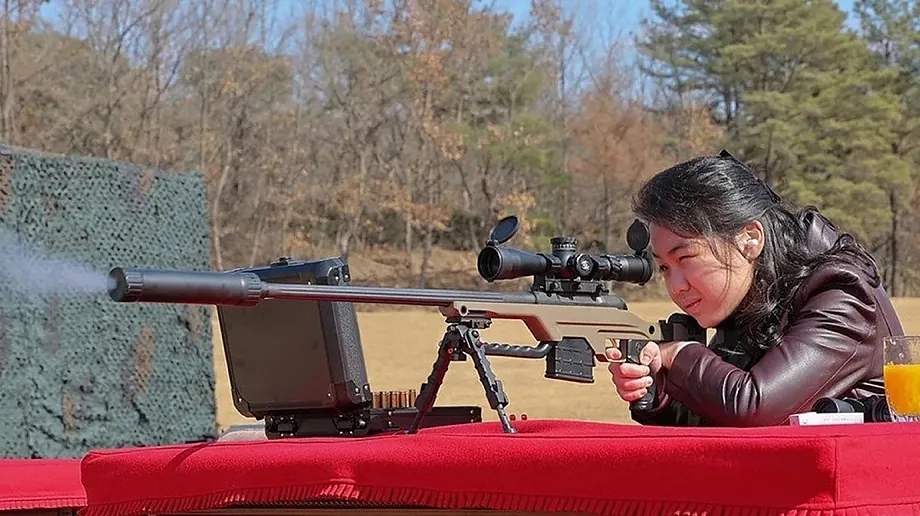
Since that debut, the girl has risen within the power scenery. This year, she even appeared in a photograph shooting a sniper rifle. Her clothing has also drawn much attention from observers. Ju-ae has transitioned from children's coats to suits, formal skirts, and leather jackets similar to those worn by her father. "Dressing her like an adult helps to disguise her extreme youth and project an image of authority," says Cheong Seong-chang, vice president of the Sejong Institute.
When Kim Jong-un was being groomed as a successor, his appearance, hairstyle, and clothing were shaped to resemble his grandfather Kim Il-sung, the country's founder and a nearly sacred figure within the official cult. Propaganda now seeks a similar association between father and daughter.
State media never publicly use the name Ju-ae. She was first introduced as the leader's "beloved" daughter and later as his "respected" daughter, a treatment reserved for figures of immense rank. South Korean Intelligence considers Ju-ae the most likely candidate to succeed her father.
Her continuous appearances alongside the Armed Forces are particularly significant. Last July, she once again took the forefront during ceremonies for the 73rd anniversary of the Korean War armistice, first at the martyrs' cemetery and then at a gala with her father, while her mother, Ri Sol-ju, and senior officials appeared behind.
The Sister Who Paved the Way
Some analysts in Seoul, however, question whether Pyongyang is truly ready for female leadership. Its political and social structure remains deeply marked by a patriarchal culture, and unverified reports persist about the existence of another son of Kim Jong-un. But the family itself offers a precedent: Kim Yo-jong, the dictator's sister, has become one of the most powerful figures in the regime in recent years.
It is precisely for this reason that Ju-ae's early appearance seems to be a campaign aimed at slowly acclimating military personnel, officials, and citizens to something that until recently would have been unthinkable.
"The regime is resorting to symbolism to overcome resistance to a future female leader within a society with Confucian and patriarchal roots," says Oh Gyeong-seob, a researcher at the Korean Institute for National Unification.
Kim Jong-un was around 27 years old when he inherited the country after his father's death in 2011 and had only a few years to publicly build his legitimacy. With Ju-ae, he seems to be taking a different path. If she is indeed the chosen one, she will have many years to transform that girl who first appeared holding his hand in front of an intercontinental ballistic missile into a familiar figure for North Koreans. After Kim Il-sung, Kim Jong-il, and Kim Jong-un, the fourth generation of the world's only hereditary communist dynasty may not have the face of a man for the first time.