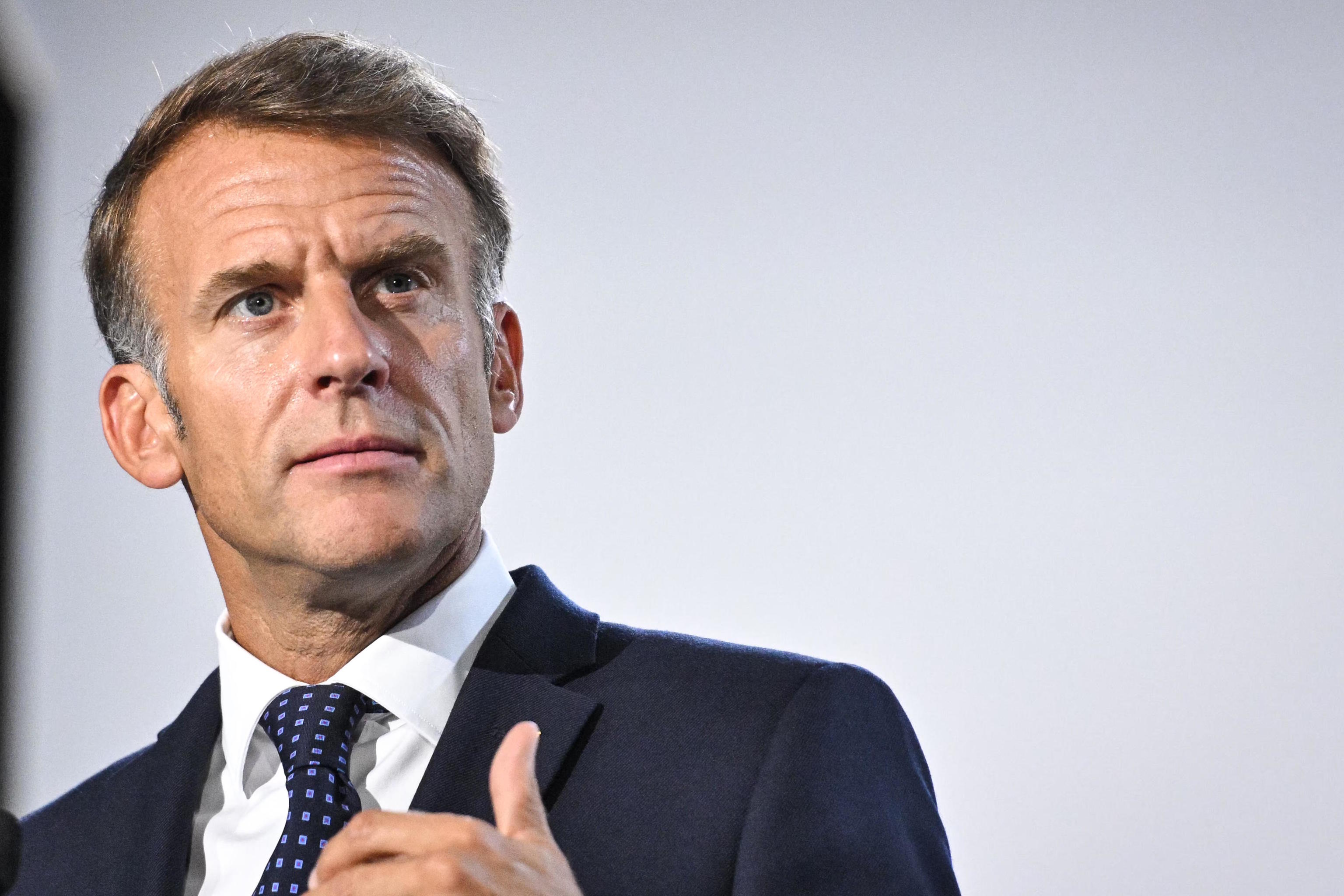
Emmanuel Macron concludes his European projection this week with the Space Summit at the Grand Palais in Paris, following his late summer tour of Sweden, the Netherlands, and the United Kingdom. His external image, as a champion of the "strategic awakening" of the old continent, starkly contrasts with his low popularity at home: only 20% of the French population currently claims to have "confidence" in their president, and 75% disapprove of his work in the final stretch of his term, according to a recent survey by Elabe for Les Échos.
Macron's unstoppable decline, driven by his push for pension reform and the early elections of 2024 that led to him losing the parliamentary majority, has indeed become the "burden" faced by the two main contenders to inherit the political center. His former prime ministers Edouard Philippe and Gabriel Attal are trailing far behind the favorite for the 2027 presidential elections, the leader of the National Rally Marine Le Pen.
Le Pen leads with 36% of voter preferences, compared to Philippe's 14.5% and Attal's 7.5%, both surpassed by the leader of La France Insoumise Jean-Luc Mélenchon (15%) in the latest Ipsos/BVA poll for Le Parisien. The polarization of the French electorate is such that the scenario of a face-off between the far right and the far left, Le Pen against Mélenchon, is becoming increasingly likely in the runoff on May 2.
Macron's burdensome shadow looms over his potential "successors", despite all the president's efforts to bolster his European vocation and even become the post-Brexit bridge between the UK and the EU, following his recent meeting in London with the new premier Andy Burham, with whom he pledged to "strengthen the special relationship".
With eight months left in his term, Macron is desperately seeking to deepen the European legacy of his presidency, despite recent tensions with Germany (which have been evident in the lead-up to this week's space summit) and his lukewarm stance on the Ceuta crisis, offering "solidarity and support" to Pedro Sánchez, and distancing himself from the 22 EU countries that openly criticized his migration policy in the initiative led by Giorgia Meloni.
The president's latest summer rentrée after nearly a decade in the Élysée Palace has not managed to reverse his unpopularity, as also confirmed these days by the YouGov barometer for the Huffington Post, which also gives him an approval rating of 20%, the same as in August. Macron remains at this point the second most unpopular president of the Fifth Republic, behind the socialist François Hollande.
Those aiming to succeed him began distancing themselves some time ago. Gabriel Attal, sidelined after the failure of the 2024 early elections, has openly admitted: "I don't understand some of the president's decisions". Edouard Philippe, who steered through the yellow vests crisis, even went as far as to call for early presidential elections due to the sense of ungovernability that prevailed in France over the past two years.
Despite their differences with their mentor, Attal remains at the helm of Renaissance, the latest incarnation of the party created in Macron's image under the name La République En Marche. Philippe leads his own centrist party, Horizons, with which he reaffirmed his victory as mayor of Le Havre in March (later tarnished by a corruption and influence-peddling scandal, still pending trial, that has marred his campaign).
Faced with voter confusion due to the increasing fragmentation of the political center, Philippe himself has taken a step forward by calling for "the creation of a new party or a new confederation of parties". "This will require the need to designate single candidates in each constituency," he added, starting with a unified centrist candidacy for the presidential elections.
"If we want a political majority, we will need a common program and slogan," Philippe warned, supported among others by the Minister of Justice Gerard Darmanin, who justified his support by stating that he is "the captain who will lead us to safe harbor," in the face of the threat of shipwreck from the impetuous advance of Marine Le Pen and the National Rally.
Unlike Attal, perceived as more progressive, Philippe seeks "a political reconfiguration based on the regrouping of the right and the center," a challenge also directed at the leader of The Republicans, Bruno Retailleau, who is also keen on distancing himself from the far right.
"We must build a coalition that allows us to share fundamental values, such as respect for the rule of law and the democratic model, attachment to European integration, defense of France's interests and security, and a clear awareness of the climate emergency," proclaimed Philippe at a campaign event in Tourcoing, outlining the red lines of a future unified centrist coalition.