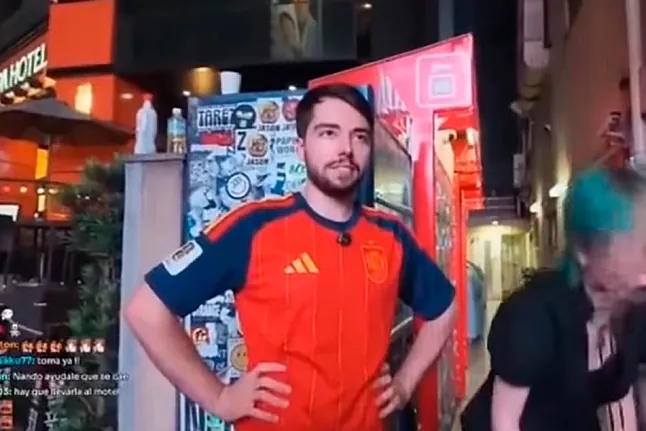
A young woman staggers down a street in Kabukicho, Tokyo's red-light district. She seems to have had too much to drink and can barely stand. By her side is Alberto Alonso, a 31-year-old Spanish man known on social media as Aruberuto Makoto.
The clip went viral in August. But Alonso is the latest name on a long list of foreign content creators fueling growing annoyance in Japan. Last year, another Spaniard, the streamer Kelton, became the focus of the Japanese press.
Dressed as Monkey D. Luffy, the pirate from One Piece, he sat in a priority seat on a train in Fukuoka and began live streaming loudly. An elderly man approached several times to ask him to lower his voice. Kelton continued the live stream until the discussion ended with the Spaniard pushing the man twice.
The situation encapsulated almost every element capable of irritating a Japanese person: noise inside a train, disregard for a seat reserved for vulnerable individuals, and a public confrontation broadcasted for views. Kick and Twitch temporarily suspended their accounts, and after initially trying to justify what happened, Kelton ended up apologizing. "Japanese people always fight against bad tourism, which is what I did: going to Japan to take advantage of their hospitality, to scratch for fame and views," he admitted.
The Asian archipelago is not only starting to tire of mass tourism. Within the debate on overtourism, another more specific phenomenon is emerging: rejection of tourism for social media, visitors turning temples, trains, residential neighborhoods, geishas, and even supermarkets into sets to get the next viral video.
Some media outlets have started calling the most annoying ones "Insta-pests," something like "Instagram plagues".
In Kyoto, one of the latest battlegrounds is behind the walls of Seirai-in, a temple at the historic Kennin-ji. Last July, its authorities began restricting access after some visitors practically turned the religious site into a photo studio: tripods set up, long posing sessions, and spaces occupied for too long to produce photos and videos for social media. A Zen temple ended up needing to defend itself not from neglect but from those who had come to use it as a backdrop.
A few kilometers away is Gion, perhaps the best laboratory for this new impossible coexistence. The geiko, as geishas are known in Kyoto, and the maiko, their apprentices, walk through its narrow alleys. For years, they have reported that some visitors chase them with cameras, block their path, pull on their kimonos, touch the ornaments in their hair, or try to take selfies with them as they head to work.
The problem reached such an extreme that some streets ended up restricting tourist access. The tourism office has had to remind of something that should be obvious: "Geiko and maiko are not your pets".
The fever to get a photograph can also turn the most mundane place into a tourist attraction. It happened in Kawaguchiko, where an image of Mount Fuji rising behind a Lawson supermarket went viral. Thousands of visitors began to pilgrimage there to replicate the exact same photo. They crossed the road recklessly, blocked sidewalks, and entered private properties. Authorities ended up installing a huge screen to block the view of the volcano. They weren't trying to hide Fuji: they were trying to give a street back to its residents.
A Thai influencer recently sparked outrage after posting images of herself lying and rolling around on protected alpine vegetation on Mount Komagatake. In Tokyo, an American was arrested for inscribing on a torii gate at Meiji Jingu Shrine. Other foreigners have been recorded doing pull-ups on sacred structures or bothering the famous deer in Nara.
Japan even has an expression for creators who have turned provocation into a genre: meiwaku-kei YouTuber or meiwaku-kei influencer. The word meiwaku means causing annoyance or problems to others, an idea especially powerful in a society where daily coexistence is based on a multitude of unwritten rules. That's where much of the clash lies.
All this is happening while the Asian country experiences an unprecedented tourism boom. In 2025, it received 36.9 million international visitors, and the crowds have reopened the debate on how much tourism the country can absorb without disrupting the lives of its residents.
This discomfort has even been politically exploited by far-right groups like Sanseito, which has turned the excesses of some foreigners into ammunition for their "Japanese first" discourse.