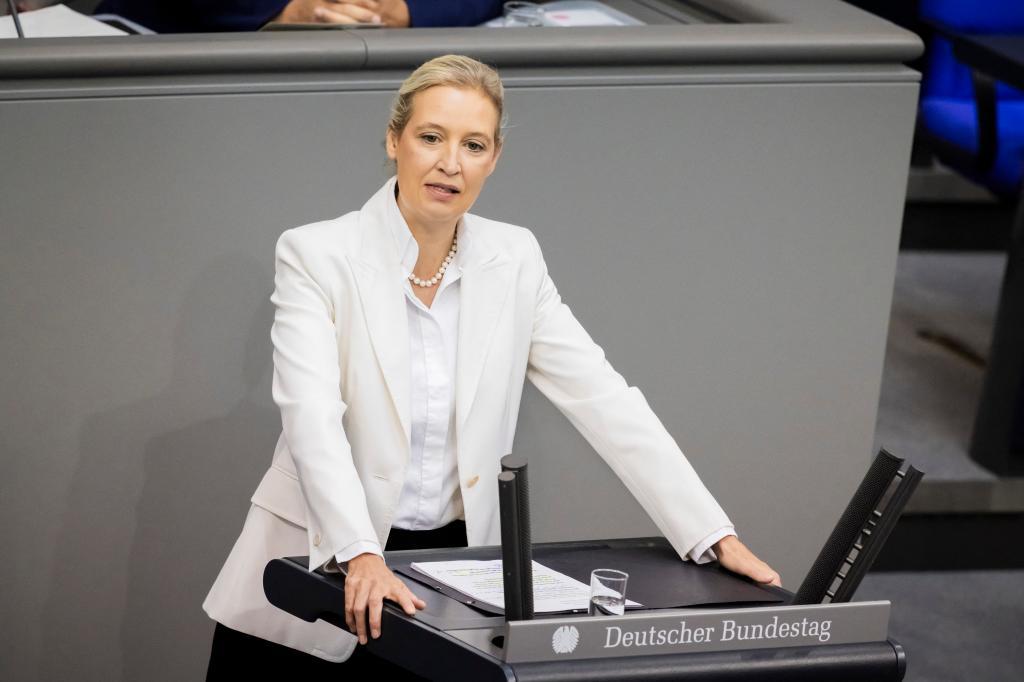
The face-off between the two political leaders took place in the aftermath of the recent elections in the eastern state of Saxony-Anhalt, where the far-right party achieved a comfortable victory with 43.8% of the votes, compared to the 17.2% obtained by Merz's Christian Democratic Union (CDU), marking their worst historical result in that region.
Alice Weidel opened the debate as the leader of the opposition parliamentary group, stating that "People finally want a political change and do not want everything to remain the same," emphasizing that "They have made it very clear: the coalition between conservatives and social democrats is over." During the debate, Weidel directly addressed the chancellor, stating that "In Saxony-Anhalt, the people not only punished you, they pulverized your party." The AfD leader continued her attack by saying, "You have not understood the message that the voters of Saxony-Anhalt sent you on Sunday," adding, "But that doesn't matter because your time is up anyway. The citizens want a policy change, and they will achieve it." She also anticipated that the upcoming elections will provide "a clear mandate to govern" for her party.
In response, Friedrich Merz described the AfD's result as "remarkable," but reminded that the far-right party did not achieve the absolute majority they sought. The chancellor asserted that "Their true electoral goal in Saxony-Anhalt, which was to secure the majority of seats, they did not achieve," and emphasized that "56% of the voters in Saxony-Anhalt did not vote for them."
In the most tense moment of the exchange, Merz accused the AfD of intending to carry out an "ethnic cleansing" in the country through their proposal of "remigration" to expel immigrants and asylum seekers. The head of the government argued that "The term 'remigration' is nothing more than a synonym for 'ethnic cleansing' based on origin and skin color." He also defended the importance of foreign workers in the German economy, stating that "One out of every six workers in the crafts sector has a foreign passport. If those working in Germany had to leave the country due to 'remigration,' the crafts sector in Germany would cease to function, no nursing home could continue to operate, no hospital in the country could function."
The parliamentary clash also addressed the German economic situation, in which 12,000 industrial jobs are lost per month. Weidel criticized the government's energy policy, accusing authorities of wanting to do away with cheap gas from Russia that arrives through pipelines, and reproaching them for allowing the Nord Stream gas pipelines to be blown up in front of their eyes, instead of laying the groundwork for a future resumption of supply through intact pipeline sections. In response to these criticisms, Merz acknowledged that mistakes were made in the past and assured that the government is working to ensure energy supply.
Finally, the chancellor criticized Weidel for not mentioning Ukraine's struggle against Russian aggression. The AfD leader urged him to follow the example of the U.S. administration of Donald Trump, stating: "Commit once and for all to peace negotiations, as the United States does," maintaining her party's stance of criticizing the aid provided to Ukraine.