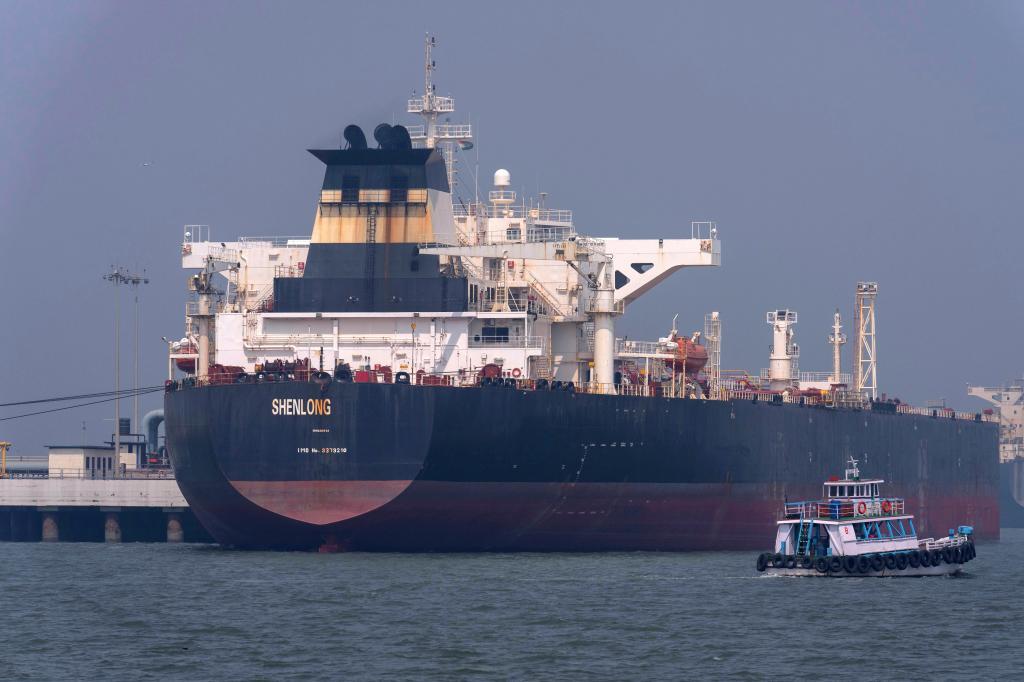
Eye for an eye, tanker for a tanker. The lex talionis or law of retaliation, the oldest rule of humanity, has reached the sea and has overturned the principle on which global trade has been built since 1948. This year it was put in writing that merchant ships are neutral, that the seas are free, and that wars between states do not have to turn into wars against trade. That agreement, which had already been on life support in recent months, was completely killed by a three-word strategy that the Pentagon (with Trump's blessing) called "tanker for tanker": for every ship Iran attacks, the US will sink an Iranian tanker.
For 78 years, the sea was the only space where the planet's rules still worked even as the world fell apart. While armies clashed on land, while borders closed and agreements were broken, merchant ships continued to cross the oceans under the protection of an international order that no one had asked for but everyone needed.
The control of the Strait of Hormuz has become the target of super tankers linked to Iran or Washington's allies. In the last 10 days, the US Navy has taken out 10 Iranian tankers. This is in response to Iranian bombings since the war began on February 28: dozens of cargo ships, bulk carriers, and tankers were visited by Iranian drones. The difference is qualitative, not just quantitative. Iran attacks merchant ships from third countries to pressure global trade. The US exclusively attacks Iranian tankers to destroy the regime's source of income.
Last Tuesday, five Iranian tankers were destroyed in the biggest day of ship bombings throughout the war off the coast of Jarg Island, Tehran's major oil terminal. The most severe consequence: the Brent barrel is now trading at over $100.
For decades, we have witnessed attacks on cargo ships in the Gulf of Aden, hijackings of merchant ships off the coast of Somalia, or theft of goods in the Strait of Malacca, but these actions were the work of militias and armed groups. Now, bombarding a civilian vesselis now doctrine for some states. Admiral Brad Cooper, commander of the US Central Command or CENTCOM, formulates the new tacit rule of the sea: "If you shoot at two of our ships, we will impose an even greater economic cost by destroying three of yours."
The situation has escalated to the point that 18 of the world's major maritime powers - including Greece, Japan, South Korea, Singapore, Norway, Denmark, Germany, and the UK - issued an unprecedented warning on Tuesday: "The rules that have underpinned international maritime trade for decades are beginning to collapse." They did so through the Maritime Transport Advisory Group (CSG), in a statement titled In Defense of Free Maritime Transport. The member countries represent more than a fifth of global trade by tonnage.
The accumulation of major wars like the US-Iran conflict or the invasion of Ukraine, the disruption of chokepoints like the straits, increasingly larger ghost fleets, and discriminatory trade measures represent a structural shift in maritime transport.
The law of the jungle is now the law of the seven seas, creating parallel navigation systems where risks increase, environmental and safety standards are bypassed, and trust and predictability in maritime markets are undermined. The result is a two-tier system: one governed by rules, the other by opacity, ultimately weakening both.
Why have super tankers now become the most coveted pieces at sea? Each destroyed Iranian tanker means oil that does not reach Chinese teapot refineries (beyond the reach of sanctions), currencies that do not enter the regime's coffers, and money that does not fund the Revolutionary Guard or its proxies in Lebanon, Yemen, or Iraq. Additionally, a burning ship in the Persian Gulf is an image that appears on front pages worldwide. Attacking one of these vessels is a way to communicate to the adversary and international public opinion that the situation is deteriorating and that the country under attack must submit and negotiate.
A crude-laden tanker is not just a ship: it is a floating industrial facility with millions of dollars' worth of cargo on board (around $200 million at current prices for the largest ones), extremely vulnerable to fire and practically defenseless militarily. Destroying one inflicts more economic and political damage than destroying many conventional military targets, at a fraction of the cost (with a drone costing around €20,000). That's why modern naval warfare is shifting towards tankers: they are where economic pain and psychological impact converge most efficiently.
The Strait of Hormuz is not the only place where this new doctrine has escalated: the Black Sea has been the other major naval war theater in recent years. Russia blocked and intimidated the Ukrainian grain export corridor from Odesa, attacking ports, silos, and port infrastructure with missiles and drones to deprive Kiev of the agricultural revenues financing its war effort and, in turn, using Africa and Asia's hunger as leverage against the West. Ukraine responded with its own version of naval economic warfare: autonomous marine drones and missiles against tankers and cargo ships supplying fuel, construction materials, and supplies to occupied Crimea, whose land connection to Russia was vulnerable and whose bridge - the Kerch Bridge - was attacked twice.
The goal was the same as the US with Iranian tankers: to make the logistical cost of maintaining an occupied territory unsustainable. The moral distinction some tried to draw between both strategies - Russia targeting grain destined for poor countries, Ukraine targeting military supplies - blurred as the war dragged on and both sides hit any target that weakened the adversary, civilian or not, turning the Black Sea into the first modern laboratory of what the Persian Gulf confirms today: that in 21st-century warfare, merchant ships are as much military targets as tanks or combat aircraft.
The Gulf War has also turned ghost fleets into a global threat, those hundreds of tankers sailing without recognizable insurance, with interchangeable flags of convenience, disconnected identification systems, and names changing every few weeks, which Iran and Russia have used for years to evade international sanctions.
With the collapse of maritime rules denounced by the 18 nations of the CSG, that opaque fleet, sometimes sailing with old tankers destined for scrapping, has shifted from a compliance issue to a war actor: the same ghost ships that transported Iranian oil disguised as Malaysian are now military targets for the US, sinking them without always distinguishing between warships and commercial vessels. The result is that nobody knows for certain which ship carries what cargo, who it works for, or under what law it sails, which is exactly the ambiguity that ghost fleets were designed to create and that war has turned into the permanent state of the seas. According to TankerTrackers.com, the ghost tanker fleet now exceeds 1,500 vessels, approaching a fifth of the global tanker capacity.
The British publication Lloyd's List, one of the world's oldest commercial newspapers, states in its latest editorial: "We are witnessing the gradual emergence of a parallel maritime ecosystem... The result is that the fundamental premise on which global trade was built - that ships can sail freely across borders - is now completely in question."